Event Transport Logistics Mistakes: A Checklist for Planners

Event Transport Logistics Mistakes: A Checklist for Planners
The single most common root cause of event transport failures is a contract and capacity mismatch combined with poor timing. Fix those two areas and you eliminate most problems before the van leaves the parking lot.
Do these four things before you book:
- Confirm total headcount AND luggage volume, then choose a van size that fits both
- Require written contract clauses covering cancellation terms, fuel policy, and mileage caps
- Assign one point of contact (a “trip captain”) who can make decisions on-site
- Build a short buffer into every pickup leg on your timeline
Table of Contents
- Common event transport logistics mistakes and why they cost you
- Contract and booking pitfalls to check before you sign
- Choosing the right van type and packing for passengers and gear
- How timing and routing mistakes create cascading delays
- Driver qualification and pre-trip safety steps organizers often miss
- Venue access, staging, and loading mistakes that stall event transport
- Common accessibility errors and how to avoid them
- Why failing to plan for breakdowns amplifies every other problem
- Pre-trip checklist and templates you can use right now
- What to look for in a van rental partner
- Key Takeaways
- The mistake most organizers make last (but should fix first)
- Myvanrentals makes event van booking straightforward
- Useful sources
- FAQ
Common event transport logistics mistakes and why they cost you
Most event transport planning issues fall into predictable categories. Here are the ones that show up most often, along with the real impact each one creates.
- Hidden fees: — Mileage overages, one-way drop charges, cleaning fees, and young-driver surcharges appear on the final invoice. Mileage surcharges can incur additional cost per mile beyond a daily cap, and one-way drop charges sometimes involve extra fees.
Contract and booking pitfalls to check before you sign
Vague contract language is where most unexpected costs originate. Before you sign, confirm each of these in writing.
Contract checklist:
- Cancellation window and refund terms (full refund vs. credit vs. forfeit)
- Fuel policy: full-to-full or pre-purchase option
- Daily mileage cap and per-mile overage rate
- One-way or drop-off fee if applicable
- Wait time and deadhead charges (what happens if the event runs long)
- Cleaning fee threshold and conditions
- Young-driver surcharge: under-25 surcharges often involve daily fees
- Supplemental liability insurance (SLI) and collision damage waivers (CDW) often incur daily fees
- After-hours pickup or return fees
- Driver substitution policy
Review how van rental contracts work for events before your vendor call. For a full breakdown of charges that rarely appear in the headline quote, the hidden fees guide covers the most common ones.
Pro Tip: Ask the vendor to send the full contract PDF before you pay a deposit. Read every line item, not just the daily rate. If a fee isn’t listed, ask for written confirmation that it won’t apply.
Choosing the right van type and packing for passengers and gear
Seat count is not the same as usable capacity. Always choose a slightly larger vehicle than your raw headcount to account for luggage, equipment, and personal comfort.
Vehicle comparison:
- 12-passenger van: — Best for groups of 8–10 with moderate luggage. Comfortable for urban hops and short airport runs. Limited cargo space when all seats are filled.
For groups around 36 passengers, two Sprinters become operationally difficult to sync. At that point, a mini-coach with undercarriage storage is usually the cleaner solution.
Pro Tip: Count bags, not just bodies. Ask each attendee to confirm one carry-on and one checked bag equivalent before you finalize the vehicle. A group of 12 with sports equipment may need a 15-passenger van or a cargo trailer.

How timing and routing mistakes create cascading delays
A single late pickup ripples through every stop on your itinerary. Here is a simple framework to prevent that.
- Add 15–20 minutes per pickup leg. Buffer time of 15–20 minutes per leg accounts for boarding, luggage stowage, and late arrivals. Never schedule back-to-back pickups with zero gap.
- Confirm venue access windows in advance. Call the venue operations team to verify load-in times, gate codes, and any staging restrictions before the event day.
- Map the route with real traffic data. Use Google Maps or Waze with the actual event date and departure time to check predicted traffic. Highway routes and urban routes need separate buffer calculations.
- Build a written timeline. Share it with the driver and your trip captain at least 48 hours before departure.
Sample timeline structure (adapt to your event):
| Time | Action |
|---|---|
| T-15–20 min | Driver arrives at staging area; organizer confirms headcount |
| T-15–20 min | Passengers board; luggage loaded |
| T-30 min | Depart first pickup location |
| T-15 min | Buffer window for second pickup or traffic |
| — | Arrive at venue |
| Event end | Driver on standby; trip captain confirms return headcount |
Pro Tip: For urban events in cities like Miami or Los Angeles, add an extra 10 minutes per stop beyond the standard buffer. City staging areas fill fast and rideshare traffic near venues creates unexpected congestion.
Driver qualification and pre-trip safety steps organizers often miss
Skipping driver verification is one of the most serious event management transport challenges. It creates both safety risk and liability exposure.
Driver qualification checklist:
- Confirm the driver holds a valid license appropriate for the vehicle class
- Request a motor vehicle record (MVR) check or ask the rental company to confirm it was completed
- Verify the driver’s age meets the rental company’s minimum requirement
- Confirm insurance coverage: personal auto policies often exclude rental vans over a certain weight or passenger count
Pre-trip vehicle inspection (do this at pickup):
- Walk the exterior and document any existing damage with time-stamped photos or video
- Check all seatbelts for function
- Confirm tires have adequate tread and correct pressure
- Check dashboard for warning lights
- Locate spare tire, jack, and first-aid kit
- Confirm fuel level matches the contract
Driver briefing items before departure:
- Full route with stops and estimated times
- Trip captain’s name and cell number
- Return time and curfew if applicable
- Emergency contact and roadside assistance number
- No-phone policy while driving
Venue access, staging, and loading mistakes that stall event transport
Arriving at a venue without a confirmed drop-off zone is one of the most frequent event logistics errors. It delays loading, frustrates passengers, and sometimes results in fines.
Venue coordination checklist (send to venue ops at least one week out):
- Confirm designated drop-off and pick-up zones for passenger vans
- Ask about height and weight restrictions for parking structures or access roads
- Verify whether a commercial vehicle permit is required
- Confirm staging time: how early can the van arrive before the event?
- Get a direct contact name and cell number for venue operations staff
- Confirm load-in and load-out windows for your specific event
For city-specific staging guidance, the city transport options guide covers venue access considerations across major U.S. markets.
Common accessibility errors and how to avoid them
Not every group has the same mobility needs, and overlooking ADA requirements creates real problems on event day.
Common ADA oversights:
- Booking a standard van without confirming accessible vehicle availability
- No plan for wheelchair securement or lift-equipped vehicles
- Failing to account for service animals (space and access)
- No accessible boarding area confirmed at the venue
ADA checklist:
- Collect accessibility needs from all attendees during registration (wheelchair, walker, service animal, boarding assistance)
- Confirm in writing that the rental company can provide an accessible vehicle if needed
- Verify the venue has an accessible drop-off point
- Assign a trip captain who knows each passenger’s needs
Passenger needs intake form (recommended fields):
- Full name
- Phone number
- Emergency contact name and number
- Mobility device (yes/no; type)
- Service animal (yes/no)
- Any boarding assistance required
Why failing to plan for breakdowns amplifies every other problem
No contingency plan means a single breakdown becomes a full event failure. A short playbook prevents that.
Most common contingency gaps:
- No backup vehicle identified or on standby
- No roadside assistance agreement confirmed with the rental company
- No communication plan for notifying attendees of delays
Contingency action flow:
- Driver contacts trip captain immediately upon breakdown or significant delay
- Trip captain calls the rental company’s roadside assistance line
- If resolution exceeds 30 minutes, trip captain activates the backup vehicle or alternate transport plan
- Trip captain notifies all attendees via the pre-shared group contact (text chain or app)
- Document the incident for insurance and contract purposes
For multi-van event coordination, synchronized check-ins between drivers and the trip captain reduce the window between a problem occurring and a fix being deployed.
Pre-trip checklist and templates you can use right now
Copy these templates and share them with your co-organizer or driver before every event.
Passenger manifest fields:
- Full name
- Cell phone number
- Emergency contact name and number
- Accessibility needs
- Confirmed pickup location and time
Driver briefing template:
- Route overview with all stops and estimated arrival times
- Trip captain name and direct cell number
- Return time and any curfew
- Roadside assistance number
- Emergency protocol (who calls who)
- No-phone-while-driving reminder
One-page pre-trip checklist:
- Headcount confirmed against manifest
- Luggage loaded and secured
- Vehicle inspection completed (photos taken)
- Fuel level verified
- Seatbelts checked
- Driver briefed
- Venue drop-off zone confirmed
- Timeline shared with all passengers
What to look for in a van rental partner
Not all rental companies handle event transport the same way. These questions help you vet a partner before you commit.
- Fleet mix: Do they offer 12-passenger, 15-passenger, and Sprinter/Transit-style vans? Can they scale to multiple vehicles for larger groups?
- Local operations team: Is there a city-specific team who knows local routes, staging areas, and permit requirements?
- Driver vetting process: Do they confirm MVR checks and license class for every driver?
- Insurance options: Do they offer SLI and CDW add-ons, and are the rates disclosed upfront?
- Contract transparency: Are all fees (mileage, fuel, wait time, cleaning) listed in writing before you pay a deposit?
- Permit handling: Can they assist with commercial vehicle permits for venue access?
- Wait-time policy: What happens if your event runs long? Is there a grace period before wait-time charges apply?
Pro Tip: Ask for a sample contract before you commit. A company that won’t share contract terms in advance is a company whose fees you’ll discover at checkout.
Key Takeaways
The most preventable event transport failures come down to three things: a vague contract, the wrong vehicle size, and no time buffer built into the schedule.
| Point | Details |
|---|---|
| Confirm capacity and luggage | Choose a van size based on passengers AND gear, not seat count alone. |
| Read the full contract | Confirm cancellation terms, mileage caps, fuel policy, and all surcharges in writing before paying. |
| Build time buffers | Allow 15–20 minutes per pickup leg to prevent cascading delays across your itinerary. |
| Vet the driver | Verify license class, MVR status, and insurance coverage before departure day. |
| Coordinate with the venue | Confirm drop-off zones, permits, and staging windows at least one week out. |
| Book through Myvanrentals | Myvanrentals offers city-specific teams, a mixed fleet (12/15-passenger, Sprinter/Transit), and transparent contracts for event, school, and church groups. |
The mistake most organizers make last (but should fix first)
The conventional wisdom says the biggest event transport risk is the vehicle itself — wrong size, breakdown, bad driver. That’s not wrong, but it misses where most failures actually start: the planning conversation that never happens.
Most transport problems are decided weeks before the event, in the gap between “we need a van” and “let me read this contract carefully.” Organizers book on price, assume the details will work out, and discover the mileage cap or the fuel policy on the day of return. The vehicle was fine. The contract was the problem.
The second underestimated issue is the trip captain role. Assigning one person to own on-site decisions, hold the driver’s number, and manage the passenger manifest removes an enormous amount of confusion. Without that person, every delay becomes a group decision made by twelve people with no authority to act.
The templates and checklists in this article aren’t bureaucratic overhead. They’re the five minutes of preparation that prevent a two-hour problem on event day.
Myvanrentals makes event van booking straightforward
Planning group transport for a school trip, church retreat, or corporate event is already a full job. Myvanrentals handles the vehicle side so you can focus on the event itself.
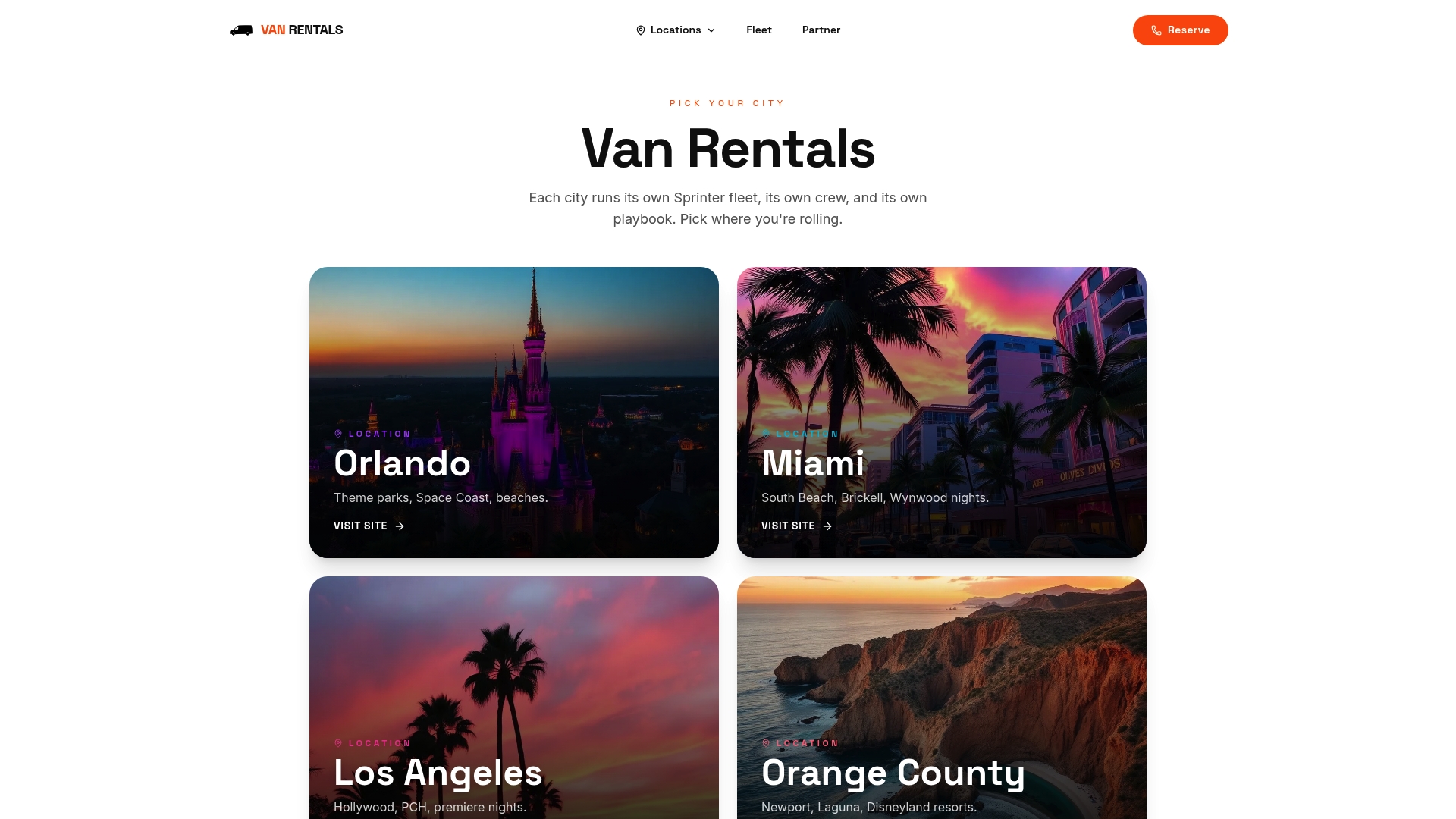
The fleet covers 12-passenger and 15-passenger vans, Sprinter and Ford Transit-style vehicles, and minivans, all managed by city-specific teams in major U.S. markets including Orlando, Miami, and Los Angeles. Those local teams know venue access routes, staging areas, and permit requirements in their cities. Contracts are transparent: fees, mileage caps, and cancellation terms are disclosed before you pay. Driver vetting and vehicle inspections are part of the standard process.
School groups and church organizations have dedicated program pages with policies built for group travel.
Check availability and pick your city to get a quote for your next event. School coordinators can go directly to the school van rental program, and faith groups can find options on the church van rental page.
Useful sources
- How Van Rental Contracts Work for Events — Myvanrentals
- Hidden Fees in Cheap Van Rentals — Myvanrentals
- Multi-Van Event Rental: A Complete Planning Guide — Myvanrentals
- City Transport Options for Business Groups — Myvanrentals
- When a 15-Passenger Van Rental Makes the Most Sense — True Concierge
FAQ
What is the most common event transport logistics mistake?
Booking a van based on seat count alone, without accounting for luggage or gear, is the most frequent error. It results in cramped passengers, left-behind equipment, or a last-minute vehicle upgrade at a higher cost.
How far in advance should you book a passenger van for an event?
Book at least 3–6 months out for peak-season events like graduations, proms, or large church retreats. Fleets in major cities sell out well before the event date.
What hidden fees should you watch for in a van rental contract?
The most common are mileage overage charges, one-way drop fees, young-driver surcharges, wait-time fees, and fuel penalties. Confirm every fee in writing before paying a deposit.
Does Myvanrentals offer accessible vehicles for event groups?
Myvanrentals operates city-specific fleets across major U.S. markets. Contact the local team directly to confirm accessible vehicle availability and securement options for your event date.
How do you prevent delays when using multiple vans for one event?
Assign a trip captain for each vehicle, share a synchronized timeline with all drivers, and establish a single group contact for real-time updates. The multi-van planning guide covers driver check-in protocols and arrival window coordination.