Hidden Fees in Cheap Van Rentals: What Organizers Must Know

Hidden Fees in Cheap Van Rentals: What Organizers Must Know
The most common hidden fees in low-cost van rentals are airport surcharges, security deposit holds, cleaning fees, mileage overages, insurance upsells, one-way drop fees, extra driver charges, and fuel penalties. Your first move: build a total-cost table and request a written, itemized quote before you pay anything.
Here is what to watch for at a glance:
- Airport surcharge: usually a modest daily fee or a flat pickup fee added when you collect from an airport terminal
- Security deposit hold: typically a few hundred dollars blocked on your card, sometimes for weeks
- Cleaning fee: a variable charge applied based on the vehicle’s return condition
- Mileage overage: a per-mile charge applies once you exceed the daily mileage cap
- Insurance upsell: additional daily charges for coverage upgrades, often with exclusions
- One-way/drop fee: a moderate to substantial fee for returning the vehicle to a different location
- Extra driver fee: Daily charge per additional driver beyond the primary renter
- Fuel/refuel penalty: a penalty charge that significantly exceeds the local fuel market rate, plus an administrative fee
Pro Tip: A low headline rate often costs more in total than a slightly higher rate that includes unlimited miles, insurance, and a modest deposit. Compare totals, not daily rates.
Table of Contents
- Common hidden fees low advertised rates often hide
- How to build a side-by-side total-cost table for comparing quotes
- Exact questions and contract items to insist on when you book
- Why city-specific fleets often lower or eliminate common fees
- Realistic fee ranges to budget for your event
- Tactical steps to avoid or reduce fees before and after pickup
- Key Takeaways
- Why fee transparency matters for group organizers
- Get a fully itemized quote for your group or event
- Useful sources
- FAQ
Common hidden fees low advertised rates often hide
Cheap van rental quotes frequently omit several charges that only appear at checkout or pickup. Knowing each fee’s trigger helps you spot them before you sign.
- Airport/destination surcharge: Triggered by pickup or drop-off at an airport terminal. Off-airport downtown locations often avoid this charge entirely.
- Cleaning fee: may be charged if the vehicle is returned with dirt or debris such as sand or pet hair. Standards vary, so documenting the van’s condition is recommended.
- Damage deductible and deposit hold: Minor damage can trigger withholding of the deductible amount. Deposit holds typically range from $200 to $1,000+ depending on the provider and vehicle, and may remain blocked during damage disputes.
- Insurance upsell: Basic coverage often excludes certain parts like roof, undercarriage, glass, and tires. Upgrade options may be offered at pickup.
- Mileage overage: Low-cost quotes often include mileage limits; exceeding these limits results in per-mile charges that can reduce overall savings.
- One-way/drop fee: Returning a van to a different city generally incurs a fee, which can be moderate to high depending on the route.
- Extra driver fee: Additional drivers beyond the primary renter often incur daily fees; clarify policies regarding event staff or co-organizers.
- Fuel/refuel penalty: If the vehicle is returned with less than a full tank, expect a penalty significantly above the local fuel price plus an administrative fee.
- Late return/after-hours fee: Returning the vehicle late or after hours may result in additional charges, sometimes equivalent to an extra day’s rental.
- Reservation or processing fee: Some providers include booking or administrative fees that appear at checkout.
- Underage/young-driver surcharge: Drivers under 25 typically pay additional daily fees beyond the base rate.
- Toll/road-use recovery fee: Some companies charge daily fees for toll administration regardless of actual toll usage.
- Mandatory extras: Some items like roadside assistance or equipment kits appear optional but may be effectively required depending on the trip.
Pro Tip: The three most disputed charges are cleaning fees, deposit holds, and damage to excluded areas (roof and undercarriage). Photograph all four sides plus the roof before you drive away.

How to build a side-by-side total-cost table for comparing quotes
A side-by-side total-cost table forces every quote onto the same rows so a lower headline rate cannot hide a higher true cost. Fill in one column per provider.
| Cost Row | Quote A (Low Rate) | Quote B (Transparent Rate) |
|---|---|---|
| Base daily rate × days | — | $110 × 3 = $330 |
| Included miles per day | 100 mi/day | Unlimited |
| Estimated mileage overage | 150 mi × $0.32 = $48.00 | $0 |
| Insurance/protection per day | $25 × 3 = $75 | Included |
| Airport surcharge | $15 × 3 = $45 | $0 (off-airport) |
| One-way/drop fee | $200 | $0 |
| Fuel policy penalty (estimated) | $40 | $0 (prepaid) |
| Deposit hold (cash-flow impact) | $800 | $300 |
| Cleaning policy buffer | $100 | — |
| Estimated trip total (excl. deposit) | $770 | — |
The table above shows how a $30/day rate difference flips completely once mileage, insurance, and a one-way fee are added. Treat the deposit hold as a short-term financing cost: $800 blocked for two weeks affects your event’s working capital even if it is eventually refunded.
To estimate mileage charges, map your full route in Google Maps, add 15% for local driving, then multiply excess miles by the per-mile rate. For a weekend event covering 300 miles with a 100-mile daily cap over three days, you have 0 included miles in excess — but a 200-mile day trip on day two adds 100 overage miles at $0.35 = $35.
Pro Tip: Ask the provider to email you an itemized total before payment and screenshot the booking flow at each step. That record protects you if charges differ at pickup.
Exact questions and contract items to insist on when you book
Get answers to these questions in writing before you pay a deposit.
- What is the exact deposit hold amount, and how many business days after return will it be released?
- What is the fuel policy? If I return less than full, what is the per-gallon rate and the admin fee?
- What is the daily mileage cap, and what is the per-mile overage rate?
- List every mandatory fee not included in the quoted base rate (airport, one-way, toll pass, processing).
- Which extras are truly optional versus required for a 12–15 passenger van?
- What are the cleaning standards? What specific conditions trigger a cleaning charge?
- How is damage reported and billed? What areas are excluded from the insurance waiver?
- Which card types are accepted for the deposit hold?
- What is the cancellation and refund policy, including the deadline for a full refund?
Request these two contract clauses in writing:
- “Total price including all taxes and mandatory fees: $X.”
- “Deposit hold will be released within Y business days unless a documented damage claim is submitted.”
Store your confirmation email, a screenshot of the final checkout page, and a printed or PDF copy of the signed contract. At pickup, photograph all four sides, the roof, the interior, and the odometer with your phone’s timestamp on.
Why city-specific fleets often lower or eliminate common fees
Locally managed fleets reduce several van rental extra charges that national providers routinely add. Here is how that works in practice for group organizers:
- Lower airport surcharges: City teams with negotiated hub contracts or nearby off-airport staging locations can bypass terminal pickup fees entirely. Myvanrentals delivers directly to hotels and venues, which removes the airport surcharge trigger for many bookings.
- Smaller deposit holds: City-level underwriting and direct relationships with local insurers allow for more flexible deposit terms, particularly for repeat event organizers.
- Faster deposit release: Local claims handling moves faster than a national call center. Disputes are resolved by a team that knows the vehicle and the route.
- Clearer fuel policies: City teams set fuel policies based on local pump prices, not a national formula. Prepaid fuel options are easier to negotiate directly.
- Tailored insurance for group/event use: Myvanrentals’ event-focused booking support means organizers can confirm coverage terms, exclusions, and deductibles before arrival rather than at the counter under pressure.
For a one-way route between two major cities, a local fleet with a drop hub in the destination city can eliminate or sharply reduce the standard one-way fee. For airport pickups, venue delivery sidesteps the surcharge entirely. These are structural advantages, not discounts that disappear at checkout.
Realistic fee ranges to budget for your event
Use these ranges to build a realistic buffer into your event budget. Figures reflect typical U.S. van rental pricing for 12–15 passenger vans.
| Fee Type | Low | Typical | High |
|---|---|---|---|
| Base daily rate | typically ranges from $70 to $150 per day | $110 typical | up to $150 |
| Mileage overage (per mile) | typically $0.25–$0.40 per mile | $0.32 typical | |
| Insurance/protection (per day) | typically $10–$40 per day | $25 typical | |
| Security deposit hold | commonly a few hundred to around $1,000 or more | $500 typical | |
| Airport surcharge | often a small daily fee typically in the range of $5 to $25 | $15 typical | |
| One-way/drop fee | generally from about $100 to $300+ | $200 typical | |
| Cleaning penalty | can be up to $400 depending on severity; most typical charges are around $150 | $150 typical | |
| Fuel/refuel penalty | penalties generally start around $30 and can exceed $100 depending on rates | — |
Weekend event scenario (3 days, 400 miles, airport pickup, same-city return): Base daily rates for standard vans typically range from $70 to $150, with insurance around $25 per day and overage mileage charges between $0.25 and $0.40 per mile. Total cost estimates should factor in these rates according to your trip duration and distance, as well as additional fees such as airport surcharges or one-way fees before the deposit hold.
Regional variation matters. Coastal metro areas and airports push rates toward the high end. Off-peak booking and off-airport pickup can bring both the daily rate and surcharges down. Always calculate your full planned mileage before accepting a quote with a daily cap.
Tactical steps to avoid or reduce fees before and after pickup
- Request a written itemized quote before paying. If the provider will not send one, that is a signal.
- Ask for corporate or block-booking terms. For multi-van group bookings, request a lower per-van deposit, consolidated invoicing, and a centralized damage reporting process.
- Prepay or negotiate a fuel package if the provider’s refuel penalty rate is high. Returning full is always safer.
- Inspect and photograph the vehicle at pickup. Timestamp every photo. Note any preexisting damage on the contract before you sign.
- Use event documentation to avoid extra-driver fees. A formal event roster or co-organizer letter sometimes qualifies additional drivers under a group policy.
- Dispute cleaning or damage charges with photo evidence. Send timestamped pickup photos immediately if a charge appears after return.
- Choose off-airport pickup when possible. Venue or hotel delivery removes the airport surcharge trigger entirely.
Pro Tip: For multi-van bookings, commit to multiple vehicles or dates in writing and ask for a block-booking fee waiver or reduced deposit per van. Providers are more flexible on deposit terms when the booking volume justifies it.
Key Takeaways
The single most effective step for any group organizer is to build a total-cost table before committing to any quote, because a low base rate routinely costs more than a transparent higher rate once fees compound.
| Point | Details |
|---|---|
| Build a total-cost table | Compare base rate, mileage, insurance, deposit, and all mandatory fees across every quote. |
| Insist on a written itemized quote | Get the full price including taxes and fees confirmed by email before you pay. |
| Photograph the vehicle at pickup | Timestamped photos of all sides and the roof protect you from disputed cleaning and damage charges. |
| Clarify insurance exclusions | Confirm whether roof, undercarriage, glass, and tires are covered before you accept the policy. |
| Budget for the deposit hold | A $200–$1,000+ deposit hold affects event cash flow even when it is eventually refunded. |
| Myvanrentals for group bookings | City-managed fleets, venue delivery, and event-focused booking support reduce common surprise charges. |
Why fee transparency matters for group organizers
Hidden fees hurt group organizers more than individual travelers because the costs multiply across vehicles and days. A $150 cleaning fee on one van becomes $450 across three. A $500 deposit hold per van ties up $1,500 in working capital for two weeks.
The right approach is not to find the lowest advertised rate. It is to find the provider who will give you the full number before you commit. That is what Myvanrentals is built around: city teams who know the local fee environment, direct delivery to your venue, and booking support that answers these questions before pickup rather than at the counter.
If you are planning a group event in Orlando, Miami, Los Angeles, or another major U.S. city, share your route and dates with a Myvanrentals city rep and ask for a fully itemized quote. You will know the real number before you sign.
Get a fully itemized quote for your group or event
Group organizers booking passenger vans for events in major U.S. cities get one concrete advantage with Myvanrentals: a city-managed fleet that delivers directly to your hotel or venue, with booking support that covers deposit terms, fuel policy, and insurance exclusions before you arrive.
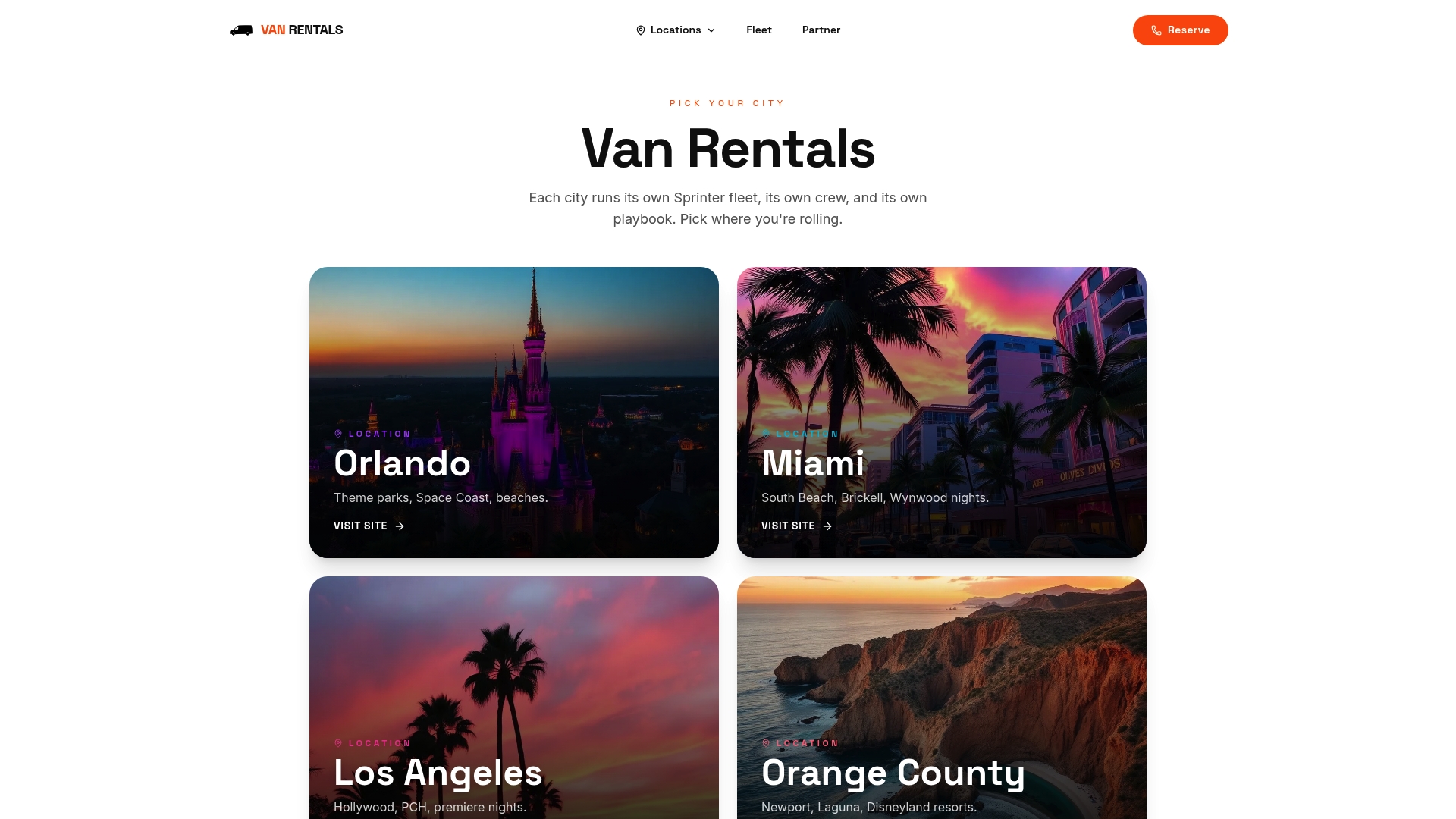
Myvanrentals offers 12 and 15 passenger vans, Sprinter and Ford Transit options, and block-booking programs for schools, churches, and corporate events. Deposit handling, one-way options, and event delivery are all confirmed in writing at booking, not at pickup.
Request your itemized quote at myvanrentals.com and include your city, dates, passenger count, and planned route for an accurate total-cost estimate.
Useful sources
- Travel Van Rental Cost Guide: Daily rate ranges ($70–$150), mileage overage rates ($0.25–$0.40/mi), deposit ranges ($200–$1,000+), and insurance daily costs ($10–$40).
- Campervan Rental Hidden Fees: Avoid Surprise Charges: Total-cost table methodology, cleaning fee mechanics, insurance exclusion traps, and mandatory-extras identification.
- One-Way Van Rentals: Fees, Rules & Smart Routes: One-way fee ranges ($100–$300+), airport vs. off-airport surcharge dynamics, and route selection tactics.
- Renting a Campervan: Expensive Mistakes: Fuel penalty mechanics (market rate × 1.5–2.5 plus admin fee) and return-condition documentation advice.
FAQ
What are the most common hidden fees in cheap van rentals?
The most common are airport surcharges, security deposit holds, cleaning fees, mileage overage charges, insurance upsells, one-way drop fees, and fuel penalties. Building a total-cost table before booking reveals how these stack up against the advertised base rate.
How much should I budget for a deposit hold on a passenger van?
Deposit holds typically range from $200 to $1,000+ depending on the provider and vehicle. Confirm the exact hold amount and release timeline in writing before you pay, and treat it as a short-term cash-flow item in your event budget.
How do I avoid mileage overage charges on a group trip?
Map your full planned route, add 15% for local driving, and compare that total against the daily mileage cap in the quote. If the cap is too low, negotiate an unlimited-miles rate or factor the overage cost at $0.25–$0.40 per mile into your total-cost table.
Does Myvanrentals charge airport surcharges?
Myvanrentals delivers directly to hotels and venues in major U.S. cities, which removes the airport terminal pickup trigger for many bookings. Contact your city rep to confirm delivery options and any applicable fees for your specific route.
What contract language should I insist on before signing?
Ask for two written confirmations: the total price including all taxes and mandatory fees, and a stated deposit release window (e.g., within five business days unless a documented damage claim is submitted). Get both by email before you pay.