Business Travel Transport Best Practices: 2026 Guide

Business Travel Transport Best Practices: 2026 Guide
Business travel transport best practices are defined by structured corporate policies that reduce costs, improve compliance, and protect traveler safety through enforceable booking windows, approved vendors, and expense tracking. Companies using formal, structured travel policies cut total travel costs by 20–30%, according to GBTA 2026 research. That figure reflects what happens when you replace ad hoc bookings with a repeatable system. The industry term for this framework is corporate transportation policy, and it covers everything from ground transport mode selection to reimbursement timelines. This guide covers the most effective practices across booking, vendor selection, expense management, and group logistics.
1. What are the critical booking and scheduling best practices?
Advance booking windows are the single most controllable variable in business travel logistics. Book too late, and you pay surge pricing or lose preferred vendors entirely. The best-practice booking timelines are 24 hours for airport transfers, 3–7 days for group transport, and a minimum of 14 days for domestic flights.
These windows exist for two reasons: cost control and availability. Airport transfer providers hold capacity for last-minute corporate accounts, but they charge for it. Group transport vendors, especially those offering vans or coaches, fill up fast around conferences and trade shows.

Centralized booking platforms enforce these windows automatically. When a traveler tries to book a flight five days before departure, the platform flags it, routes it for approval, or blocks it entirely depending on your policy rules. That enforcement removes the burden from managers and puts it in the system.
Pro Tip: Set a “Safe Harbor” booking window in your policy. Any booking made within the approved timeline is auto-approved. Anything outside it requires a written justification. This single rule reduces policy exceptions by a significant margin.
Last-minute bookings do more than raise costs. They reduce service quality, limit vehicle options, and create gaps in your duty of care coverage. A driver booked two hours before pickup has not been vetted through your approved vendor process. That is a liability, not just an inconvenience.
For multi-city trips, map the full itinerary before booking any single leg. Booking legs in isolation creates connection conflicts and inflates ground transport costs at each stop. Off-peak booking strategies also apply here: scheduling ground transport outside peak hours reduces both cost and wait times.
2. Which transportation options and vendor standards ensure safe, efficient travel?
Approved vendor lists are the backbone of any corporate transport strategy. Every vendor on your list should carry commercial liability insurance, employ vetted drivers, and operate vehicles that meet your company’s safety standards. Spot checks matter. A vendor that passed your initial review two years ago may have changed ownership or let certifications lapse.
Preferred transport modes by situation:
- Airport transfers: Use approved car services or ride-share accounts tied to your corporate profile, not personal accounts.
- City travel: Ride-share is the default. Taxis are acceptable when ride-share is unavailable. Personal vehicles require pre-approval and mileage reimbursement.
- Extended trips (3+ days): Rental cars are cost-effective when the traveler has multiple stops or needs flexibility.
- Group travel: Vans beat multiple car rentals on cost, coordination, and carbon footprint. One driver, one vehicle, one invoice.
| Transport Mode | Best Use Case | Key Requirement |
|---|---|---|
| Ride-share (corporate account) | City transfers, short distances | Corporate profile, not personal account |
| Approved car service | Airport pickups, executive travel | Vetted driver, liability insurance |
| Rental car | Extended trips, multi-stop itineraries | Pre-approval, insurance confirmation |
| Van rental | Group travel, conference transport | Approved vendor, advance booking |
Centralized booking platforms enforce vendor standards at the point of booking. If a traveler tries to book a vendor not on your approved list, the platform blocks it. That is the only way to guarantee compliance at scale.
Pro Tip: Require vendors to provide proof of insurance annually, not just at onboarding. A lapsed policy discovered after an incident is a serious legal exposure.
For groups, a van over multiple cars reduces coordination complexity, cuts per-person cost, and keeps the group together. That last point matters more than most travel managers realize. Splitting a team across three cars in an unfamiliar city creates real logistical risk.
3. How can business travel expense and reimbursement processes be optimized?
Expense reporting is where most corporate travel policies break down. Travelers submit late, receipts go missing, and finance teams spend hours chasing documentation. The fix is process design, not reminders.
Core expense policy standards:
- Submit expense reports within 14–30 days of trip completion.
- Process reimbursements within 5 business days of approval.
- Require itemized receipts for all ground transport over your policy threshold (typically $25).
- Flag out-of-policy expenses automatically rather than rejecting them outright. Rejection without explanation drives shadow bookings.
Auto-linked expense drafts tied to bookings are the most underused tool in travel expense management. When a traveler books through your centralized platform, the system pre-populates the expense report with vendor, amount, date, and trip leg. The traveler confirms and submits. Auto-linked drafts save 60–120 minutes per trip during reconciliation. That time adds up fast across a team.
Threshold-based approval routing prevents the most common enforcement failure in corporate travel: manager rubber-stamping. When every expense routes to the same manager regardless of amount, approvals become automatic. Set escalation thresholds. Expenses under $100 auto-approve. Expenses between $100 and $500 go to the direct manager. Expenses above $500 go to finance.
Pro Tip: Set per diem ground transport caps as a daily total, not per trip. A $60 daily cap is harder to game than a $30 per-trip cap. Travelers consolidate rides rather than splitting them to stay under the per-trip limit.
4. What service-level agreements and wait time rules improve ground transport reliability?
Service-level agreements (SLAs) turn vague expectations into measurable standards. Without them, “the driver was late” is a complaint. With them, it is a policy violation with a defined remedy.
Key SLA rules for ground transport:
- Hotel pickups: driver must be present within 15 minutes of the scheduled time.
- Airport pickups: driver must be present within 45 minutes of wheels-down, accounting for baggage claim.
- Cancellation window: travelers must cancel at least 2 hours before pickup to avoid a no-show fee.
- Wait time cap: if a driver exceeds the SLA wait time, the traveler may book an alternative and expense it without pre-approval.
SLA-defined wait-time rules reduce hidden costs and prevent trip abandonment. A traveler who waits 40 minutes for a no-show driver and then books a last-minute taxi has just paid twice. Clear SLA rules with defined remedies prevent that outcome.
“Precise wait-time rules in your SLA playbook are the difference between a reliable ground transport program and one that generates constant exception requests.” — DRVN Corporate Travel SLA Playbook
Buffer time policies matter most in high-density urban areas. In cities like Los Angeles or Miami, traffic variability is high. Build 20–30 minutes of flex time into ground transport schedules for airport runs. Automation tools that monitor real-time traffic and adjust pickup times accordingly reduce missed connections significantly.
5. What situational strategies improve logistics for groups and multi-city trips?
Multi-city trips require a different planning approach than single-destination travel. The most common mistake is booking each leg independently without mapping the full itinerary first. That creates budget gaps, approval delays, and ground transport conflicts at each stop.
Map the complete itinerary before any booking is confirmed. Assign budget ownership per leg and per program. When a trip spans three cities and four days, each leg needs its own cost center code. That makes reconciliation straightforward and gives finance a clear audit trail.
Per-leg approval routing works better than single trip-level approval for complex itineraries. A manager approving a “trip to Chicago, Dallas, and Atlanta” does not have visibility into the ground transport costs at each stop. Per-leg routing surfaces those costs before they are incurred.
Pro Tip: For group trips to conferences or trade shows, check event-specific van rental discounts well in advance. Vendors often offer group rates for event-adjacent bookings that are not available through standard corporate accounts.
Auto-routing for itinerary changes saves significant time on complex trips. When a flight is delayed, the system should automatically push the ground transport pickup time and notify the driver. Manual coordination in those moments is slow and error-prone. Pre-generated expense reports that update with each itinerary change further reduce the reconciliation burden after the trip.
High-performing teams also prioritize total travel time over lowest ticket price. Choosing secondary airports closer to city centers can reduce transfer times even when the ticket costs more. For executives with back-to-back meetings, that time trade-off is almost always worth it.
Key takeaways
Structured corporate transportation policies are the most direct way to reduce travel costs, enforce compliance, and protect travelers across every trip type.
| Point | Details |
|---|---|
| Book within defined windows | Use 24-hour, 3–7 day, and 14-day advance booking rules to control cost and availability. |
| Enforce vendor standards | Require annual insurance proof and use centralized platforms to block unapproved vendors. |
| Automate expense routing | Auto-linked drafts and threshold-based approvals cut reconciliation time and prevent rubber-stamping. |
| Set SLA wait-time rules | Define 15-minute hotel and 45-minute airport wait limits to prevent double-booking and trip abandonment. |
| Use vans for group travel | One van reduces per-person cost, coordination complexity, and logistical risk versus multiple cars. |
What I’ve learned about corporate travel policies that most guides won’t tell you
The biggest gap in most corporate travel programs is not the policy document. It is the enforcement gap between what the policy says and what actually gets approved. I have seen companies with detailed 40-page travel policies where 60% of bookings still go through personal accounts because the approval workflow was too slow. Travelers do not break policy out of bad intent. They break it because the compliant path is harder than the non-compliant one.
The fix is not stricter rules. It is faster systems. When your centralized platform auto-approves compliant bookings in seconds and flags exceptions for review, travelers stop going around it. The policy becomes the path of least resistance.
Travel policies need annual reviews to stay relevant. Market rates shift, new transport options emerge, and your traveler mix changes. A policy written in 2023 with price caps based on 2023 hotel and ground transport rates will generate constant exceptions by 2026. Rigid price caps during conference-driven price inflation are a particular failure point. Percentage-above-market rules work better than fixed dollar caps because they flex with actual market conditions.
The other thing most guides miss: manager approval is the weakest link in any travel program. Automation does not remove manager judgment. It focuses it. When the system handles routine approvals automatically, managers only see the exceptions that actually need human review. That is a better use of everyone’s time.
— Gabriel
Myvanrentals for group business travel transport
Group ground transport is one of the most overlooked cost centers in corporate travel budgets. Coordinating multiple cars across a team adds booking complexity, splits receipts across multiple expense reports, and creates real logistical risk in unfamiliar cities.
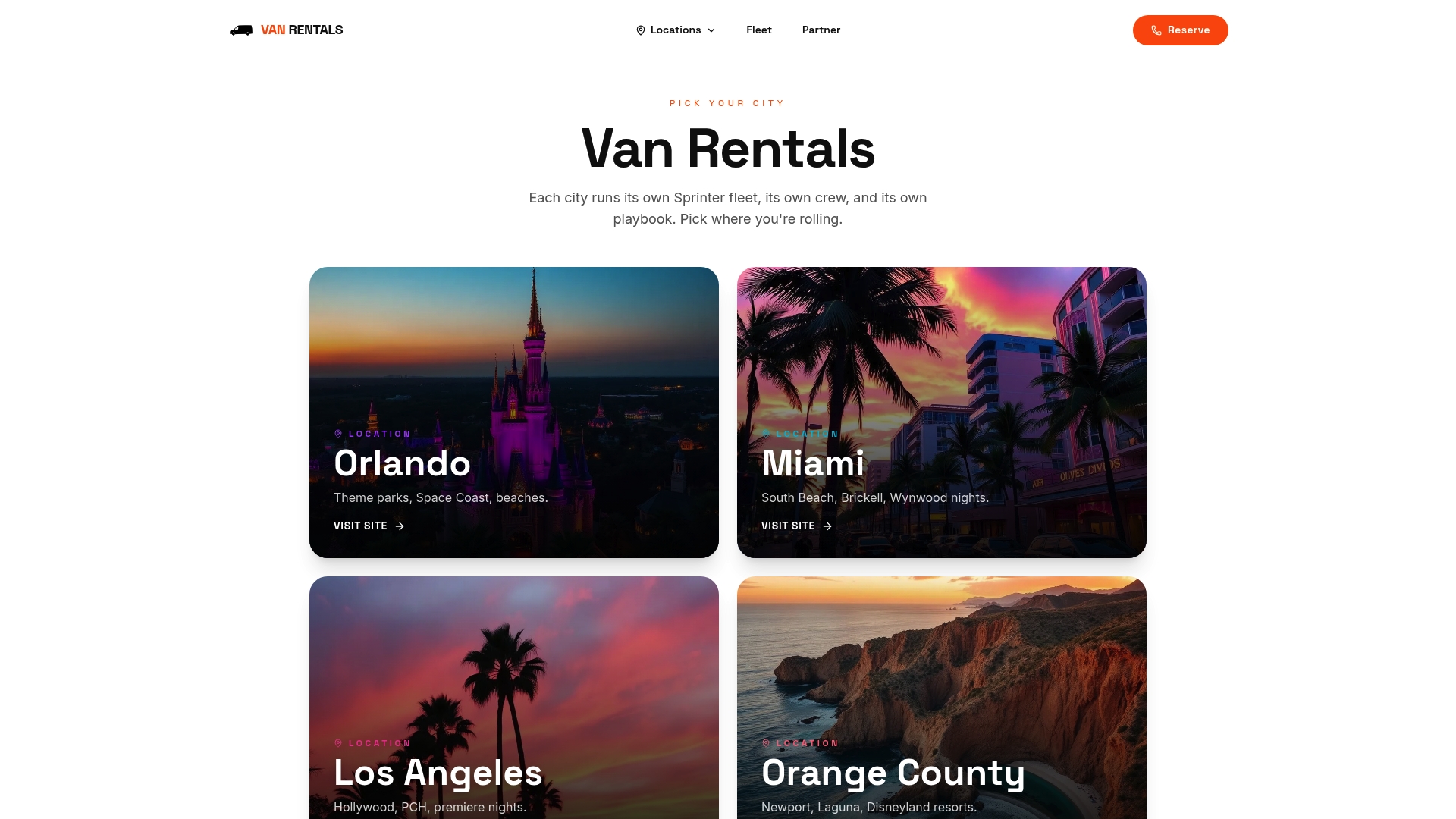
Myvanrentals offers van rentals across major business travel cities including Orlando, Miami, and Los Angeles. Each city fleet is managed by a local team with direct knowledge of routes, traffic patterns, and airport logistics. For corporate groups, that local expertise reduces the coordination burden significantly. You book one vehicle, get one invoice, and keep your team together from arrival to destination. Pick your city and book directly through Myvanrentals to find van options that fit your group size and schedule.
FAQ
What are business travel transport best practices?
Business travel transport best practices are the structured policies and procedures that govern how employees book, use, and expense transportation during business trips. They cover advance booking windows, approved vendors, expense reporting timelines, and service-level standards.
How far in advance should you book business travel transport?
Book airport transfers at least 24 hours ahead, group transport 3–7 days ahead, and domestic flights a minimum of 14 days ahead to control costs and secure availability.
Why are SLAs important in corporate ground transport?
SLAs define measurable wait-time standards, such as 15 minutes for hotel pickups and 45 minutes for airport pickups, that prevent trip abandonment and eliminate hidden costs from last-minute alternative bookings.
How do auto-linked expense drafts improve travel compliance?
Auto-linked drafts pre-populate expense reports from booking data, saving travelers 60–120 minutes per trip and reducing the errors and delays that cause late submissions.
When should a company use a van instead of multiple rental cars?
Use a van for any group of four or more travelers sharing a route. A single van costs less per person, produces one invoice, and keeps the group coordinated in unfamiliar cities.