How Van Rental Contracts Work for Events

How Van Rental Contracts Work for Events
A van rental contract for events is a legally binding agreement that defines the responsibilities, coverage, and limitations for renting a van used in event transportation. Understanding how van rental contracts work for events before you sign protects your budget, your group, and your event timeline. These agreements cover rental duration, pricing, insurance, mileage limits, and geographic restrictions. Miss a clause, and you could face unexpected fees that derail your entire event budget.
What are the key terms in event van rental contracts?
A van rental contract is a legally binding agreement covering rental period, pricing, insurance liabilities, mileage, and geographic restrictions. Every clause in that document carries real financial weight for event planners. Knowing what each term means before pickup prevents costly surprises at return.
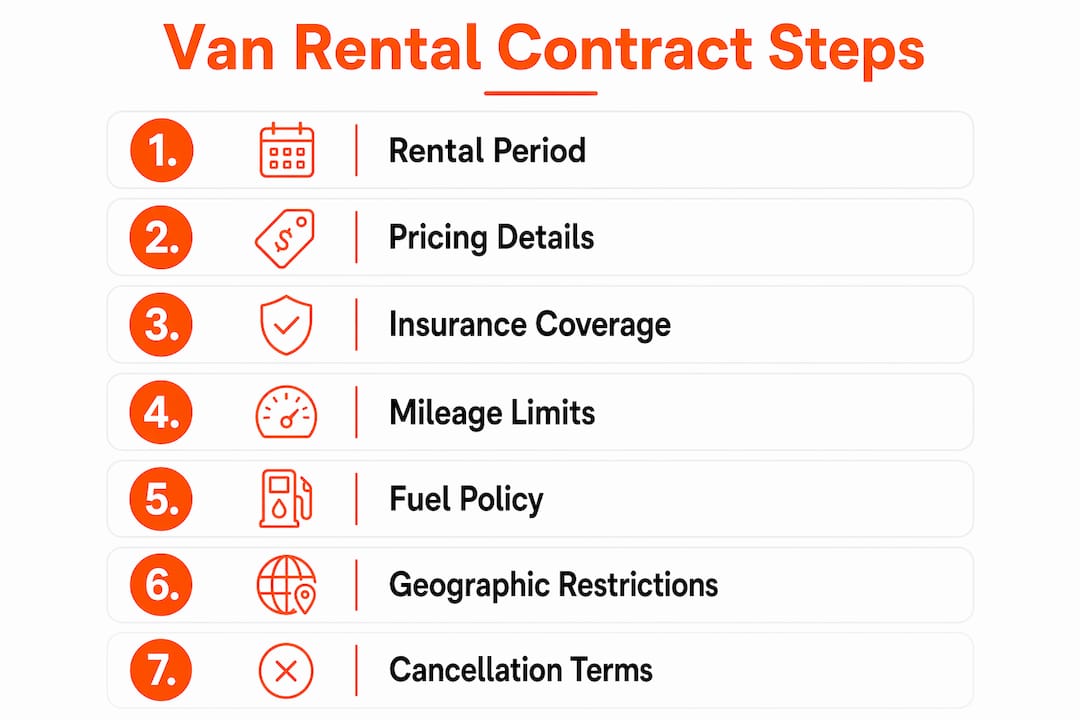
Rental period and timing define when your contract starts and ends, down to the hour. Most rental companies charge a full extra day if you return even one hour late. For events with tight schedules, like a Saturday wedding or a Sunday conference, confirm your return window in writing.
Pricing structure goes beyond the daily base rate. You will typically encounter:
- Base daily or weekly rate
- Airport or location surcharges
- Additional driver fees (usually $10–$15 per day per extra driver)
- Young driver surcharges for operators under 25
- Late return penalties, often calculated at 1.5x the daily rate
Mileage limits are one of the most overlooked clauses in event van rental agreements. Many contracts cap mileage at 100–150 miles per day. Multi-stop event routes, airport shuttle runs, or cross-city transfers can exceed that cap quickly. Overage fees typically run $0.25–$0.50 per mile, and those charges add up fast on a long event day.
Geographic restrictions prohibit off-road use and, in many cases, crossing state or national borders without prior written approval. Any breach, such as unauthorized off-road use or crossing restricted borders, can void insurance and leave you fully liable for all costs. Always confirm your full route with the rental company before the event.

Cancellation and late return policies vary widely. Some companies offer free cancellation up to 48 hours before pickup. Others charge a full day’s rate for any cancellation. Read this clause carefully if your event date is subject to change.
Pro Tip: Request a written summary of all fees before signing. Ask specifically about mileage overage rates, late return charges, and any fuel-related penalties. A five-minute conversation at booking can save hundreds of dollars at return.
How does insurance work in event van rental contracts?
Insurance is the most financially consequential section of any event van rental agreement. Rental insurance divides into mandatory liability coverage and optional damage waivers like Collision Damage Waivers (CDW) and Loss Damage Waivers (LDW) that limit your financial exposure. Without CDW or LDW, you can face multi-thousand-dollar expenses for vehicle repairs, towing, and loss-of-use fees from a single accident.
Here is what each coverage type means in practice:
- Liability insurance: Covers bodily injury and property damage you cause to third parties. This is mandatory and usually included in the base rate.
- Collision Damage Waiver (CDW): Limits your responsibility for physical damage to the rental van. It is not technically insurance but a waiver of the company’s right to charge you.
- Loss Damage Waiver (LDW): Combines CDW with theft protection. This is the broadest protection option at the rental counter.
- Supplemental Liability Insurance (SLI): Adds extra liability coverage above the mandatory minimum, useful for large group events.
Many commercial renters assume their credit card rental insurance covers large passenger or cargo vans. It often does not. Credit card rental benefits frequently exclude large passenger vans and any vehicle used for commercial purposes. Verify explicit coverage for your van type in writing before declining the rental counter’s damage waiver.
Commercial auto insurance policies also commonly exclude physical damage coverage for rented vans used for passenger transport. This means your business policy may not fill the gap either. Verifying coverage in writing before the rental date is the only way to know for certain.
Legal risk extends beyond the rental contract itself. Businesses using rented vans for event services should draft clear terms with their clients to limit liability for delays or breakdowns caused by the rented vehicle. The rental contract protects the rental company first. Your client agreement protects you.
Pro Tip: Call your personal auto insurer and your credit card benefits line before the rental date. Ask both specifically whether large passenger vans used for group events are covered. Get the answer in writing or via email.
What are the fuel policies in van rental contracts?
Fuel policy is a clause that directly affects your final bill, yet most event planners do not read it until they are standing at the return counter. Fuel policies typically fall into three categories, and non-compliance results in premium refueling charges that can greatly exceed market fuel prices.
| Fuel Policy | How It Works | Best For |
|---|---|---|
| Full-to-full | You receive a full tank and return it full | Most events; predictable cost |
| Prepaid fuel | You pay for a full tank upfront; unused fuel is not refunded | Short trips with uncertain return timing |
| Same-as-pickup | You return the van at the same fuel level as pickup | Flexible but requires careful tracking |
Full-to-full is the most cost-effective policy for most event scenarios. You pay only for what you use, and you control where you refuel. Prepaid fuel works if you know you will use a full tank and want to avoid a last-minute gas station stop before returning the van.
Refueling fees charged by rental companies can run two to three times the local pump price. For a 15-passenger van with a 25-gallon tank, that difference can add $75–$100 to your final bill for a single refueling charge.
Fuel policy, mileage limits, and return deadlines impact final event rental costs more than the advertised daily rate. Careful review of these clauses reduces budget overruns.
Pro Tip: For multi-stop event routes, map your fuel stops in advance. Identify gas stations near your final stop before the return location so you can top off the tank without a detour.
What operational steps should event planners take when renting vans?
Getting the contract right is only half the work. Operational planning determines whether your event transportation runs without problems on the day. Follow these steps to avoid the most common logistical failures:
-
Confirm loading zones and delivery windows with the venue. Parking is the biggest logistical challenge for urban event van rentals. Securing loading zones and permits ahead of time prevents costly parking fines and delays.
-
Register all authorized drivers before pickup. Every driver who may operate the van must be listed on the contract. Unlisted drivers void your insurance coverage instantly. Collect driver’s license information from all potential operators before you visit the rental counter.
-
Book a slightly larger van than you think you need. Booking a larger van initially provides flexibility since last-minute upgrades during high-demand events are often unavailable. Downgrading at pickup can yield a partial refund. Upgrading last minute typically cannot be done.
-
Communicate van usage and permits to venue management. Many venues require advance notice for large vehicle access. Some require permits for loading dock use or overnight parking. Confirm these details at least one week before the event.
-
Plan your route and confirm mileage before signing. Calculate your total expected mileage for the event day, including all stops, transfers, and return trips. Compare that number to the contract’s mileage cap. If your route exceeds the limit, negotiate an unlimited mileage option upfront. Reviewing group van rental basics can help you estimate vehicle needs accurately.
-
Confirm roadside assistance coverage. Check whether the contract includes roadside assistance or whether you need to purchase it separately. For events where a breakdown would cause serious disruption, this coverage is worth the added cost.
Key Takeaways
Understanding the full scope of a van rental contract, from insurance waivers to fuel policy and mileage caps, is the single most effective way to protect your event budget and avoid last-minute penalties.
| Point | Details |
|---|---|
| Read every clause before signing | Mileage limits, fuel policy, and return deadlines affect final costs more than the base rate. |
| Verify insurance coverage in writing | Credit card and commercial policies often exclude large passenger vans used for events. |
| Register all drivers upfront | Unlisted drivers void insurance coverage; collect license details before the rental counter visit. |
| Book larger, plan your route | Upgrades are rarely available last minute; calculate total mileage before signing the contract. |
| Coordinate parking with the venue | Secure loading zones and permits at least one week before the event to avoid fines and delays. |
What I have learned from event van rental contracts
Event planners consistently underestimate how much the fine print costs them. The advertised daily rate is almost never the final number. The real cost lives in the mileage overage fees, the fuel charge at return, and the insurance gap that nobody checked before the event.
The single biggest mistake I see is assuming that existing coverage, whether from a credit card or a business auto policy, extends to large passenger vans used for group events. It usually does not. That assumption has cost event organizers thousands of dollars in uninsured damage claims. Verify coverage in writing. Every time.
Early booking matters more than most planners realize. Locking in a larger van early gives you room to downsize if attendance drops. Waiting until the week before the event means you take whatever is available, at whatever price the market sets. For high-demand weekends in cities like Orlando, Miami, or Los Angeles, inventory moves fast.
The operational details, parking permits, driver registration, venue coordination, are where most event transportation plans fall apart. The contract is the foundation. The logistics are the structure built on top of it. Both require the same level of attention.
— Gabriel
Van rentals for events made straightforward with Myvanrentals
Planning event transportation does not have to mean sorting through confusing contract terms on your own. Myvanrentals offers transparent rental agreements with clear pricing, flexible vehicle options, and city-specific teams who know the routes, venues, and parking logistics in Orlando, Miami, and Los Angeles.
Whether you are coordinating airport transfers, shuttling guests between venues, or managing a full-day conference transport program, Myvanrentals provides the vehicle variety and local knowledge to keep your event moving. Visit Myvanrentals to browse available vans by city and get a quote that fits your event’s size and schedule. Transparent contracts, no hidden fees, and a team that understands event logistics from the first booking to the final return.
FAQ
What does a van rental contract for events include?
A van rental contract covers rental period, pricing, mileage limits, insurance requirements, fuel policy, geographic restrictions, and cancellation terms. Every clause directly affects your total cost and liability exposure.
What is van rental insurance for events?
Van rental insurance for events includes mandatory liability coverage and optional waivers like CDW and LDW that limit your financial responsibility for vehicle damage or theft. Without these waivers, a single accident can result in multi-thousand-dollar out-of-pocket costs.
What is the best fuel policy for event van rentals?
Full-to-full is the most cost-effective fuel policy for most event rentals because you pay only for the fuel you use. Prepaid fuel works for short trips but does not refund unused fuel.
Do I need to register all drivers on the van rental contract?
Yes. Every driver who may operate the van must be listed on the contract before pickup. An unlisted driver voids your insurance coverage for any incident that occurs while they are driving.
Can I use my credit card insurance for a rental van at an event?
Credit card rental insurance frequently excludes large passenger vans and vehicles used for commercial or group event purposes. Always verify your specific coverage in writing before declining the rental company’s damage waiver.