Van Size and Family Budget Travel: 2026 Guide

Van Size and Family Budget Travel: 2026 Guide
Van size is the single biggest variable in family budget travel, shaping your rental cost, fuel bill, cargo room, and overall trip comfort before you book a single night’s stay. Families planning road trips in 2026 face a real tradeoff: pick a van that’s too small and you pay for roof boxes, trailers, and cramped tempers; pick one that’s too large and you overpay on fuel and parking. The role of van size in family budget travel goes well beyond the daily rental rate. Getting it right means calculating the full system cost, including insurance, tolls, parking, and fuel, against your group’s actual needs. Myvanrentals helps families in cities like Orlando, Miami, and Los Angeles match the right van size to their budget from the start.
How does van size affect family budget travel costs?
Van size directly controls how much your family pays across every line item of a trip budget. The daily rental rate is only the starting point. A larger van costs more per day, but it can eliminate the need for a second vehicle entirely, which wipes out a duplicate insurance package, a second parking space, and an extra set of tolls on every leg of the trip.
Renting a single van for groups of seven or more is often more cost-effective than splitting into multiple vehicles. That math gets more compelling the longer your trip runs, because every duplicated cost compounds daily. A family of eight paying for two midsize rentals for seven days can easily spend more than they would on one properly sized passenger van.

The full system cost of a trip should always include insurance, parking, tolls, and fuel, not just the daily rate. A van that costs $30 more per day but eliminates a second vehicle often saves $80 to $100 per day in combined fees. Budget-conscious families should run this calculation before assuming the cheaper-looking option is actually cheaper.
Cargo capacity and seating: what the numbers actually mean
Cargo space is the most misunderstood factor in van sizing for family trips. Most families compare maximum cargo volume, which is measured with all rear seats folded flat. That number is useless when you are traveling with a full passenger load.
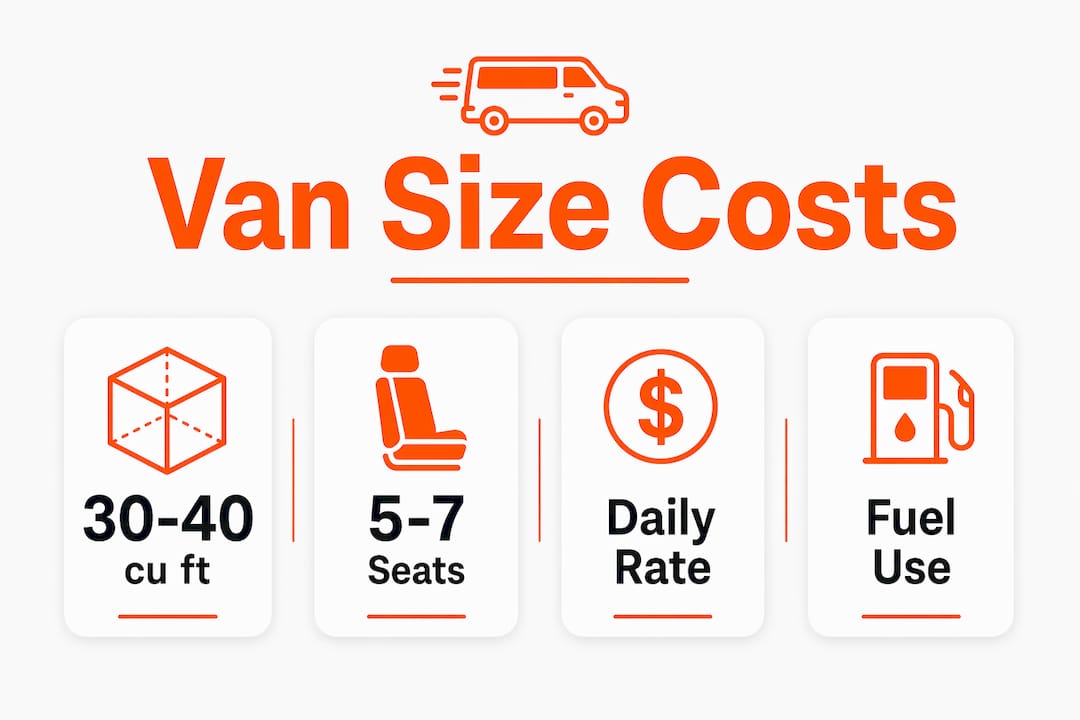
The correct metric is behind-third-row cargo space, meaning the room available with every seat occupied. Minivans provide 30–40 cubic feet of cargo space behind the third row. Midsize three-row SUVs average only 14–22 cubic feet in the same configuration. That gap is the difference between fitting a week’s worth of luggage for five people and leaving bags behind.
| Vehicle type | Behind-third-row cargo | Best for |
|---|---|---|
| Minivan | 30–40 cu ft | Families of 5–7 with full luggage |
| Midsize 3-row SUV | 14–22 cu ft | Smaller families or light packers |
| Full-size passenger van | 40+ cu ft | Groups of 8–15 with gear |
| Sprinter van | Configurable | Groups up to 18 passengers |
For gear-heavy multi-day trips, size up by 30–50% in seating capacity relative to your passenger count. That buffer gives you real cargo room without folding seats or strapping bags to the roof.
Pro Tip: Before you book, load all your bags into your driveway and measure the total pile. Compare that volume to the behind-third-row spec of the van you are considering, not the maximum cargo figure listed in the brochure.
What are the cost implications of van size for different group sizes?
Group size is the clearest driver of which van category makes financial sense. The cost math shifts significantly at specific passenger thresholds.
For families of four to six, a minivan or midsize SUV rental typically delivers the best balance of daily rate and cargo room. For groups of seven to twelve, a full-size passenger van becomes the cost-efficient choice because it eliminates the second-vehicle penalty entirely. For groups of 13 to 18, a Sprinter-style van is the standard recommendation. Sprinter vans are optimal up to 18 passengers; beyond that threshold, minibuses or charter buses deliver better cost efficiency than multiple van rentals.
Key cost factors to weigh by group size:
- Duplicate insurance: Two rental agreements mean two liability packages, which can add $30–$60 per day per vehicle.
- Parking fees: Urban destinations like Miami or Los Angeles charge per vehicle, so two cars double your parking bill at every stop.
- Toll roads: Florida’s toll network, for example, charges per axle and per vehicle, making a single van significantly cheaper than two cars on the same route.
- Fuel stops: Two vehicles require two fill-ups, two drivers managing fuel apps, and twice the coordination time.
- Roof racks and cargo add-ons: Underestimating cargo needs with a full passenger load leads to last-minute roof box rentals, which add cost and increase aerodynamic drag, cutting fuel efficiency by a measurable amount.
The hidden costs of workarounds routinely exceed the base price difference between vehicle categories. Choosing the right size upfront is almost always cheaper than patching a bad choice mid-trip.
How van size affects driving ease and passenger experience
Van size shapes the daily feel of a family trip in ways that do not show up in any budget spreadsheet but absolutely affect whether the trip is worth repeating.
Minivan advantages for frequent stops
Minivans are built for the stop-and-go reality of family travel. Sliding doors and lower load floors reduce loading friction in tight parking lots and at frequent rest stops. A child can exit a minivan independently in a standard parking space. That same child needs a parent’s help stepping down from a full-size van or a lifted SUV, which adds time and effort at every stop over a seven-day trip.
Larger vans and urban driving
Larger vans increase fuel consumption and create real challenges in urban parking structures. Many downtown garages in cities like Los Angeles have height restrictions that exclude full-size vans entirely. If your itinerary includes dense urban areas, a full-size passenger van may force you into surface lots or street parking, adding both cost and walking distance.
- Check garage clearance heights before booking a full-size van for any city-center itinerary.
- Confirm parking availability at your hotel or rental property for oversized vehicles.
- Plan highway-heavy routes when using larger vans, since they perform best on open roads rather than stop-and-go city traffic.
- Assign one driver who is comfortable with the van’s width and turning radius before the trip starts, not in a parking lot on day one.
Pro Tip: If your trip mixes urban stops with highway driving, a minivan or midsize passenger van often beats a full-size van on total cost and daily convenience. Reserve the larger vehicle for groups that genuinely need the extra seats.
Practical guidelines for selecting the right van size
Choosing the right van size comes down to three inputs: your group size, your luggage volume, and your itinerary type. Get all three right and the van pays for itself in avoided friction and duplicate costs.
Use this checklist before you book:
- Count passengers accurately. Include car seats and boosters as full seat occupants. A family of five with two car seats effectively needs a six-seat minimum configuration.
- Measure your gear. Lay out every bag, stroller, cooler, and sports equipment item. Compare the total volume to the behind-third-row spec of your target van.
- Map your itinerary type. Urban-heavy trips favor smaller, more maneuverable vans. Highway-heavy trips allow for larger vehicles without the parking penalty.
- Run the full system cost. Add insurance, parking, tolls, and fuel for every vehicle option you are comparing. The cheapest daily rate rarely produces the cheapest total trip.
- Apply the family weekend test. Pack your car exactly as you would for a weekend trip, seats occupied, bags loaded. If it does not fit comfortably, you need a larger van category.
For smaller families or modest luggage, midsize SUVs may offer the best balance between rental cost and convenience despite less cargo space. For extended travel with full gear loads, a minivan or passenger van consistently delivers better space-per-dollar. The van rental budget checklist from Myvanrentals walks through each of these factors with city-specific pricing context.
Avoid the two most common mistakes: underestimating cargo with a full passenger load, and overpaying for a 15-passenger van when a 7-passenger minivan covers your actual needs. Both errors cost money. The first costs you in add-ons and stress; the second costs you in daily rate and fuel.
Key Takeaways
Van size determines total trip cost, not just the daily rental rate. Families who calculate the full system cost, including cargo fit, insurance, parking, and fuel, consistently spend less and travel more comfortably.
| Point | Details |
|---|---|
| Behind-third-row cargo is the real metric | Minivans offer 30–40 cu ft with seats occupied; midsize SUVs offer only 14–22 cu ft. |
| Single van beats two vehicles for 7+ travelers | One rental eliminates duplicate insurance, parking, tolls, and fuel coordination costs. |
| Size up 30–50% for gear-heavy trips | Booking extra seat capacity creates real luggage room without roof racks or trailers. |
| Sprinter vans suit groups up to 18 passengers | Beyond 18, minibuses deliver better cost efficiency than multiple van rentals. |
| Full system cost beats daily rate as a decision metric | A more expensive van often produces a cheaper total trip when all fees are counted. |
What I’ve learned from watching families pick the wrong van
Families consistently underestimate how much van size affects the emotional experience of a trip, not just the budget. I’ve watched groups book the cheapest available vehicle, show up with seven people and a week’s worth of bags, and spend the first hour of their vacation rearranging luggage on a parking lot curb. That friction sets the tone for everything that follows.
The counterintuitive truth is that sizing up usually costs less in total. The families who book a van one category larger than they think they need almost never regret it. The families who book tight almost always do. The extra daily rate on a larger van is real, but it is almost always smaller than the combined cost of a roof box rental, a second parking space, and the fuel penalty from overloading a smaller vehicle.
I also think the cargo conversation is broken in most travel planning guides. They talk about maximum cargo volume, which assumes all seats are folded. That number is irrelevant for a family of six on a seven-day trip. The only number that matters is what fits behind the third row with every seat occupied. Once families understand that distinction, their van size decisions get dramatically better.
The best advice I can give is to treat van selection as a logistics problem, not a price problem. Map your group, your gear, and your route. Then find the van that solves all three. The price will take care of itself.
— Gabriel
Planning your next family trip with Myvanrentals
Families traveling to Orlando, Miami, or Los Angeles can browse van options by city on the Myvanrentals platform, where fleet options range from minivans to full-size passenger vans sized for groups up to 15. Each city team knows local parking restrictions, toll routes, and high-traffic periods, so you get sizing advice that fits your actual itinerary, not a generic recommendation.
Myvanrentals provides transparent pricing that includes the vehicle category, seating configuration, and cargo specs upfront. You can compare van sizes and pricing before you commit, which makes the full system cost calculation straightforward. Visit Myvanrentals to find the right van for your group size, luggage load, and budget before your next trip.
FAQ
How does van size affect the total cost of a family road trip?
Van size affects rental rate, fuel consumption, insurance, parking, and the need for cargo add-ons. A correctly sized van eliminates the cost of a second vehicle and avoids last-minute roof box or trailer rentals.
What is the best van size for a family of seven?
A full-size passenger van or a large minivan works best for seven passengers. This configuration keeps all travelers in one vehicle and eliminates duplicate insurance and parking fees compared to splitting into two cars.
How much cargo space does a minivan have with all seats occupied?
Minivans provide 30–40 cubic feet of cargo space behind the third row with all seats in use. Midsize three-row SUVs offer only 14–22 cubic feet in the same configuration.
When should a family rent a Sprinter van instead of a standard passenger van?
A Sprinter van is the right choice for groups of 9–18 passengers. Beyond 18 passengers, a minibus or charter bus delivers better cost efficiency than multiple van rentals.
Is a larger van always more expensive for family travel?
Not when you count the full system cost. A larger van with a higher daily rate often costs less overall by eliminating a second vehicle’s insurance, parking, tolls, and fuel expenses across a multi-day trip.