Why a Van Beats Multiple Car Rentals for Groups

Why a Van Beats Multiple Car Rentals for Groups
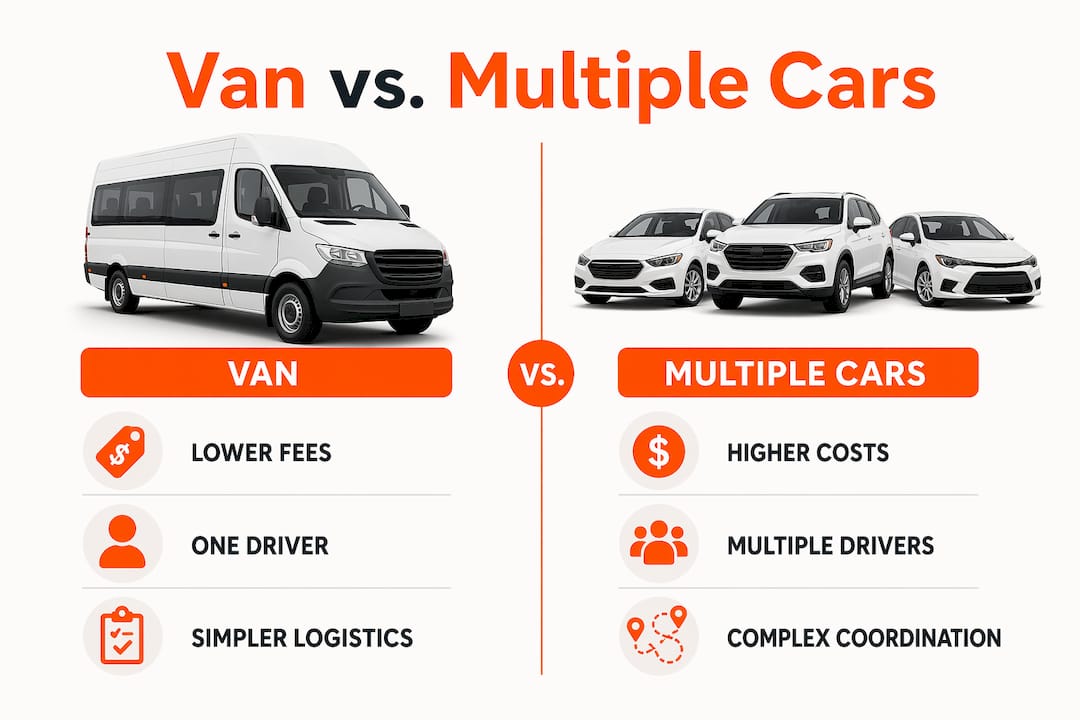
Renting one van instead of multiple cars is the most cost-effective and logistically sound choice for group travel. When you split a group across two or three separate vehicles, you multiply every cost: tolls, parking, insurance, and fuel. You also multiply every risk: missed turns, staggered arrivals, and coordination headaches. This article breaks down why van rental beats multiple cars on cost, logistics, and overall experience, and it covers the specific situations where splitting into separate vehicles actually makes sense.
Why van beats multiple car rentals: the full cost breakdown
The base rental rate is not the real number. Per-vehicle charges like toll transponders, parking permits, insurance packages, and local taxes stack up separately for every car you rent. A van may carry a higher daily rate than a single sedan, but once you duplicate those fees across two or three vehicles, the math shifts fast.
Here is a practical example. A group of ten people renting two midsize cars might pay $80 per day per car in base rates. Add two insurance packages, two parking fees at a downtown garage, and two toll transponders, and the real daily cost climbs well above the rate for one 12-passenger van. Daily rates alone can mislead travelers who stop at the headline number without accounting for duplicated fees.

Fuel is another factor. A 12-passenger van carries ten people on one tank. Two cars carrying five people each burn two tanks. The cost per passenger per mile is lower in the van, especially on longer drives between cities like Orlando and Miami.
Pro Tip: Before booking, ask the rental company for a full fee breakdown including insurance, tolls, and taxes. Compare that total across one van versus two cars, not just the base rates.
| Cost category | One van | Two cars |
|---|---|---|
| Base rental rate | One charge | Two charges |
| Insurance | One package | Two packages |
| Parking | One space | Two spaces |
| Toll transponder | One unit | Two units |
| Fuel per trip | One tank | Two tanks |
How does one van simplify group logistics?
Coordination is simpler with one vehicle and one driver than with multiple drivers trying to sync arrivals, departures, and luggage. When your group travels in separate cars, someone always falls behind. Someone misses the turn. Someone parks on a different level and takes 20 minutes to find the group at the theme park entrance.
One van eliminates those friction points entirely. You load luggage once, in one place. Everyone departs at the same time. Everyone arrives together. There is no need to text coordinates or wait at a corner for the second car to catch up.
Fewer vehicles also mean fewer failure points. A flat tire, a dead battery, or a wrong turn affects the whole group when you are in one van. With two or three cars, any one of those problems splits the group and stalls the entire trip. Professional travel planners consistently recommend minimizing failure points by keeping the group in a single vehicle.
Beyond logistics, there is a real social benefit. Traveling together in one van keeps conversations going, allows shared music, and lets the group make real-time decisions together. That shared experience is a core part of what makes a group trip worth taking.
Pro Tip: Assign one person as the trip coordinator before you leave. That person handles navigation, communicates with the driver, and keeps the group on schedule. It takes two minutes to set up and saves hours of confusion.
When do multiple cars make more sense than a van?
A van is not the right answer for every group. Multiple cars become the better option when group members arrive on staggered flights or need to reach different destinations at different times. A van waiting at the airport for a delayed flight burns idle time and adds unnecessary cost.
Here are the specific scenarios where splitting into separate vehicles is the smarter call:
- Staggered arrivals. If half your group lands at 2 p.m. and the other half at 8 p.m., a van sitting idle for six hours is not efficient. Two cars on separate schedules serve the group better.
- Split drop-off points. If some travelers are heading to a hotel in downtown Los Angeles while others need to reach a suburb, separate cars avoid backtracking and extra mileage.
- Corporate or privacy needs. Some groups, particularly mixed corporate teams, prefer separate vehicles for confidential conversations or individual schedules.
- Small groups of five or six. A large SUV handles five or six passengers comfortably and is easier to park in tight urban areas than a full-size van.
- Itinerary differences. If subgroups plan different activities on the same day, separate cars give each group the freedom to move on their own timeline.
Chauffeur service experts note that privacy needs and staggered schedules are the two most common reasons groups choose multiple cars over a single van. Knowing your group’s actual schedule before booking is the single most important step in making the right call.
What practical challenges come with driving a van?
A 12-passenger van is a large vehicle. Full-size vans typically run 19–21 feet long, which creates real challenges in city parking garages, narrow downtown streets, and tight drop-off zones. Urban areas with limited parking require extra planning when you are driving a vehicle that size.
Driver comfort matters too. Not everyone is confident behind the wheel of a full-size van. Wide turns, limited rear visibility, and height clearance in parking structures are all factors that catch first-time van drivers off guard.
Here are the key practical considerations before you commit to a van:
- Check your route. If your trip includes downtown Miami or central Los Angeles, identify parking options in advance. Many garages have height and length restrictions that exclude full-size vans.
- Know your driver. If the designated driver has never handled a vehicle longer than a standard SUV, a test drive or a smaller vehicle may be the safer choice.
- Consider a mid-size option. For groups of six to eight, a large SUV or a minivan offers most of the capacity benefits with better maneuverability in tight spaces.
- Ask about driver assistance features. Many newer rental vans include backup cameras and blind-spot monitoring. Drivers less comfortable with large vans can benefit significantly from these features.
Pro Tip: If your trip includes a mix of highway driving and city stops, ask Myvanrentals about the specific dimensions of the van you are booking. Knowing the length and height in advance lets you confirm parking availability before you arrive.
Key takeaways
One van beats multiple car rentals for most group trips because it cuts duplicated fees, reduces coordination risk, and keeps the group together from start to finish.
| Point | Details |
|---|---|
| Total cost is lower | Duplicated tolls, insurance, and parking fees make multiple cars more expensive than they appear. |
| Logistics are simpler | One driver, one departure time, and one luggage load eliminates the coordination problems that split groups face. |
| Fewer failure points | A single van reduces the risk of breakdowns, wrong turns, or vehicles getting separated mid-trip. |
| Exceptions exist | Staggered arrivals, split itineraries, and small groups of five or six may be better served by separate vehicles. |
| Van size requires planning | Full-size vans need advance parking research in urban areas like Los Angeles, Miami, and Orlando. |
My honest read on vans versus multiple cars
I have watched group trips fall apart over logistics that should have been simple. Two cars leave the hotel at the same time and arrive at the theme park 40 minutes apart because one driver took a wrong exit. Three people end up waiting in the heat while the rest of the group is already inside. That is a solvable problem, and the solution is usually just booking one van.
The cost argument is real, but it is the logistics argument that actually changes trips. When everyone is in the same vehicle, the group moves as a unit. Decisions happen faster. No one gets left behind. The trip feels like a shared experience rather than two parallel ones that occasionally intersect.
That said, I want to be direct about the exceptions. If your group has genuinely different schedules or arrival times, forcing everyone into one van creates idle time costs that can wipe out your savings. The van advantage is strongest when the group is actually traveling together, not when you are using one vehicle to serve two separate itineraries.
The honest advice is this: map out your group’s actual schedule before you book anything. If everyone is arriving together and going to the same places, one van is almost always the better call. If your group is fragmented by timing or destination, run the real numbers on both options before you commit.
— Gabriel
Plan your group trip with Myvanrentals

Myvanrentals makes it straightforward to book a van for your group in Orlando, Miami, Los Angeles, and other major cities. Each city fleet is managed by a local team that knows the routes, the parking options, and the best ways to get your group where it needs to go. You get competitive group pricing with no hidden surprises, and you can reach the support team directly with questions about vehicle size, capacity, or city-specific logistics. If you are planning a group trip and want one vehicle that handles everything, Myvanrentals is the place to start.
FAQ
Why does one van cost less than two cars for group travel?
Multiple cars multiply every fee, including insurance, tolls, parking, and taxes. One van carries the same group at a lower total cost once all per-vehicle charges are added up.
Is a 12-passenger van better than renting two SUVs?
For groups of eight or more traveling together on the same schedule, a 12-passenger van is more cost-effective and easier to coordinate than two SUVs. Two SUVs make more sense when the group has staggered arrivals or different drop-off points.
What are the biggest challenges of renting a full-size van?
Full-size vans require extra care in urban areas due to their length and height. Parking garages, narrow streets, and tight drop-off zones can be difficult. Check vehicle dimensions and parking availability before your trip.
When should a group choose multiple cars over a van?
Multiple cars are the better choice when group members arrive at different times, need separate drop-off locations, or have different daily itineraries. Idle time costs for a waiting van can quickly offset the savings a single vehicle normally provides.
Does traveling in one van actually improve the group experience?
Yes. Traveling together in one van keeps the group connected, allows shared decision-making on the road, and eliminates the coordination gaps that split groups into separate experiences.