Book Van Conference Team Transport: Planner's Guide

Book Van Conference Team Transport: Planner’s Guide
Size your fleet to the busiest 30–60 minute arrival or departure window, not total headcount, and book Myvanrentals for city-specific van fleets across major U.S. cities. For large multi-day events, reserve vehicles 30–40 days in advance. Smaller single-venue events can often be secured with 2–3 weeks’ notice. Start your request now: have your event dates, hotel list, and peak-hour window ready, then go to Myvanrentals to get an itemized quote.
Table of Contents
- Which vehicle types should you book for your team size?
- How do you size the fleet for peak-flow windows?
- What does the booking process and timeline look like?
- What drives the cost, and how do you get an accurate quote?
- What should you verify before signing a contract?
- How do airport pickups and city routing affect your plan?
- Myvanrentals handles your conference transport from quote to day-of
- Key Takeaways
- What most planners get wrong about conference transport
- Useful sources for conference transport planning
- FAQ
Which vehicle types should you book for your team size?
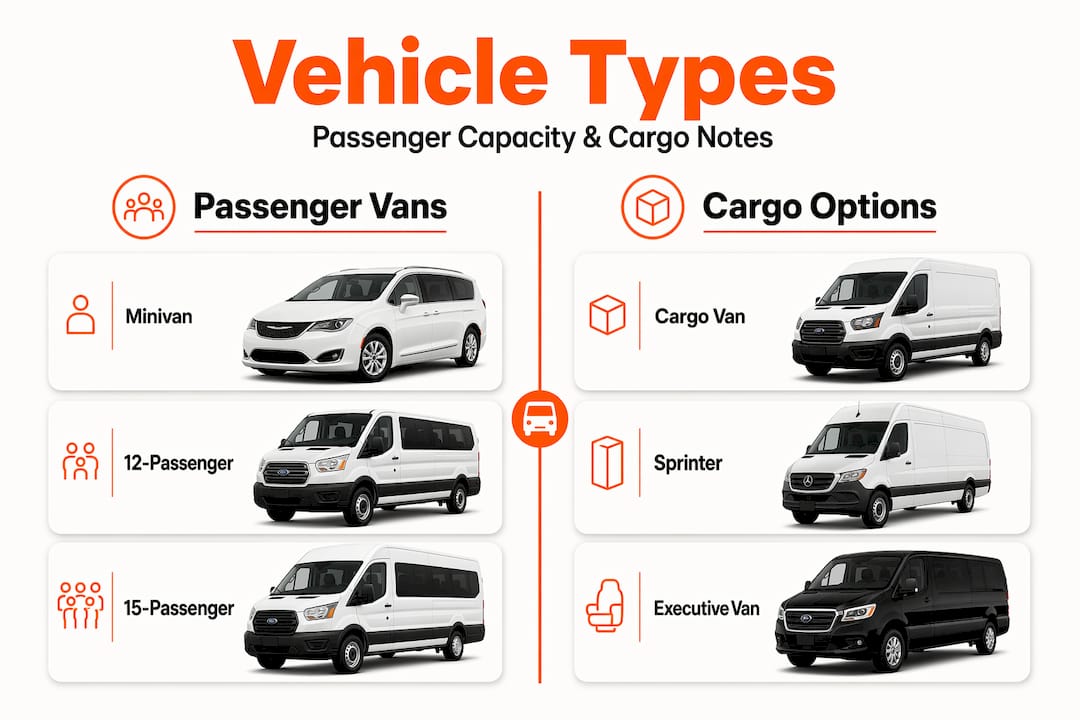
The right vehicle depends on headcount, luggage volume, and service level. Mixing types is common for conferences where VIPs, exhibitors, and staff all have different needs.
Here is a quick breakdown of available options:
- Minivan (5–7 passengers): Best for small breakout groups, VIP transfers, or airport runs for speakers. Limited cargo space.
- 12-passenger van: The workhorse for teams of 10–12. Fits standard luggage. Good for hotel-to-venue loops.
- 15-passenger van: Handles groups up to 15. Useful for staff shuttles and exhibitor crews with moderate gear.
- Sprinter or Ford Transit (8–12 conference-style seats): Convertible seating makes these ideal for teams that need to debrief en route. More headroom and a smoother ride than a standard van.
- Executive or luxury van: Reserved for C-suite attendees, keynote speakers, or VIP guests. Leather seating, climate control, and a polished appearance.
- Wheelchair-accessible van: Required when any attendee uses a mobility device. Confirm lift capacity and tie-down availability when booking.
When attendees bring booth displays, AV equipment, or large cases, upgrade to a cargo-capable van or add a dedicated cargo vehicle. For a team of 10–20 staff with standard luggage, one or two 12 or 15-passenger vans usually cover the load. Add a Sprinter if appearance or comfort is a priority.
| Vehicle Type | Passenger Range | Luggage/Gear Notes |
|---|---|---|
| Minivan | 5–7 | Light luggage only; no large cases |
| 12-passenger van | 10–12 | Standard luggage; moderate gear |
| 15-passenger van | 13–15 | Moderate gear; limited booth equipment |
| Sprinter/Ford Transit | 8–12 | Good cargo area; suits AV and cases |
| Executive/luxury van | 6–10 | Minimal cargo; comfort-focused |
| Wheelchair-accessible van | 4–8 | Lift required; confirm tie-down specs |
How do you size the fleet for peak-flow windows?
Size to peak flow, not total attendance. The busiest 30–60 minute window, typically morning arrivals or evening departures, determines how many vehicles you actually need. Average-flow capacity will not clear a surge.
Here is the calculation logic:
- Estimate how many attendees arrive or depart in your peak 60-minute window.
- Divide that number by the effective load per vehicle per loop (seat count × occupancy rate, typically 80–90%).
- Factor in loop turnaround time. If a round trip takes 30 minutes, each vehicle completes two loops per hour.
- Multiply vehicles needed per loop by loops per hour to get your total required fleet.
Worked example: 150 attendees arriving in 60 minutes. You are using 12-passenger vans at 90% occupancy (about 11 seats per run). Round-trip time is 20 minutes, so each van completes three loops per hour, moving 33 people. Divide 150 by 33: you need roughly five vans running simultaneously to clear the surge without a queue.
Shuttle planning adds another layer. Fixed loop headways (departures every 10–15 minutes) keep attendees moving without crowding. Dedicated VIP vehicles run outside the main loop. Manifested pickups, where attendees are assigned to specific departure times, reduce staging chaos at large venues. Open shuttles work for smaller events where flexibility matters more than precision.

Pro Tip: Assign one transportation coordinator to own all vehicle communication. Keep 10–15% contingency capacity, or at minimum one standby vehicle per route, to absorb delays and no-shows without disrupting the main schedule.
What does the booking process and timeline look like?
Book early. Large multi-day events need 30–40 days of lead time. Smaller single-venue events can be confirmed in 2–3 weeks, though local fleet availability varies. For peak-city conventions during major trade-show seasons, some providers recommend booking 60–90 days ahead.
When you submit your booking request, include:
- Event dates and daily schedule
- Venue address and all hotel addresses
- Room block details and estimated check-in/check-out times
- Peak-hour arrival and departure windows
- Vehicle type preferences and VIP vehicle requirements
- Estimated headcount per route
- Any equipment or cargo requirements
- Flight arrival details if airport pickups are needed
- Your on-site contact name and mobile number
Day-of coordination requires its own checklist. Confirm driver briefings the evening before. Establish a radio or group-chat channel for real-time updates. Designate staging locations at each hotel and the venue. Name one on-site transportation coordinator who drivers can reach directly. Have your contingency vehicle list and standby driver contacts ready before the first pickup.
| Milestone | Recommended Lead Time |
|---|---|
| Initial inquiry and quote request | 30–40 days before event (60–90 days for peak-city shows) |
| Contract signed and deposit paid | 25–35 days before event |
| Routing and schedule confirmed | 14–21 days before event |
| Driver briefing documents sent | 3–5 days before event |
| Final attendee manifest submitted | 24–48 hours before event |
For multi-van events, the multi-van event planning guide from Myvanrentals covers routing coordination in more detail.
What drives the cost, and how do you get an accurate quote?
Conference van pricing has several moving parts. Understanding each line item helps you compare quotes accurately and spot missing fees before you sign.
Primary cost drivers:
- Vehicle type and count: Sprinters and executive vans cost more per hour than standard 12-passenger vans.
- Hourly vs. daily rates: Most providers charge hourly with a minimum (often three hours). Multi-day events may qualify for a daily rate.
- Driver labor hours: Includes active drive time, wait time between runs, and any overnight or per-diem charges for multi-day programs.
- Mileage: Some quotes include mileage; others charge per mile above a threshold.
- Airport fees: Ground access fees, parking, and terminal permits are often passed through as line items.
- Fuel surcharges and service fees: Ask whether these are included in the base rate or added separately.
“A reliable quote should include: per-vehicle rate, driver hours, estimated mileage, parking and airport fees, cancellation policy, and any required deposits. Missing any of these items is a signal to ask more questions before signing.” — Eurocoaches
When requesting quotes, ask for each item broken out separately. A quote that bundles everything into one number makes it impossible to compare vendors or identify what changes if your schedule shifts.
Red flags to watch for: vague “service fees” with no explanation, no explicit insurance or driver qualification disclosure, and missing cancellation terms. Any of these should prompt a follow-up before you commit.
What should you verify before signing a contract?
Vendor vetting protects your attendees and your event. Run through this checklist before you sign anything.
Trust signals to confirm:
- Commercial general liability insurance certificate (request a copy, not just a verbal confirmation)
- Vehicle maintenance records and fleet age
- Driver background check policy and CDL credentials where required
- DOT/FMCSA compliance for commercial passenger carriers
- Written safety policies and incident response procedures
Operational signals to confirm:
- Dedicated transportation coordinator assigned to your event
- 24/7 dispatch or ops support during event days
- Standby/contingency vehicles available on the day
- Written driver briefing documents and route manifests
Questions to ask directly:
- Can you provide your insurance certificate and FMCSA operating authority number?
- Who is the day-of contact, and how do we reach them in real time?
- What is your contingency plan if a vehicle breaks down mid-event?
- What are your cancellation and change fees, and what is the deadline for changes without penalty?
Red flags: evasive answers about insurance, no written cancellation policy, no local references for events of comparable size, and no standby vehicles available during peak periods. A provider that cannot answer these questions clearly is not ready for a conference program.
For city transport for business groups, Myvanrentals operates with local teams who know venue access rules and airport procedures in each city.
How do airport pickups and city routing affect your plan?
Airport pickups add complexity that pure venue shuttles do not have. Flight tracking and meet-and-greet options reduce missed connections and no-show risk, especially for VIP speakers arriving on different carriers.
Curbside pickup rules vary by airport and city. Some terminals restrict commercial vehicles to designated staging areas. Others require advance permits for repeated pickups over a multi-day event. Ask your provider whether they have prior experience at the specific airports and venues on your itinerary.
For multi-hotel routing, centralized pickup points simplify driver schedules. Staggered pickup windows, 10–15 minutes apart per hotel, prevent all vehicles from converging at the venue simultaneously. A shuttle hub at the conference hotel works well when most attendees stay in one property.
| Scenario | Recommended Approach |
|---|---|
| VIP speaker arriving at airport | Dedicated meet-and-greet with flight tracking |
| Large exhibitor load-in | Advance dock scheduling; cargo-capable van |
| Multi-hotel staff shuttle | Staggered pickups; centralized hub stop |
| Single-venue, single-hotel | Fixed loop with 10–15 min headways |
| Airport group arrival (20+ pax) | Staged holding area; manifested boarding |
Speakers and VIPs generally need reserved curb access and a named driver contact. Large exhibitor loads may require advance coordination with the venue’s loading dock. For airport and event transport in cities with complex terminal rules, working with a provider that has local experience at those specific facilities saves time and avoids surprises.
City-specific knowledge matters. A team familiar with Orlando’s convention center access roads handles the same job differently than one operating in Los Angeles or Miami. Myvanrentals operates city-specific fleets managed by local teams, which reduces the learning curve on routing and venue access.
Myvanrentals handles your conference transport from quote to day-of
Myvanrentals gives conference planners a direct path from quote request to confirmed vehicles, without coordinating across multiple vendors.
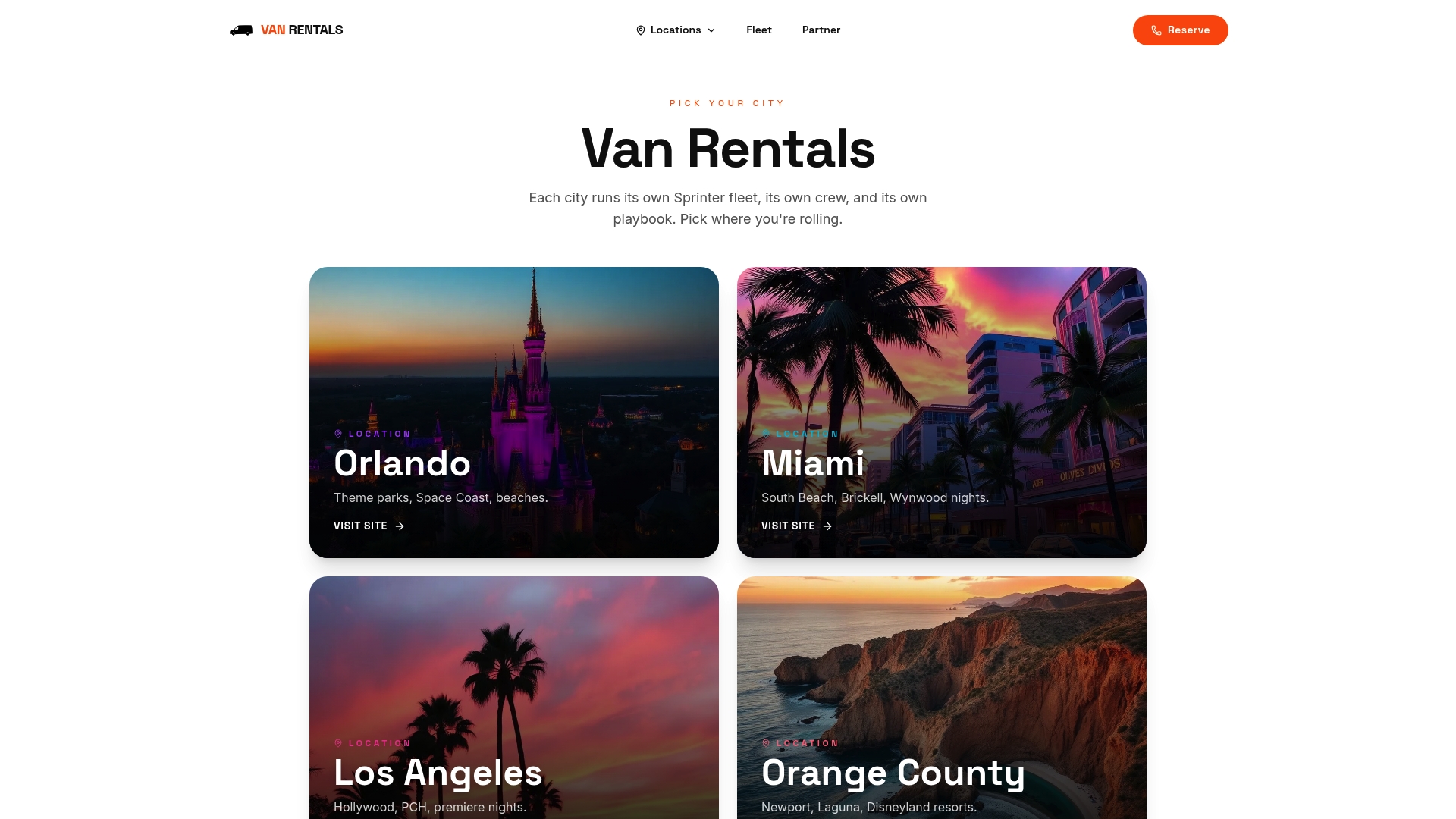
The fleet covers Sprinters, Ford Transits, 12 and 15-passenger vans, and executive options across major U.S. cities including Orlando, Miami, and Los Angeles. Each city is managed by a local team that knows airport procedures, venue access rules, and the fastest routes between hotels and convention centers. You get one transportation coordinator per event, an itemized quote with all fees broken out, and contingency capacity built into the program.
To get started, go to Myvanrentals and submit your event details: dates, venue and hotel addresses, estimated peak-hour headcount, vehicle preferences, and any airport pickup requirements. The team will return an itemized quote you can take to procurement or use to finalize your transport budget.
Key Takeaways
Sizing to peak flow, not total headcount, is the single decision that determines whether your conference transport runs smoothly or creates a bottleneck.
| Point | Details |
|---|---|
| Size to peak flow | Plan vehicle count around the busiest 30–60 minute window, not total attendance. |
| Book with lead time | Large multi-day events need 30–40 days lead time; smaller events can be confirmed within 2–3 weeks. |
| Request itemized quotes | Ask for per-vehicle rates, driver hours, mileage, airport fees, and cancellation terms separately. |
| Verify trust signals | Confirm insurance, DOT/FMCSA compliance, driver background checks, and standby vehicles before signing. |
| Use Myvanrentals | Book city-specific vans with local teams and one coordinator at myvanrentals.com. |
What most planners get wrong about conference transport
The most common mistake is treating conference transport as a headcount problem. Planners count total attendees, divide by van capacity, and book that many vehicles. Then the morning arrival surge hits, and the queue stretches out the hotel lobby.
The second mistake is splitting the work across two or three providers to save money. One vendor handles airport pickups, another runs the venue shuttle, and no one owns the full picture. When a flight is delayed or a hotel changes its pickup window, there is no single person to call. Centralizing into one partner with a single coordinator eliminates that gap.
A detail that gets overlooked: VIP staging. Speakers and executives should never wait in the general shuttle queue. A dedicated vehicle with a named driver, confirmed the night before, is a small cost relative to the impression it makes. Stage that vehicle separately, brief the driver on the VIP’s schedule, and keep the coordinator’s number in the driver’s hand.
The same logic applies to exhibitor load-in. Cargo timing at convention centers is tightly controlled. A van that shows up at the wrong dock window can sit for an hour. Coordinate load-in slots with the venue in advance, and make sure your transport provider knows the dock schedule before the first vehicle rolls.
Useful sources for conference transport planning
These resources support the operational guidance in this article and are useful for deeper research on compliance, routing, and booking best practices.
- FMCSA (Federal Motor Carrier Safety Administration): fmcsa.dot.gov — the primary U.S. authority for commercial passenger carrier licensing, DOT numbers, and driver qualification standards. Use this to verify a provider’s operating authority before signing a contract.
- NHTSA (National Highway Traffic Safety Administration): nhtsa.gov — vehicle safety standards and recall information. Useful for checking fleet safety compliance, particularly for 15-passenger vans.
- Myvanrentals city fleet pages: myvanrentals.com — city-specific van availability, vehicle types, and quote requests for U.S. conference programs.
- Shuttle and group transport operations: seattlecarservices.com/shuttle-services — an operational reference for shuttle scheduling and city-specific routing in major markets.
When evaluating any provider, request proof of insurance and driver screening documentation directly. Prefer vendors with documented local routing experience at your specific venues and airports.
FAQ
How far in advance should you book vans for a conference?
Large multi-day events generally require 30–40 days of lead time; smaller single-venue events can often be confirmed in 2–3 weeks. For peak-city conventions during trade-show seasons, some providers recommend booking 60–90 days ahead to reduce risk of fleet unavailability.
How many vans do you need for a 150-person conference team?
Size to your peak-flow window, not total headcount. For 150 arrivals in 60 minutes using 12-passenger vans with high occupancy and efficient loops, you need multiple vans running simultaneously to clear the surge.
What should an itemized conference transport quote include?
A complete quote covers per-vehicle rates, driver hours, estimated mileage, airport and parking fees, fuel surcharges, cancellation terms, and required deposits. Missing any of these items is a reason to ask for clarification before signing.
Does Myvanrentals handle airport pickups for conference groups?
Yes. Myvanrentals provides airport pickup options with city-specific teams across major U.S. cities. Include flight arrival details and hotel addresses in your quote request to get airport transfer options included in your plan.
What is the biggest risk in conference van planning?
Under-sizing for peak flow and splitting transport across multiple uncoordinated vendors are the two most common failures. Both are solved by sizing to the busiest 60-minute window and booking through a single provider with one assigned transportation coordinator.