The Band Van Guide: Pick, Pack, and Rent Right
The Band Van Guide: Pick, Pack, and Rent Right
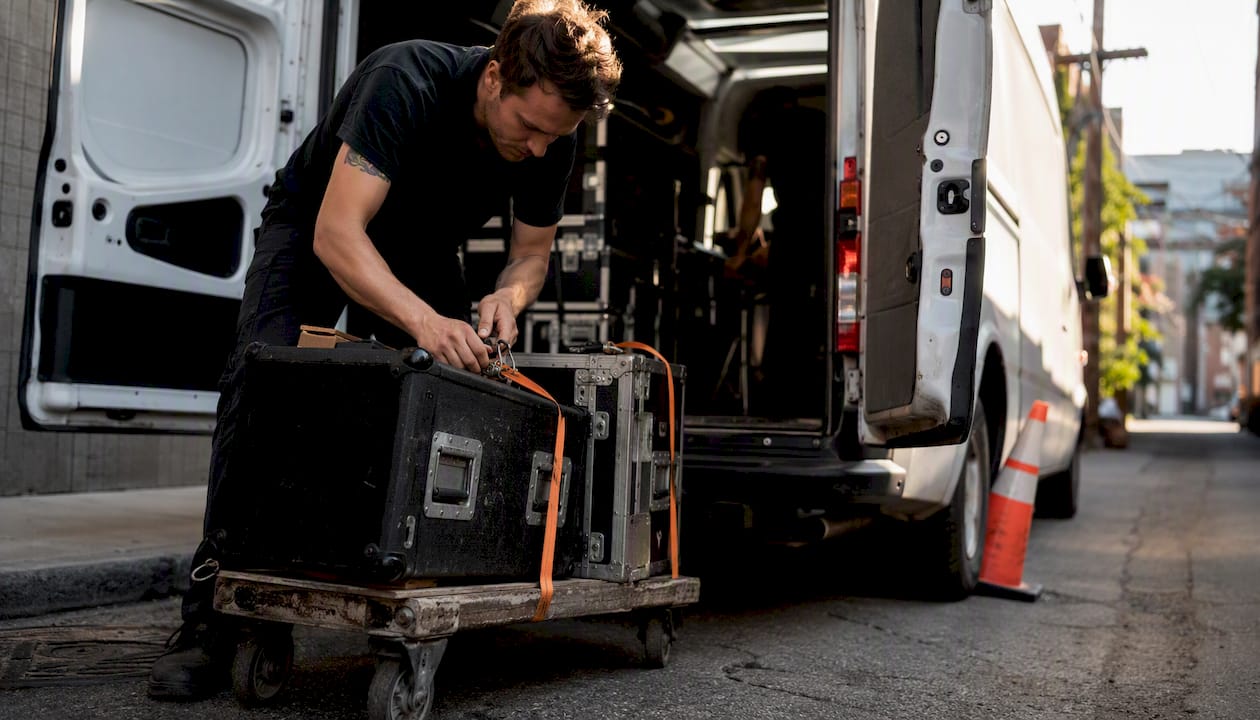
A band van is any passenger or cargo-passenger vehicle configured to move your crew and gear from show to show. For most four- to eight-piece bands, a long-wheelbase cargo-passenger van or Sprinter-style high-roof conversion is the most practical choice. It gives you enough headroom to stand, enough floor space for a full drum kit and amp stacks, and enough seats to keep everyone in one vehicle.
Before you read further, here are three things to do right now:
- Match your van type to your crew size first, then check gear volume second.
- Decide whether to rent or buy based on tour length and how often you tour per year.
- Book at least two to three weeks ahead during summer festival season and holiday weekends.
Myvanrentals operates city-based fleets with Sprinter-style, Transit-style, and 12–15 passenger vans across major U.S. markets, with airport and venue delivery available.
Table of Contents
- What van type fits your band size?
- Van types bands actually use
- What should you expect when renting a band van in the U.S.?
- How to pack and load a touring van
- Pre-trip safety checklist every band should run
- How Myvanrentals supports touring bands
- How do band van rental platforms compare?
- What additional equipment can you rent alongside a band van?
- How do you manage climate control on long drives?
- Parking and loading at venues: what bands need to know
- What insurance do bands need for van transport?
- Key Takeaways
- What touring musicians have learned the hard way
- Book a band-ready van with Myvanrentals
- Useful sources
- FAQ
What van type fits your band size?
Matching the van to your headcount and gear load is the single fastest way to narrow your options. Here is a quick map:
- Duo or trio with light gear: A minivan (Chrysler Pacifica, Honda Odyssey) or a compact SUV like a Honda Element handles two to three players with guitar cases and a small PA. The Element’s fold-flat floor is surprisingly useful for oddly shaped loads.
Daily regional runs vs. multi-week tours: For regional one-nighters, fuel economy matters more. A Transit or ProMaster in a cargo-passenger hybrid configuration keeps costs down. For a three-week run, prioritize comfort and interior height. Sleeping in a Sprinter high-roof is possible; sleeping in a standard-roof Express is not.
Van types bands actually use
Touring musicians consistently point to a short list of van types that work for live touring. Here is what each one offers.
High-roof Sprinter-style vans
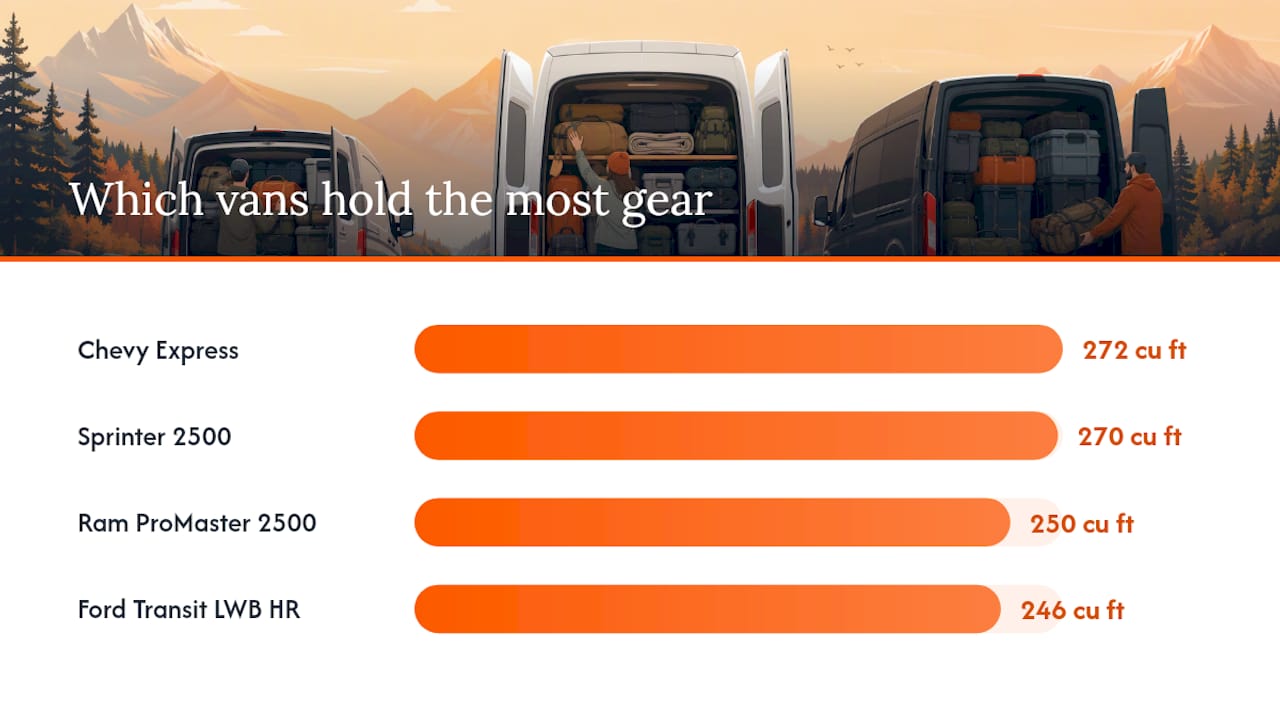
The Mercedes-Benz Sprinter 2500 and its Ford Transit equivalent are the most popular choice for mid-size to larger bands. The Sprinter offers up to 270 cubic feet of cargo volume in its longest configuration, with a payload capacity around 2,500 lbs depending on trim. You can stand upright inside, which matters after a 10-hour drive.
Pros: Maximum cargo volume, standing headroom, configurable seating, strong resale value, widely available for rent. Cons: Higher daily rental rates, harder to park in dense urban venues, diesel variants require DEF fluid management.
Ford Transit long-wheelbase
The Transit 250/350 LWB is the most common band van on U.S. roads right now. It comes in low, medium, and high-roof options, with cargo volumes ranging from roughly 130 to 246 cubic feet. The high-roof extended version competes directly with the Sprinter at a lower price point.
Pros: Widely available parts, lower operating cost than Sprinter, comfortable driver’s seat, good fuel economy for its size. Cons: Medium-roof versions lack standing headroom; extended wheelbase requires practice to park.
Ram ProMaster and ProMaster City
The ProMaster 2500 has a front-wheel-drive layout, which gives it a lower floor height than competitors. That makes loading heavy gear easier. Cargo volume reaches up to 250 cubic feet in the longest configuration.
Pros: Low load floor, wide cargo door opening, front-wheel drive handles well in snow. Cons: Less refined interior than Transit or Sprinter, fewer aftermarket conversion options.
Chevy Express and GMC Savana
The Express and Savana are the workhorses of the 12 and 15 passenger van market. They are rear-wheel drive, easy to service anywhere in the country, and widely available through rental fleets. Cargo volume in the cargo version reaches around 272 cubic feet.
Pros: Extremely common, cheap to maintain, easy to find parts nationwide, familiar to most drivers. Cons: Older platform, less fuel-efficient than Transit or Sprinter, no high-roof option.
Conversion vans
Conversion vans offer configurable interiors with captain’s chairs, fold-out beds, and entertainment systems built in. They have been a long-standing option for bands needing comfort alongside moderate cargo. You trade raw cargo volume for livability.
Minivans and compact SUVs
For duos, trios, and solo performers, a minivan or compact SUV keeps costs low. The Toyota Prius and similar hybrids appear among solo performers and very small acts who prioritize fuel economy over cargo volume. Practical for regional runs; impractical for a full band with a drum kit.
Van type comparison
| Van Type | Seating (max) | Cargo Volume (approx.) | Best For |
|---|---|---|---|
| High-roof Sprinter 2500 | 12–15 (converted) | Up to 270 cu ft | 5–8 piece bands, multi-week tours |
| Ford Transit LWB High-Roof | 12–15 | Up to 246 cu ft | 4–7 piece bands, regional and national |
| Ram ProMaster 2500 | 2–5 (cargo config) | Up to 250 cu ft | Gear-heavy 4–6 piece bands |
| Chevy Express | 12–15 passenger | Up to 272 cu ft (cargo) | Large crews, budget-conscious bands |
| Conversion Van | 6–8 | Moderate | Comfort-first, smaller gear loads |
| Minivan / Compact SUV | 5–8 | — | Duos, trios, solo performers |
Model spec snapshot
| Model | Payload Capacity | Roof Options | Drive Type |
|---|---|---|---|
| Mercedes Sprinter 2500 | ~2,500 lbs | Standard / High | RWD / AWD |
| Ford Transit 350 LWB | — | Low / Med / High | RWD / AWD |
| Ram ProMaster 2500 | — | Standard / High | FWD |
| Chevy Express | — | Standard | RWD |
What should you expect when renting a band van in the U.S.?
Rental policies vary by provider, but most U.S. van rental companies follow a similar structure. Here is what to confirm before you sign anything.
Driver and age requirements:
- Most providers require drivers to be at least 21 years old; some set the minimum at 25 for larger vans.
- Additional drivers typically cost an extra daily fee per person.
- A valid U.S. driver’s license is required; international licenses may need an IDP.
Mileage and fuel:
- Some rentals include unlimited mileage; others cap at 100–150 miles per day with a per-mile overage charge.
- Confirm whether the van must be returned full or whether a fuel purchase option is available.
Insurance options:
- Basic rental agreements include a collision damage waiver (CDW) and liability coverage up to state minimums.
- Supplemental liability insurance (SLI) raises your liability limit.
- Personal effects coverage does NOT typically cover musical instruments or professional equipment. You need a separate policy for gear.
Deposits and holds:
- Expect a credit card hold of $200–$500 on top of the rental cost.
- Debit cards are often not accepted for van rentals.
Before you sign, confirm these items:
- Damage documentation policy (photograph the van before and after).
- Roadside assistance availability and response time.
- Whether touring and gear hauling are permitted uses under the rental agreement.
- Whether city-based support or local fleet teams are available if something goes wrong.
How to pack and load a touring van
Budget-conscious touring musicians have developed reliable packing systems over years of regional and national touring. The loading order matters as much as the gear itself.
Loading order for a four-piece band:
- Load the drum kit first. Bass drum case goes in the back corner, floor tom and rack tom cases stacked on top. This is your heaviest, most awkward item and it anchors everything else.
- Amp heads and speaker cabinets go in next, flush against the drum cases. Stack 4x12 cabs on their sides if ceiling height allows.
- Flight cases and keyboard cases fill the middle layer. These are rigid and stack cleanly.
- Soft bags, merch boxes, and personal luggage go on top and in any remaining gaps.
- Fragile items (laptop bags, pedal boards) ride in the passenger cabin or in a padded case secured to an anchor point.
Roof racks and trailers: A roof rack adds meaningful storage for soft cases and sleeping bags without eating into interior space. For bands with more gear than a single van can hold, a small enclosed trailer is often more cost-effective than upgrading to a larger vehicle.
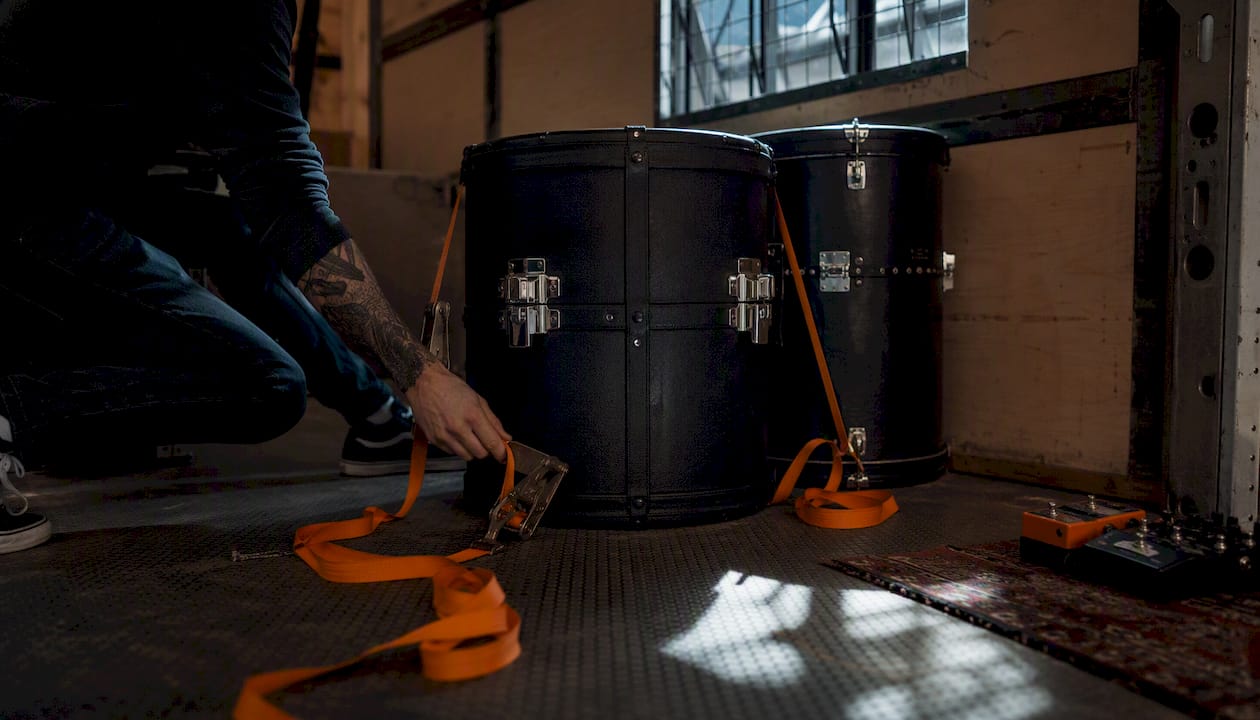
Pro Tip: Use ratchet straps with soft loops at the anchor points to avoid scratching cases. Run one strap across the drum cases and one across the amp stack. Check both every morning before you drive.
Interior layout options depend on your van type. A passenger-forward layout keeps seats in place and uses the rear for gear. A passenger-around-table conversion (common in splitter-style vans) puts a table and facing seats in the middle, with a rear cargo hold. The second layout is more comfortable for long drives but reduces raw cargo volume.
Weight distribution affects handling. Keep heavy items low and centered over the rear axle. Avoid loading all weight to one side.
Pre-trip safety checklist every band should run
A breakdown on tour costs you a show. Run this checklist before every departure.
- Tires: Check pressure on all four tires and the spare. Look for uneven wear, cracks, or embedded objects.
- Brakes: Listen for squealing or grinding during a slow stop in a parking lot. If you hear either, get the van inspected before driving.
- Lights: Walk around the van and confirm headlights, brake lights, turn signals, and reverse lights all work.
- Fluid levels: Check engine oil, coolant, brake fluid, and windshield washer fluid. On a diesel Sprinter, check DEF level.
- Battery: Look for corrosion on terminals. If the van has been sitting, test the battery before a long drive.
- Belts and hoses: Look for cracking or fraying. A snapped serpentine belt will strand you.
- Spare tire and jack: Confirm the spare is inflated and the jack is in the vehicle.
- Load security: Pull on every strap and confirm nothing shifts before you hit the highway.
- Trailer hitch: If towing, confirm the hitch ball is the correct size, the safety chains are crossed and attached, and trailer lights work.
Keep these items on board at all times:
- Basic tool kit (screwdrivers, pliers, adjustable wrench, zip ties, duct tape)
- Jumper cables or a portable jump starter
- First-aid kit
- Tire inflator and sealant (Fix-a-Flat or equivalent)
- Reflective triangles or road flares
- Fire extinguisher (rated for vehicle fires)
- Water and non-perishable snacks for weather delays
For longer tours, schedule an oil change every 5,000–7,500 miles depending on the engine. Document any new scratches or dents with dated photos before and after each rental period.
How Myvanrentals supports touring bands
Myvanrentals operates city-based fleets across major U.S. markets, including Los Angeles, Miami, and Orlando, with Sprinter-style, Transit-style, and 12–15 passenger vans available for short-term and long-term rental.
What the service offers bands:
- Sprinter-style and Ford Transit-style vans with configurable cargo-passenger layouts.
- 12 and 15 passenger vans for larger crews.
- Airport pickup and venue delivery in supported cities.
- Local fleet teams with city-specific knowledge for routing and support.
- Add-on options for extended rentals and custom configurations.
Booking pathway:
- Pick your city on the Myvanrentals site.
- Choose your van configuration (passenger count vs. cargo priority).
- Confirm insurance options and any add-ons.
- Select pickup or delivery to your hotel, airport, or venue.
City-based teams mean you are not calling a national 800 number when something goes wrong. Local support is available in markets like Los Angeles and Seattle, where touring bands frequently need same-day help.
For bands focused on van comfort for long trips, Myvanrentals also provides guidance on interior features that reduce fatigue on multi-day runs.
How do band van rental platforms compare?
The U.S. band van rental market splits into three broad categories: national general-purpose rental companies, peer-to-peer van-sharing platforms, and specialist group van rental services.
National general-purpose rental companies carry large fleets of passenger vans and cargo vans. They are widely available and easy to book, but their policies often restrict commercial use, gear hauling, and touring. Customer reviews for these providers frequently cite mileage caps and damage dispute processes as friction points for touring musicians.
Peer-to-peer platforms let private owners rent their vans directly to bands. Pricing can be lower, and some owners have already converted their vans for touring use. The tradeoff is inconsistency: vehicle condition, insurance coverage, and support vary significantly from listing to listing.
Specialist group van rental services like Myvanrentals focus on group travel and offer passenger-configured and cargo-passenger hybrid vans with local support teams. For bands, this category offers the most predictable experience: known vehicle types, clear insurance options, and city-based assistance. Service areas are concentrated in major U.S. touring markets, which aligns well with most regional and national tour routing.
When reading band van reviews, look specifically for comments on mileage policy, damage claim handling, and whether the provider allowed gear hauling under the rental agreement. Those three factors separate a smooth tour from a costly dispute.
What additional equipment can you rent alongside a band van?
Renting a van covers transportation. It does not cover everything you need at the venue. Several categories of additional rental equipment are worth knowing about.
Stage and production gear: Many cities have production rental houses that offer PA systems, monitor wedges, lighting rigs, and backline equipment (amplifiers, drum kits) by the day or week. Renting backline locally is common on national tours where flying in is not practical and driving a full rig cross-country adds wear.
Cargo and loading equipment: For larger venues or festival load-ins, a hand truck or appliance dolly is worth renting or buying outright. Some venues provide forklifts for stage-level loading, but you cannot count on it. A folding utility cart handles most load-in situations and fits in the back of a Sprinter.
Climate and comfort add-ons: Portable coolers, 12V refrigerators, and battery-powered fans are available through camping and outdoor rental companies. These are practical for long drives in summer heat, particularly in the South and Southwest.
Power and connectivity: A portable power station (Jackery, EcoFlow, or similar) lets you charge phones, laptops, and pedal boards without running the engine. Some specialist van conversions include shore power hookups for overnight stops.
How do you manage climate control on long drives?
Heat and cold inside a van affect focus, mood, and physical condition. On a 10-hour drive, poor climate management is a real problem.
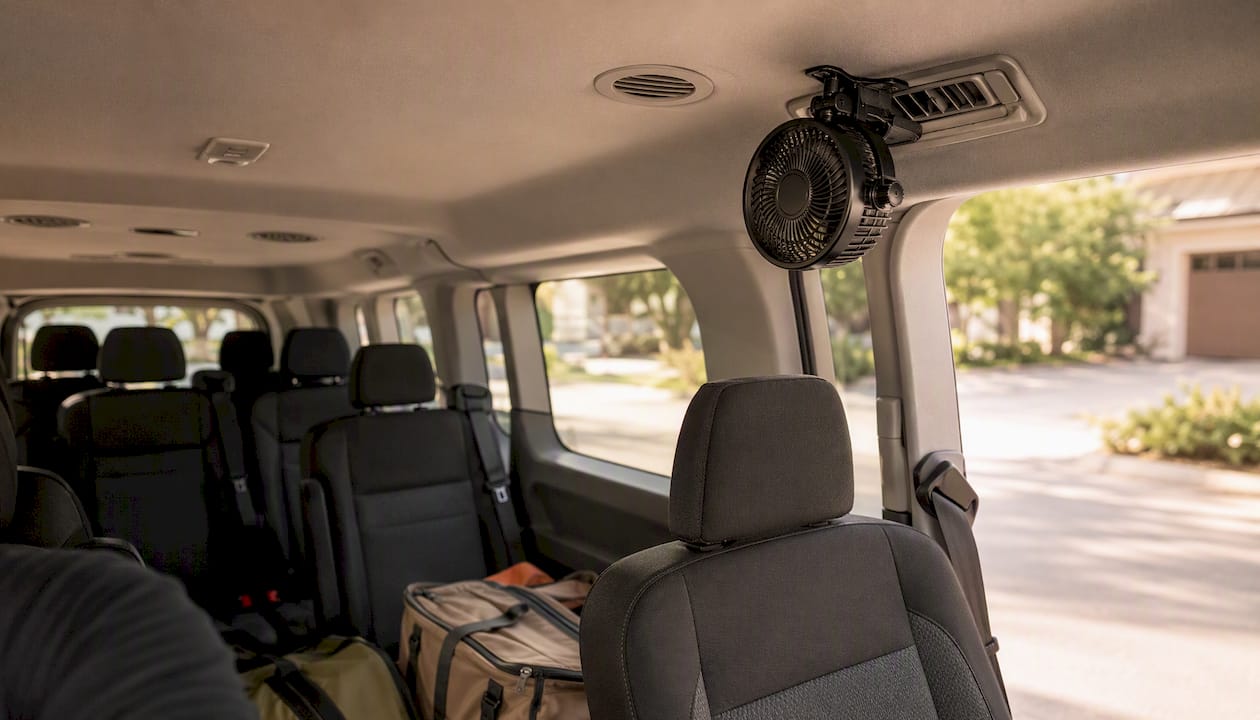
The factory HVAC in most full-size vans is adequate for the front two rows. Rear passengers in a 12 or 15 passenger van often get significantly less airflow. If your van has rear climate controls, use them. If it does not, a small 12V fan mounted near the rear ceiling improves circulation noticeably.
In summer, park in shade whenever possible and crack windows during stops. A reflective windshield shade keeps the interior 20–30 degrees cooler during a 30-minute load-in. In winter, give the van 10 minutes to warm up before loading gear. Cold temperatures affect battery-powered equipment and can crack older cases.
Ventilation matters for air quality too. Six people in a sealed van for eight hours produces significant humidity. Crack a window slightly even in cold weather to prevent fogging and reduce fatigue. Some Sprinter and Transit conversions include roof vents or fans specifically for this reason.
Parking and loading at venues: what bands need to know
Load-in logistics vary widely by venue type, city, and time of day. Getting this wrong costs you time and sometimes money.
Call the venue before you arrive. Ask specifically: Where is the load-in entrance? Is there a loading dock? Is there a time window for load-in? Is there parking for a full-size van or trailer? Many venues in dense urban areas have 15-minute load-in zones that are strictly enforced.
Parking permits and restrictions: In cities like New York, Chicago, and San Francisco, parking a 15-passenger van near a venue requires either a loading zone permit or a very short window. Some venues can provide a temporary parking pass. Others cannot. Plan to drop gear at the door and then move the van to a paid lot.
Loading zones: Most cities allow commercial loading in marked zones for 15–30 minutes. A full-size van qualifies. Do not park in a fire lane, even briefly. The fine is significant and towing a loaded van is a serious disruption.
Overnight parking: If you plan to sleep in the van, research the city’s overnight parking rules before you arrive. Many cities prohibit sleeping in vehicles, and enforcement varies. Truck stops, Walmart parking lots (where permitted), and campgrounds near tour routes are common alternatives.
What insurance do bands need for van transport?
Standard rental insurance does not cover your gear. This is the most common and costly mistake touring musicians make.
Collision Damage Waiver (CDW): Covers damage to the rental vehicle itself. Does not cover your equipment, other vehicles, or personal injury beyond state minimums.
Supplemental Liability Insurance (SLI): Raises your liability coverage above the state minimum. Worth adding if you are driving a 12 or 15 passenger van, where an accident can involve multiple people.
Personal effects coverage: Covers personal belongings inside the vehicle. Musical instruments and professional equipment are usually excluded or capped at a low dollar amount. Read the policy carefully.
Inland marine insurance (equipment floater): This is the correct policy for touring musicians. It covers instruments, amplifiers, PA equipment, and other gear during transport, at venues, and in storage. Policies are available through specialty insurers and through organizations like the American Federation of Musicians. Coverage is typically based on a scheduled list of items with appraised values.
Renter’s or homeowner’s policy riders: Some personal policies extend to equipment away from home, but coverage limits are often too low for a full band’s gear. Confirm the limit and whether “professional use” is excluded.
Get gear coverage in place before the first show. A stolen amp or a damaged drum kit mid-tour is not a recoverable situation without it.
Key Takeaways
Choosing the right band van comes down to crew size, gear volume, and tour length. Rent from a specialist group fleet with local support, and always carry separate gear insurance.
| Point | Details |
|---|---|
| Match van to crew and gear | Measure your gear in cubic feet before booking; a four-to-eight piece band typically needs a long-wheelbase high-roof van. |
| Rent vs. buy decision | Rent for tours under 30 days per year; buying makes sense only when annual mileage and frequency justify the ownership cost. |
| Gear insurance is separate | Rental CDW does not cover instruments; get an inland marine (equipment floater) policy before the first show. |
| Book early for peak season | Reserve two to three weeks ahead during summer festival season and holiday weekends to secure the right van type. |
| Myvanrentals for U.S. tours | Myvanrentals offers Sprinter-style, Transit-style, and 12–15 passenger vans with city-based teams and venue delivery across major U.S. markets. |
What touring musicians have learned the hard way
Most bands underestimate how much the van shapes the tour. Paste Magazine’s profiles of touring bands show that musicians consistently describe their van as both home and chariot. That framing is not sentimental. It is practical. When you spend 10 hours a day in a vehicle, the difference between a van with legroom and one without is the difference between arriving ready to play and arriving exhausted.
Comfort is not a luxury upgrade. It is a performance variable. A band that sleeps poorly and sits cramped for three weeks plays worse, argues more, and makes worse decisions about routing, food, and rest stops. The van configuration you choose at the start of a tour sets the baseline for everything that follows.
Secure gear is the other lesson that comes up repeatedly. Gear that shifts during driving damages itself and creates noise that makes long drives worse. Double-check tie-downs every morning. It takes 90 seconds and it prevents a $500 repair.
One more thing veteran touring musicians mention: choose a van you can get serviced anywhere. A Chevy Express or Ford Transit can be worked on at almost any shop in the country. A specialty conversion with proprietary parts cannot. Maintainability is a real factor on a six-week tour through rural markets.
Book a band-ready van with Myvanrentals
Myvanrentals gives touring bands a faster path to the right vehicle. Instead of sorting through general-purpose rental inventory, you get a fleet built for group travel, with Sprinter-style, Transit-style, and 12–15 passenger vans available across major U.S. tour markets. City-based teams handle delivery to your airport or venue, and local support is available when you need it.
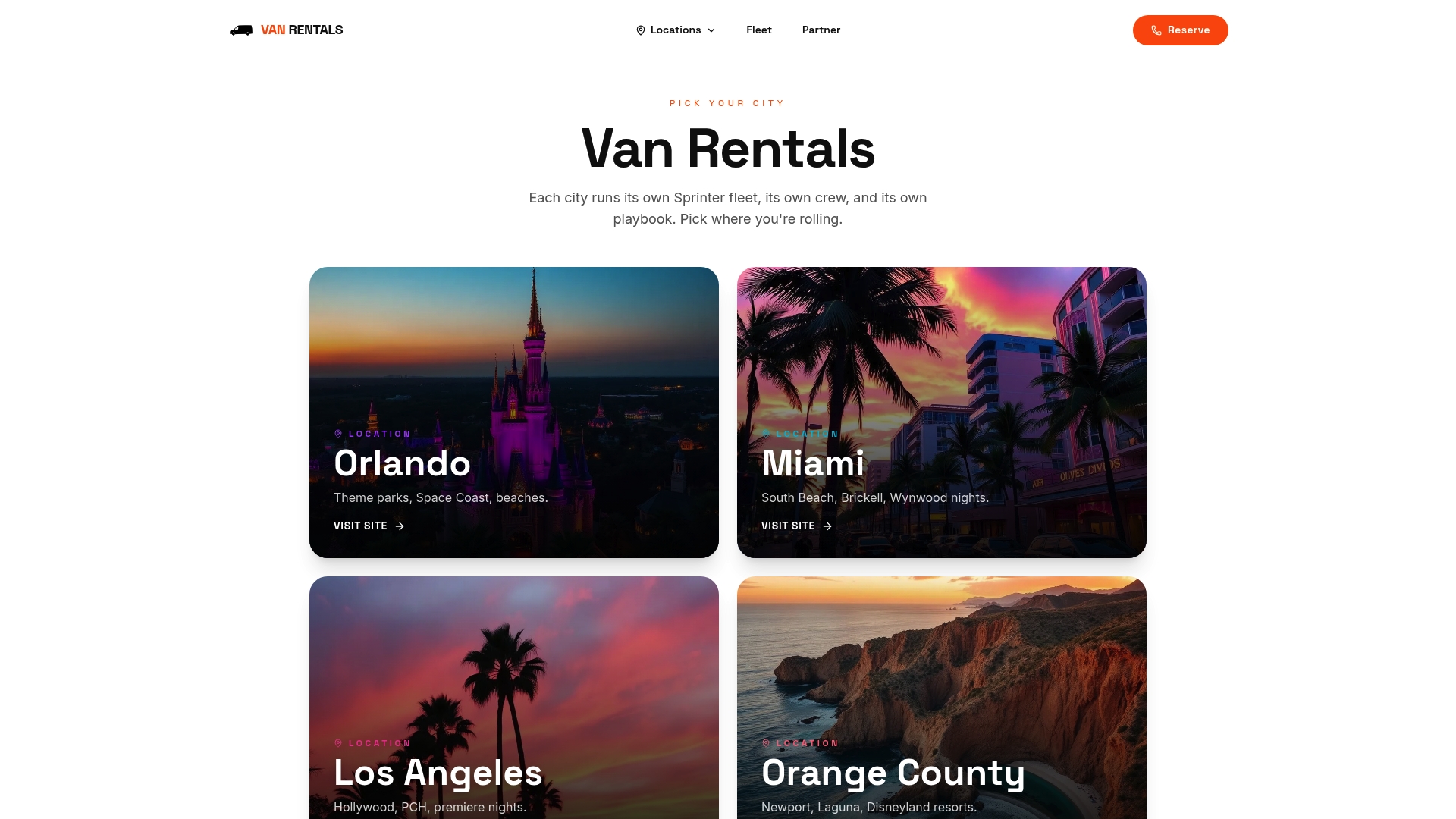
Pick your city, choose your configuration, and confirm your insurance and add-ons in one booking flow. No long-term contract, no fleet minimum. Check availability and reserve your van for your next tour dates now.
Useful sources
- Nine Bands Show Off Their Tour Vans
- The Best Vehicles to Tour in for Bands on a Budget – Soundfly
- The Best Vehicles to Tour in for Bands on a Budget – Soundfly
- Conversion van — Wikipedia
- Honda Element — Wikipedia
- Toyota Prius — Wikipedia
- Van Rentals — Pick Your City
FAQ
What vans do bands typically use on tour?
Most touring bands use a Ford Transit, Mercedes-Benz Sprinter, Ram ProMaster, or Chevy Express, depending on crew size and gear volume. The Transit and Sprinter are the most common choices for four-to-eight piece bands because of their cargo volume and high-roof options.
Do you need a CDL to drive a 15-passenger van?
In most U.S. states, a standard driver’s license covers 15-passenger vans used for non-commercial purposes. Some states have additional requirements for vans used in paid transportation, so confirm the rules for each state on your tour route.
Where can I rent a 12 or 15 passenger van for a band tour?
Myvanrentals offers 12 and 15 passenger vans with city-based fleets in major U.S. markets, including Los Angeles, Miami, and Orlando, with airport and venue delivery available.
What is the difference between a cargo van and a passenger van for bands?
A cargo van maximizes floor space for gear but has no rear seating. A passenger van seats 12–15 but leaves little room for equipment. Most touring bands use a cargo-passenger hybrid, which keeps a few rear seats while opening the back for gear.
Does rental insurance cover musical instruments in a van?
Standard rental collision damage waivers cover the vehicle, not your gear. Musical instruments and professional equipment require a separate inland marine (equipment floater) policy to be covered during transport and at venues.