Credit Card Hold on a Rental Car: What Renters Need to Know

Credit Card Hold on a Rental Car: What Renters Need to Know
A car-rental authorization hold temporarily reserves funds on your card. It is not a posted charge, but it reduces your available credit or freezes bank cash until the agency releases it. Expect the hold to cover your quoted rental total plus an incidental buffer, commonly a few hundred dollars on top of the base rate. That buffer exists because the final bill is unknown at pickup: fuel, tolls, damage, and late fees can all change the total.
Using a credit card is the safer choice. Under the Fair Credit Billing Act, credit cardholders have stronger dispute protections than debit users, and a hold on credit reduces available credit rather than freezing real cash. Myvanrentals provides localized booking pages so you can confirm pickup-location hold policies before you arrive.
Key Takeaways
Every U.S. rental agency places a credit card hold at pickup that covers the quoted rental total plus an incidental buffer, commonly a few hundred dollars, and the hold reduces your available credit or freezes cash until the agency releases it.
| Point | Details |
|---|---|
| Expected hold range | Budget quoted rental total + $200–$500 incidental buffer; premium vehicles and debit cards often require more. |
| Credit over debit | Credit card holds reduce available credit, not cash, and carry stronger dispute rights under the Fair Credit Billing Act. |
| Ask for it in writing | Request the exact authorization amount from the counter agent before signing the rental agreement. |
| Get the final receipt | Confirm the agent posts final settlement at return; keep a copy as proof if the hold lingers. |
| Track release timing | Credit holds typically clear within 10 business days; debit holds can take up to 15 business days after final settlement. |
| Myvanrentals | Myvanrentals provides localized city pages where you can confirm pickup-location hold policies and book with clear deposit expectations. |
Table of Contents
- How a credit card hold on a rental car actually works
- Typical hold amounts and what changes them
- How major U.S. rental agencies typically apply holds
- How holds affect your available credit and billing timeline
- What you need to know about renting with a debit card
- How to keep your hold as small as possible
- What to do if the hold isn’t released after you return the car
- Do Avis, Hertz, and Budget all place holds?
- What renters consistently get wrong about holds
- Myvanrentals makes group van rental deposits straightforward
- Sources
- FAQ
How a credit card hold on a rental car actually works
An authorization hold and a charge are two different things. A charge posts to your account and money moves. A hold is a temporary reservation: the merchant asks your card network to earmark funds, and your issuer sets them aside. No money leaves your account yet.
Rental agencies use holds because the final amount is unknown at pickup. Fuel, tolls, damage assessments, and loss-of-use fees can all add to the total. The hold guarantees the agency’s financial exposure until settlement. Once you return the car and the agency posts the final charge, the hold converts to that charge. If the final amount is lower, the agency sends a release for the difference.
The bank treats the hold as “pending.” The merchant must either post a final transaction or send a release to remove it, as explained in this Hourly Chauffeur Service: A Practical Travel Guide. That two-step process is why holds sometimes linger even after you’ve returned the vehicle.
Pro Tip: Ask the counter agent for the exact authorization amount in writing at pickup. A text or email confirmation takes 30 seconds and gives you a clear reference if the hold looks wrong on your statement later.
Typical hold amounts and what changes them
The working rule of thumb: quoted rental total + incidental buffer + any unprepaid counter add-ons. The incidental buffer commonly runs $200–$500, but several factors push it higher or lower.
Factors that affect the hold size:
- Vehicle class. Compact and mid-size vehicles typically carry smaller buffers. Premium SUVs and luxury vans often require larger holds.
- Payment type. Debit cards usually trigger larger holds and stricter requirements than credit cards.
- Location. Airport locations tend to apply stricter holds than neighborhood branches.
- Seasonal demand. Peak travel periods can mean higher incidental buffers at some locations.
- Prepaid add-ons. Paying for GPS, child seats, or fuel plans online before pickup can reduce the counter hold.
- Proof of alternate insurance. Showing your own auto policy or a card benefit that covers collision may reduce the damage-related portion of the hold at some agencies.
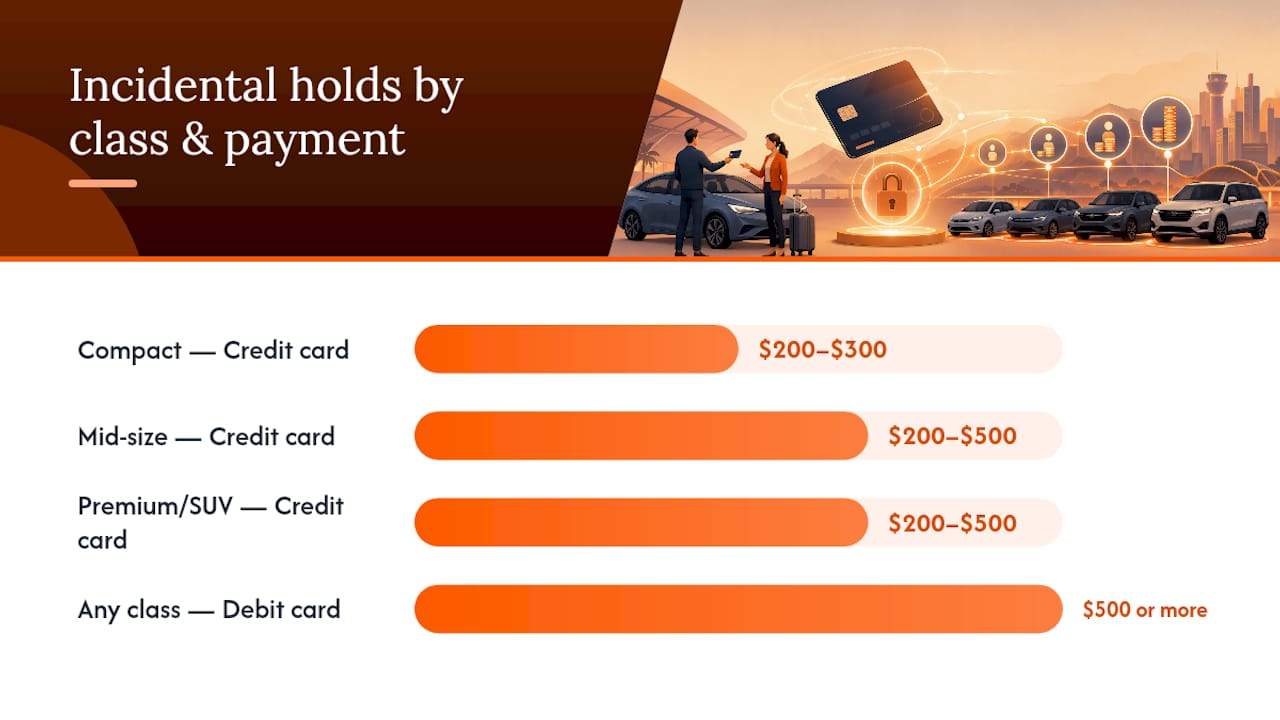
The table below shows example hold scenarios using generic vehicle classes and sourced ranges:
| Vehicle class | Payment type | Typical incidental buffer | Notes |
|---|---|---|---|
| Compact | Credit card | $200–$300 | Lower risk class, standard buffer |
| Mid-size | Credit card | $200–$500 | Most common rental category |
| Premium/SUV | Credit card | $200–$500 | Higher exposure, larger buffer |
| Any class | Debit card | $500 or more | Extra ID and itinerary often required |
Check the van rental add-on costs guide to see how counter extras like GPS and fuel plans affect your out-the-door total.
How major U.S. rental agencies typically apply holds
Every major U.S. rental agency places a credit card hold. The practice is universal. What varies is the buffer amount, the debit-card rules, and how airport locations differ from off-airport branches.
Common patterns across the market:
- Fixed incidental buffers. Most agencies add a set buffer ($200–$500) on top of the quoted rental total. The exact figure depends on the location and vehicle class.
- Higher debit-card holds. Agencies that accept debit cards at all typically require larger holds, extra government-issued ID, and sometimes proof of a return travel itinerary.
- Airport vs. off-airport. Airport locations operate under stricter policies. Off-airport branches sometimes offer more flexibility on hold amounts.
- Counter discretion. The hold you see at pickup can differ from the online quote because agents add counter add-ons, account for card type changes, or apply location-specific rules.
Three agencies renters frequently ask about:
Avis places an authorization hold at pickup that covers the estimated rental charges plus an incidental buffer. Avis’s published payment policy confirms that the hold amount varies by location and vehicle. Debit-card acceptance at Avis is location-specific.
Hertz applies a hold that typically includes the rental total and an additional incidental amount. Hertz’s policy page notes that the hold can be $200 or more above the estimated rental cost, and debit-card rentals require a credit check at many locations.
Budget follows a similar structure. Budget’s payment FAQ states that an authorization is placed at the time of rental and that the amount includes the rental estimate plus an incidental buffer. Budget also restricts debit-card use at certain airport locations.
For any location, call ahead or check the agency’s payment page for your specific pickup branch. Counter policies can differ from the national FAQ.
How holds affect your available credit and billing timeline
The moment the agency runs the authorization, your available credit drops by the hold amount. If your card has a $2,000 limit and the hold is $800, you have $1,200 to spend until the hold clears. That reduction is real and immediate, even though no money has moved.

For debit cards, the effect is sharper: the hold freezes actual cash in your checking account. A $600 hold on a debit card with a $900 balance leaves you $300 to cover other expenses during the rental period.
Credit utilization note. A large hold can temporarily raise your credit utilization ratio. If you’re close to a billing cycle or planning a major purchase, time your rental accordingly.
Release windows:
- Credit card holds often clear within 24–72 hours after the final charge posts, but banks may take up to 10 business days depending on the issuer.
- Debit holds commonly take 5–15 business days to release after final settlement.
On your statement, the hold appears as “pending.” Once the agency posts the final charge, the pending hold converts and the difference (if any) drops off. Rewards points typically post after the final charge settles, not when the hold is placed.
Pro Tip: Keep a screenshot of your statement showing the pending hold and the final posted charge. If the hold doesn’t clear within 10 business days on a credit card or 15 on a debit card, you have clear documentation to show your issuer.
What you need to know about renting with a debit card
Debit cards freeze real cash, not a credit line. That distinction matters when you’re budgeting for a trip. A $500 hold on a debit card is $500 you cannot spend on gas, food, or emergencies until the agency releases it.
Beyond the cash freeze, debit-card rentals often come with extra requirements. Many U.S. agencies require additional government-issued ID, proof of a return travel itinerary, and holds of $500 or more at specific locations. Some agencies refuse debit cards entirely for premium vehicle categories or at airport locations.
Prepaid cards and non-reloadable gift cards are not accepted at most major rental counters. They carry no dispute protections and cannot hold a variable authorization.
Practical alternatives if you prefer not to use a credit card:
- Bring a backup credit card dedicated to the rental hold.
- Use a debit card linked to an account with a comfortable buffer above the expected hold.
- Show proof of personal auto insurance or a card benefit that covers collision to reduce the damage portion of the hold.
Using a debit card for a rental is not impossible, but it requires more planning than a credit card. Confirm the specific location’s debit policy by phone before you arrive. Some branches that accept debit on their website have tighter rules in practice at the counter.
How to keep your hold as small as possible
Small steps before, during, and after the rental can reduce both the size and the duration of the hold.
Before pickup:
- Use a credit card with a limit well above the expected hold (quoted total + $500 buffer is a safe minimum).
- Prepay add-ons online when the agency offers it. Fuel plans, GPS, and child seats paid in advance reduce the counter authorization.
- Call the pickup location directly to confirm the exact hold amount for your vehicle class and payment type.
- Bring a second backup card in case the primary card is declined or the hold exceeds your available credit.
- Review your existing auto insurance and any credit card travel benefits. Documented alternate coverage can reduce the damage-related buffer at some agencies.
At the counter:
- Ask the agent for the exact authorization amount before signing. Request it in writing or by email.
- Decline add-ons you don’t need. Each counter add-on increases the hold.
- Get a signed or emailed copy of the rental agreement showing the authorization amount.
At return:
- Take photos of the vehicle at return, including the odometer and fuel gauge.
- Confirm the agent has posted the final settlement before you leave the lot.
- Note the agent’s name and the return timestamp.
Pro Tip: Dedicate one high-limit credit card exclusively to rentals. Keeping it separate from your everyday spending card isolates the utilization impact and makes it easier to track the hold and final charge on your statement.
The family van rental budget checklist walks through a full pre-trip financial checklist, including how to account for holds when planning group travel.
What to do if the hold isn’t released after you return the car
Most holds clear on their own within the standard windows. When they don’t, follow these steps in order.
Step 1: Confirm the agency posted the final invoice. Contact the rental agency and ask for written confirmation that the final charge has been posted and the authorization released. Get the agent’s name and the confirmation in writing.
Step 2: Contact your card issuer. Call the number on the back of your card. Tell them the rental has been returned, the final charge has posted, and the hold is still showing as pending. Provide the authorization number, the return date, and the agency’s written confirmation. The issuer can work with the merchant acquirer to accelerate the release.
Step 3: Know your escalation windows. Credit card holds that haven’t cleared within 5–7 business days after final settlement warrant a call to your issuer. Debit holds can take up to 14 business days. If the hold remains after those windows, escalate to a formal dispute.
Step 4: File a dispute if needed. Credit cardholders can dispute an incorrect or unreleased hold under the Fair Credit Billing Act. Debit cardholders have narrower protections. This is one of the clearest practical reasons to use a credit card for rentals.
What to include in your dispute: the rental agreement number, the return date and time, the agent’s name, the final invoice showing the posted charge, and any written confirmation from the agency that the hold was released. The more documentation you provide, the faster the issuer can act.
Escalation checklist:
- Written confirmation of final settlement from the agency
- Authorization number and hold amount
- Return date, time, and agent name
- Photos of the vehicle at return
- Copy of the final posted charge on your statement
Do Avis, Hertz, and Budget all place holds?
Yes. Avis, Hertz, and Budget all place authorization holds at pickup. This is standard practice across the U.S. rental industry, not a policy unique to any one company.
Avis holds cover the estimated rental charges plus an incidental buffer. The exact amount varies by location and vehicle class, and Avis’s payment policy page confirms that debit-card acceptance is location-specific.
Hertz typically holds the rental total plus $200 or more as an incidental buffer. At many Hertz locations, debit-card rentals require a credit check. The Hertz terms and conditions page outlines the general framework, but branch-level policies can differ.
Budget applies an authorization at the time of rental that includes the estimated charges and an incidental buffer. Budget restricts debit-card use at certain airport locations, and the Budget payment FAQ notes that the hold amount is location-dependent.
The consistent takeaway: call the specific pickup branch before you arrive. National FAQ pages describe general policy. The counter agent applies local rules.
What renters consistently get wrong about holds
The most common mistake is treating the quoted rental price as the only amount the card needs to cover. Renters show up with a card that has exactly $350 available, the quoted rate is $320, and the agency places an $800 authorization. The card declines. The trip stalls.
The second mistake is assuming the hold disappears the moment you hand back the keys. It doesn’t. The agency posts the final charge, the bank processes it, and the pending hold clears on its own schedule. That schedule is the bank’s, not the agency’s. Calling the agency won’t speed it up once the final charge is posted. Calling your card issuer will.
My recommendation: treat every rental as a two-amount transaction. The first is the rate you agreed to. The second is the buffer the agency needs to cover unknowns. Add them together, confirm the total with the pickup location before you arrive, and make sure your card has room for both. That single habit eliminates most of the surprises renters run into at the counter.
For group van rentals, where the base rate is already higher, this planning step is even more important. Myvanrentals’ city pages let you check local policies and expected costs before you book, so there are no surprises at pickup.
Myvanrentals makes group van rental deposits straightforward
Group rentals carry higher base rates, which means the authorization hold is larger by default. Myvanrentals addresses that directly: city-specific teams in Orlando, Miami, Los Angeles, and other major U.S. cities provide localized guidance on pickup policies, expected hold amounts, and add-on costs before you confirm your booking.

You get a 12-passenger, 15-passenger, Sprinter, or Ford Transit van matched to your group size, delivered to your hotel or venue, with no guesswork about what the counter will ask for. Check your city, confirm the deposit expectations, and reserve your van at Myvanrentals.
This article is general information, not a substitute for advice from a qualified financial advisor. Consult a qualified financial professional about your own circumstances before acting on anything here.
Sources
- Rental Car Security Deposit: Amounts, Holds, and Refunds - LegalClarity
- What Is a Credit Card Hold? And How Does It Work? | SoFi
- Rental Car Credit Card Authorization Holds: What You Should Know
- Rental Car Deposit Calculator: Estimate Holds in 2026
FAQ
Do all rental car companies put a hold on your credit card?
Yes. Every major U.S. rental agency places an authorization hold at pickup. The amount varies by company, location, vehicle class, and payment type, but the hold itself is universal.
Does Avis put a $200 hold on credit cards?
Avis places a hold covering the estimated rental charges plus an incidental buffer. The exact amount depends on the pickup location and vehicle class. Avis’s payment policy page is the authoritative source for your specific branch.
Can I rent a car in the USA without a credit card?
Some agencies accept debit cards, but with stricter requirements: larger holds (often $500 or more), extra ID, and sometimes proof of a return itinerary. Prepaid and non-reloadable gift cards are not accepted at most major counters.
What is the $200 hold on Hertz rental cars?
Hertz typically holds the rental total plus an incidental buffer that can be $200 or more above the estimated cost. The exact figure is location-dependent. Debit-card rentals at many Hertz locations also require a credit check. Check the specific branch’s payment policy before pickup.