Van Rental Add-On Costs: Estimate Your Out-the-Door Price

Van Rental Add-On Costs: Estimate Your Out-the-Door Price
Van rental add-on costs are any line items added to the base daily or weekly rate, covering both optional extras and mandatory fees you cannot skip. The final bill typically includes insurance or damage waivers, mileage overages, fuel charges, surcharges, equipment rentals, one-way fees, and a security deposit hold. Together, these extras matter more than the headline rate. Industry analysis shows the out-the-door price commonly runs roughly double the advertised base rate once mandatory surcharges, realistic mileage, and protection are counted.
The biggest contributors to a higher-than-expected invoice are:
- Mileage overages: per-mile charges that accumulate fast on longer trips
- Fuel refill penalties: providers can charge up to $8.00 per gallon plus a service fee when you return the van less than full
- Collision/damage waivers: daily protection fees that add up across a multi-day rental
- One-way or drop-off fees: route-dependent charges that can reach several hundred dollars
The right approach is to build a full van rental fees breakdown before you book, not after you return the keys.
Table of Contents
- What are the common van rental add-ons and what do they cost?
- What mandatory surcharges appear on every van rental invoice?
- How are van rental add-ons billed, and when do charges actually post?
- How do you calculate an accurate out-the-door van rental estimate?
- How can you reduce van rental add-on costs before and at pickup?
- What questions should you ask before confirming a van rental?
- Key Takeaways
- Transparent pricing matters more than a low headline rate
- Get a clear, itemized quote with Myvanrentals
- Useful sources
- FAQ
What are the common van rental add-ons and what do they cost?
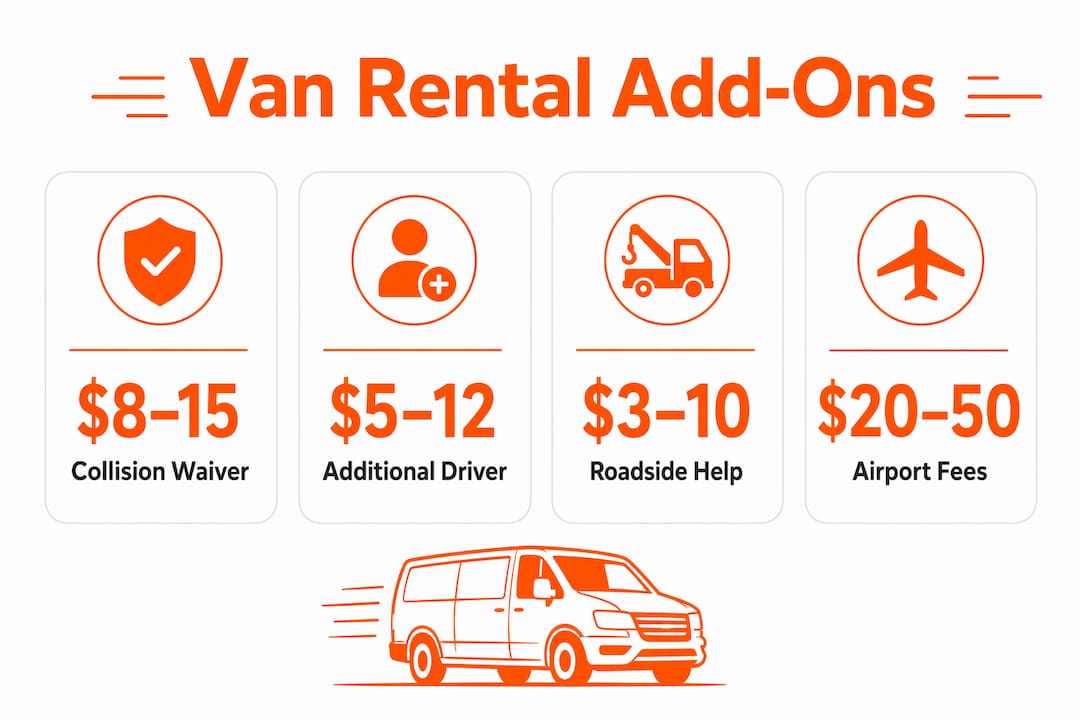
Most add-ons fall into one of three billing formats: charged per day, charged as a flat fee per rental, or charged based on usage (per mile, per gallon, or per incident). The table below covers the items you are most likely to see on a U.S. invoice.

| Add-On | Billing Format | Typical U.S. Range |
|---|---|---|
| Collision/Damage Waiver (CDW/LDW) | Per day | $8–$60/day |
| Supplemental liability insurance | Per day | $10–$20/day |
| Roadside assistance | Per day or flat | $5–$15/day |
| Additional driver fee | Per day or flat | $5–$15/day |
| Young driver surcharge | Per day | $15–$35/day |
| GPS/navigation unit | Per day | $10–$20/day |
| Child safety seat | Per day | $10–$15/day |
| Cargo dolly or hand truck | Flat per rental | $10–$20 |
| Furniture pads/blankets | Flat per rental | $10–$20 |
| Lift gate or ramp service | Flat per rental | $20–$50 |
Base daily rates for cargo vans typically run $30–$60 per day in non-peak periods. Urban markets and summer demand can push that figure higher. Add even a modest set of extras from the table above and the daily cost climbs quickly.
Mileage is its own category. Local rentals usually include a daily allowance and then charge per-mile overages at a moderate rate beyond that cap. Some long-distance one-way rentals bundle unlimited miles into the quoted price, so always confirm which policy applies to your specific booking. For group trips where you are comparing vehicle sizes, affordable passenger van options can sometimes reduce per-trip mileage costs by eliminating repeat runs.
What mandatory surcharges appear on every van rental invoice?
Beyond the optional add-ons you choose, several fees are non-negotiable. They show up regardless of what coverage or equipment you select.
- Environmental fee: typically $1–$10 per day, varies by provider and state
- Vehicle license recovery fee: covers registration and fleet licensing costs, often $1–$5 per day
- Airport concession fee: charged when you pick up at an airport location, commonly 10%–15% of the subtotal
- State and local taxes: rates vary widely by state; combined rental-vehicle taxes in some states exceed 20% of the pre-tax total
- Facility/service fee: some locations add a flat facility charge of $2–$5 per day
- Cleaning fee: applied if the van is returned in poor condition, typically $50–$250 depending on severity
- Late-return fee: usually one additional full day’s rate per hour or partial day over the agreed return time
Airport pickup locations consistently carry higher fees than off-airport sites. The concession fee alone can add a meaningful amount to a multi-day rental. If you have flexibility on pickup location, an off-airport site in the same city often saves money on this line item alone. State tax rules also differ significantly; California, Texas, and Florida each apply their own rental vehicle tax structures on top of local rates.
Before booking, search the provider’s fee schedule for your specific pickup ZIP code. Many providers list location-specific surcharges in the reservation summary before you confirm.
How are van rental add-ons billed, and when do charges actually post?
Understanding billing timing prevents surprises on your bank statement.
Three billing models cover most add-ons. Daily fees (CDW, roadside assistance, additional driver) multiply by the number of rental days and are calculated at checkout. Flat per-rental fees (cargo dolly, furniture pads, lift gate) are charged once regardless of trip length. Usage-based charges (per-mile overages, fuel service fees, per-incident damage) post after return, sometimes days later, once the provider processes the vehicle inspection.

Deposits and credit card holds work differently from actual charges. At pickup, the provider places an authorization hold on your card, typically $150–$500 for a standard van, though some providers hold more for one-way or long-distance rentals. That hold is not a charge; it is a reserved amount that reduces your available credit. The hold is released after return and final inspection, which can take 3–7 business days depending on your bank. If damage is found, the hold converts to a charge.
Timing risks to watch for:
- After-hours returns can trigger a surcharge if the lot is unstaffed and the return is logged the next business day
- Fuel service fees often post as a separate transaction 24–48 hours after return
- Toll charges collected via the provider’s transponder system may post weeks later
Keep your rental agreement and any receipts from the return. If a charge appears that you do not recognize, a documented return receipt is your clearest basis for a dispute. For more on how location and timing affect your total, the van rental pricing guide covers seasonal and city-specific factors in detail.
How do you calculate an accurate out-the-door van rental estimate?
Use this formula as your starting point:
Total estimate = base rental + mileage overage + fuel + insurance/protection + equipment fees + taxes/surcharges + one-way fee
Here is a concrete U.S.-based example: a 3-day local cargo van rental in a mid-size city, with 200 miles planned and a 100-mile daily allowance included.
| Line Item | Calculation | Amount |
|---|---|---|
| Base rate | $55/day × 3 days | $165 |
| Mileage overage | 200 miles used, 100 included (none) | $0 |
| CDW/damage waiver | $20/day × 3 days | $60 |
| Roadside assistance | $10/day × 3 days | $30 |
| Cargo dolly (flat) | Flat fee | $15 |
| Environmental fee | $3/day × 3 days | $9 |
| Vehicle license recovery | $2/day × 3 days | $6 |
| State/local taxes (est. 12%) | 12% of $285 | $34.20 |
| Estimated total | $319.20 | |
| Security deposit hold | Authorization only, not a charge | $300 |
The base rate in this scenario is $165. The out-the-door estimate is $319.20, nearly double, before the deposit hold is even considered. That gap is the base-rate trap in practice.
To run this calculation for your trip:
- Get the confirmed base rate and daily mileage allowance from the reservation summary.
- Estimate your total miles, including detours, and calculate any overage at the provider’s per-mile rate.
- Add each protection or equipment item you plan to select, using the daily rate × rental days.
- Add mandatory surcharges using the location-specific amounts from the provider’s fee schedule.
- Apply the estimated tax rate for your pickup location.
- Add any one-way or drop-off fee if applicable.
- Budget to the high end of each range, not the low end.
One more factor worth considering: choosing the right van size affects total cost beyond the daily rate. A van that is too small may require extra trips, adding fuel, mileage, and time costs that exceed the price difference of a larger vehicle.
How can you reduce van rental add-on costs before and at pickup?
Most add-on savings come from decisions made before you arrive at the counter.
- Check your existing coverage first. Your personal auto insurance policy may extend to rental vehicles. Many travel credit cards also include collision damage coverage when you pay for the rental with that card. Verify both before purchasing the provider’s CDW or LDW.
- Choose unlimited-mileage options when the math supports it. If your trip involves significant distance, an unlimited-mileage rate often costs less than a capped rate plus overages.
- Return the van full. Fuel service fees of $5–$9 per gallon are avoidable. Refuel at a gas station near the drop-off location and you pay pump price instead.
- Decline equipment you already have. GPS navigation on your phone replaces a $10–$20/day rental unit. Child seats you own are usually accepted with advance notice.
- Compare all-in quotes, not headline rates. Ask for the total with taxes and fees before confirming any reservation.
- Book off-peak and early. Urban centers and peak-moving windows (spring and summer) push rates and add-on exposure higher. Off-peak booking strategies can reduce both the base rate and demand-driven surcharges.
- Pick up off-airport when possible. Skipping the airport concession fee saves a percentage of the entire subtotal.
Pro Tip: Refuel within 5 miles of the drop-off location and keep the pump receipt. A dated, location-stamped receipt is your best defense if the provider disputes the fuel level at return.
What questions should you ask before confirming a van rental?
Confirm these points before you sign the reservation or accept the keys.
- What is the mileage policy? Ask for the daily or total allowance and the exact per-mile overage rate.
- What is the fuel policy? Confirm whether it is full-to-full or prepaid fuel, and what the service fee per gallon is if you return less than full.
- What is the exact deposit or hold amount? Ask how long the hold takes to release after return.
- What counts as damage? Request a written definition or review the damage clause in the rental agreement before accepting the vehicle.
- Where and when are fees charged? Clarify whether any charges post after return and how you will be notified.
- Are tolls included or billed separately? If the provider uses a transponder, ask for the daily fee and how toll charges are passed through.
You can find most of these answers in the rental agreement or the reservation confirmation email. If the summary does not list them, ask customer service to confirm in writing before pickup.
Key Takeaways
Van rental add-on costs routinely double the advertised base rate, so budgeting to the high end of each line item before booking is the most reliable way to avoid billing surprises at return.
| Point | Details |
|---|---|
| Out-the-door vs. base rate | The final bill often runs roughly double the headline daily rate once fees and protection are added. |
| Fuel and mileage risk | Fuel service fees can reach $8.00/gallon. |
| Verify existing coverage | Check personal auto insurance and credit card benefits before buying CDW/LDW at the counter. |
| Deposit is a hold, not a charge | Authorization holds reduce available credit and typically release several days after return. |
| Myvanrentals city quotes | Myvanrentals provides city-specific, itemized pricing so you see the full cost before you book. |
Transparent pricing matters more than a low headline rate
The single most consistent frustration renters describe is not the total cost itself. It is discovering that total at the return counter rather than at the booking screen. A $55/day rate that becomes $320 after three days is not a scam; it is a predictable outcome of stacking daily protection fees, mandatory surcharges, and taxes. The math is always there. The problem is that most booking flows present the headline rate prominently and bury the rest.
The practical fix is simple: ask for the full itemized estimate before you confirm. Any provider that cannot or will not show you a line-item breakdown before you hand over your card is one worth reconsidering. Transparent pricing is not a premium feature. It is a baseline expectation, and it is the standard Myvanrentals holds itself to across its city-specific fleet operations.
Get a clear, itemized quote with Myvanrentals
Myvanrentals gives you city-specific pricing with no guesswork about what the final number will be. Instead of a headline rate that grows at the counter, you see the full cost breakdown before you commit, including vehicle type, protection options, and location-specific fees.

City teams in markets like Orlando, Miami, and Los Angeles manage the fleets directly, which means local knowledge is built into every recommendation. Whether you need a 12-passenger van for a group trip or a larger Sprinter for an event, the fleet configuration page lets you select your vehicle and review pricing in one place.
Ready to see your all-in cost? Pick your city and get a quote today.
Useful sources
- How Much Does It Cost to Rent a Cargo Van? — EngineerSkill.blog: Detailed cost breakdown including fuel penalty rates and the out-the-door doubling effect.
- Moving Van Cost Calculator — moving-calculator.net: Budgeting formula, mileage overage ranges, and mandatory surcharge examples.
- Cargo Van Rental Cost Guide — selector.kurlon.com: Base daily rate benchmarks for standard cargo vans across U.S. markets.
- U-Haul Cargo Van Cost Guide — selector.kurlon.com: CDW/LDW daily cost ranges and provider-specific fee structures.
- Cargo Van Rental Guide: Sizes, Space, Costs — carforrent.xyz: Guidance on van sizing decisions and how cargo capacity affects total trip cost.
- Truck Rental Price vs. Cost — U-Haul: Real-world fee structures and per-mile rates from a major U.S. provider.
- Myvanrentals fleet and booking pages — myvanrentals.com: City-specific van options with itemized pricing for groups and events.
FAQ
What are the hidden costs of van rentals?
The most common unexpected charges are mileage overages, fuel service fees, airport concession fees, and after-hours return surcharges. These items are disclosed in the rental agreement but are easy to miss when you focus only on the daily rate.
What add-ons do rental companies typically offer?
Standard add-ons include collision/damage waivers, supplemental liability insurance, roadside assistance, additional driver fees, GPS units, child seats, and cargo equipment like dollies or furniture pads. Each is optional, though some providers bundle certain items by default.
How much does it cost to rent a van for a day?
Base daily rates for cargo vans typically run $30–$60 per day in non-peak periods. The all-in cost varies depending on location and add-ons selected.
What is the cheapest way to rent a van?
Book off-peak, pick up at an off-airport location, verify your existing auto or credit card coverage before buying the provider’s protection plan, and decline equipment you already own. Comparing all-in quotes rather than headline rates is the most reliable way to find the lowest total cost.
Does a security deposit get charged to my card?
A security deposit is typically an authorization hold, not an immediate charge. The hold reduces your available credit at pickup and is released 3–7 business days after you return the vehicle and the provider completes the inspection.