How to Load Surfboards in a Van Rental: 2026 Guide

How to Load Surfboards in a Van Rental: 2026 Guide
The safest way to load surfboards in a van rental is to choose a van with adequate interior length or roof rail compatibility, protect boards with padded board bags, and secure them to fixed cargo tie-down points. Never attach straps to plastic trim or seatbelt anchors. For exterior transport, rear-door racks like the PUSH components PUSHrack can carry up to three boards while keeping your interior clear. US federal and state load rules require that all cargo be secured against shifting or falling, and exterior loads must not obstruct the driver’s view or extend unsafely beyond the vehicle.
- Select a van with a usable interior length that matches your board size, or confirm roof rail compatibility for exterior racks
- Use padded board bags on every board, inside or outside the vehicle
- Secure boards only to fixed metal cargo loops, ISOFIX points, or manufacturer-installed tie-down rails
- Measure your boards and the van interior at pickup before committing to a loading plan
- Confirm in writing whether seat folding or rack installation is permitted under your rental agreement
- Track total vehicle height when using roof or rear-door racks to avoid low-clearance obstacles
- Follow California DMV and federal DOT cargo-securing standards for all external loads
Pro Tip: Bring a tape measure to pickup. Measure the van’s interior length with seats folded and compare it to your longest board before you load anything.
How to choose the right van rental for surfboard transport
The van you pick determines everything else. A cargo van with a flat load floor and metal tie-down rails is far easier to work with than a passenger van where the only anchor points are seatbelt buckles. For most surfers carrying one or two shortboards, a mid-size cargo van with a usable interior length of around 8–10 feet works well. Longboards, typically 9 feet or longer, often require a full-size cargo van or an exterior rack solution.
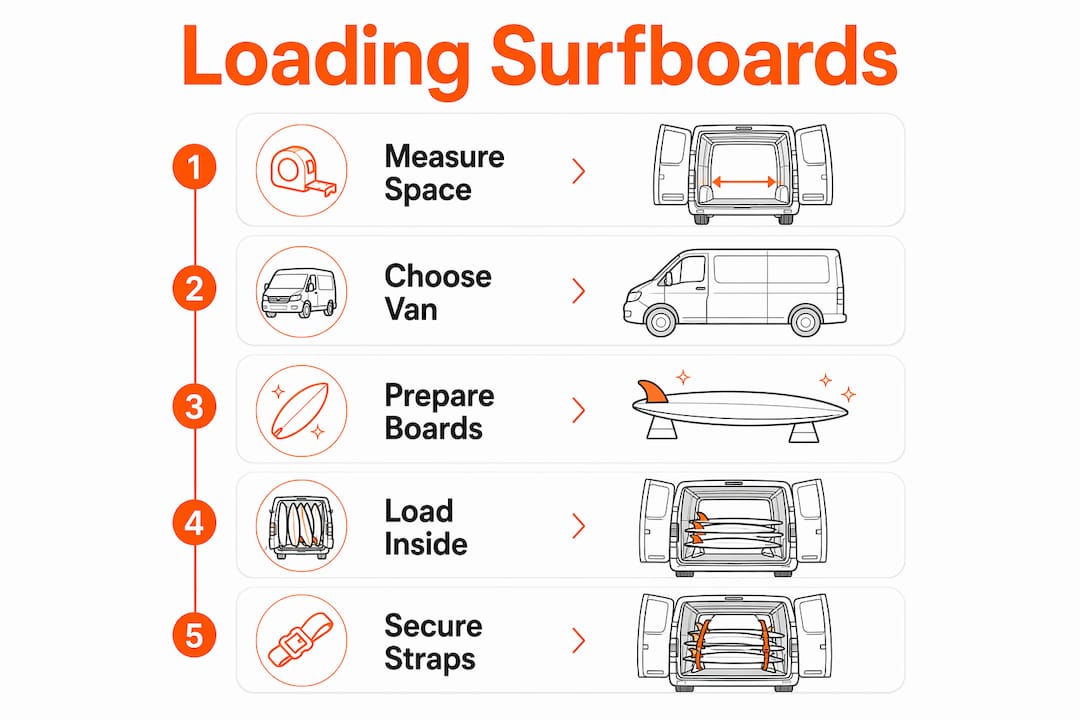
Interior dimensions matter more than the cargo spec sheet suggests. The usable cabin length is the real limiting factor, not just the advertised cargo volume. A slope or step where folded seatbacks meet the floor can shorten that usable length by a foot or more and create a pressure point that dents a board.
Key features to look for when booking a van rental for surfboards:
- Interior length: Confirm the flat-floor length with seats folded, not just the boot depth
- Rear door opening: Wide double doors make diagonal loading far easier than a single tailgate
- Cargo tie-down rails: Metal rails or fixed D-ring loops are the only safe anchor points
- Roof rail compatibility: Needed for exterior racks; confirm the rail type (Airline, Thule, or Fiamma)
- Seat-folding policy: Ask at booking and get written confirmation at pickup
- Minimum van height: Exterior rear-door racks like the PUSHrack require a van height of at least 2.25 meters
Van models commonly used for surf transport in the US include the Ford Transit, Mercedes Sprinter, and Ram ProMaster. All three offer flat load floors, wide rear openings, and roof rail options. If you are traveling to a surf-heavy market like Southern California, van rentals in Huntington Beach give you direct access to local fleets already suited to coastal trips.
Best practices for loading surfboards inside a rental van safely
Interior loading keeps your boards out of the weather and away from theft risk, but it requires planning. The two most common mistakes are forcing a board into a space that is too short and letting it slide during braking. Both are avoidable.
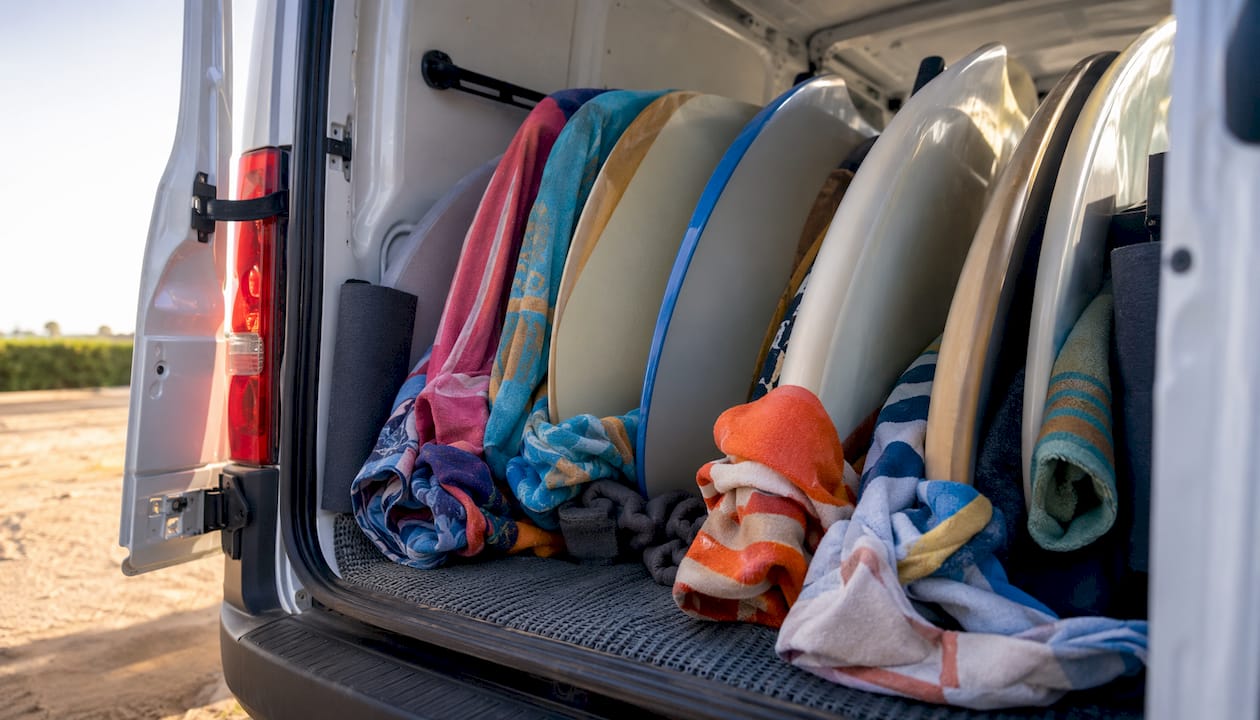
Start with protection. A padded board bag reduces the risk of both board damage and interior scuffs. If you only have a light sock cover, wrap towels around the nose, tail, and rails before loading. Place a clean floor mat or folded blanket under the board where it contacts the van floor or folded seatbacks.
Step-by-step interior loading:
- Fold rear seats flat and confirm the policy allows it in writing
- Lay a non-slip mat or blanket on the load floor
- Slide the board in nose-first, bag zips facing up to prevent zipper snags on trim
- Check for fin clearance at the rear door lip before pushing the board fully in
- Attach a strap from the board bag to a fixed metal cargo loop, not plastic trim
- Add a second restraint: thread the front passenger seatbelt around the bag if the board extends forward
- Wedge folded towels on both sides of the board to prevent rolling
For multiple boards, stack them with a layer of foam or a towel between each one. Ceiling-mounted interior racks free up floor space but reduce headroom noticeably in standard-height vans, making them practical only for one or two shortboards.
Pro Tip: Measure the diagonal from the rear corner of the load floor to the front passenger footwell. Shorter boards often fit diagonally in vans where they would not fit straight, giving you more options without folding seats.
What are your options for roof and exterior surfboard racks?
Exterior racks solve the space problem completely. Your boards ride outside, your interior stays clean and livable, and loading takes less than a minute once the rack is set up. The trade-off is added vehicle height and exposure to weather.
The main exterior rack types for van rentals:
- Rear-door racks: Mount to the van’s rear door using existing rails. The PUSH components PUSHrack carries up to three surfboards, each up to 8 kg, with a maximum total rack load of 25 kg. It fits vans from 2.25 meters tall, including the Ford Transit, Mercedes Sprinter, Ram ProMaster, and VW Crafter.
- Side-mounted surf poles: Attach to the side rail of roof racks and extend down the van’s exterior. The Flatline Van Co. Transit Surf Pole pairs with surf hooks, each set carrying two surfboards or one SUP, for a total of four boards or two SUPs per van.
- Roof racks: Carry longboards and multiple boards above the vehicle. They add the most height and require secure strapping to prevent wind lift at highway speeds.
All three options work best with racks compatible with Airline, Thule, or Fiamma rails, which are the most common rail standards on US cargo vans. The PUSHrack system is specifically designed for these rail types and is made in Germany from materials rated for coastal corrosion resistance.
One practical note: exterior racks keep wet boards, sand, and salt outside the vehicle. Ocean Camper, which operates surf-ready campervans in Portugal, builds outdoor showers into their vans specifically to rinse boards and gear before they ever touch the interior. That same logic applies to any rental van setup: keep the salt outside.
US legal load rules you need to know before driving
Federal DOT regulations and California DMV commercial driver guidelines both require that all cargo be secured against shifting, falling, or becoming a hazard during transit. These rules apply to personal vehicles and rental vans, not just commercial trucks.
For exterior loads, the key restrictions are:
- Loads must not obstruct the driver’s forward view or access to controls
- No load may extend more than 3 feet beyond the front of the vehicle
- Rear overhangs beyond 4 feet require a red flag or light during daylight hours
- Side extensions must not create a hazard to other road users
The California DMV cargo transport guidelines require that loads be tied, chained, netted, or otherwise secured so they cannot shift or fall. Surfboards on exterior racks must be strapped with rated tie-down straps, not bungee cords.
Height is the most overlooked legal issue. Adding a rear-door rack or roof rack increases your van’s total height. Parking structures, drive-throughs, and some highway underpasses post clearance limits as low as 7 feet. A standard cargo van is already 8–9 feet tall before any rack is added.
Pro Tip: Check your rental agreement for any clauses about exterior modifications or rack installation. Some rental companies prohibit aftermarket rack hardware and will hold you liable for door seal damage if the rack is incorrectly fitted.
Key legal points to confirm before you drive:
- Total vehicle height with rack installed
- Rear overhang distance of any board extending beyond the bumper
- Strap and tie-down rating relative to board weight
- Local ordinances at your destination, which may differ from California rules
How to secure surfboards so they do not shift during transit
Boards that move during transit cause two problems: damage to the board and damage to the van interior. Both show up on your rental return inspection. The solution is two independent restraints on every board, whether it is inside or outside the vehicle.
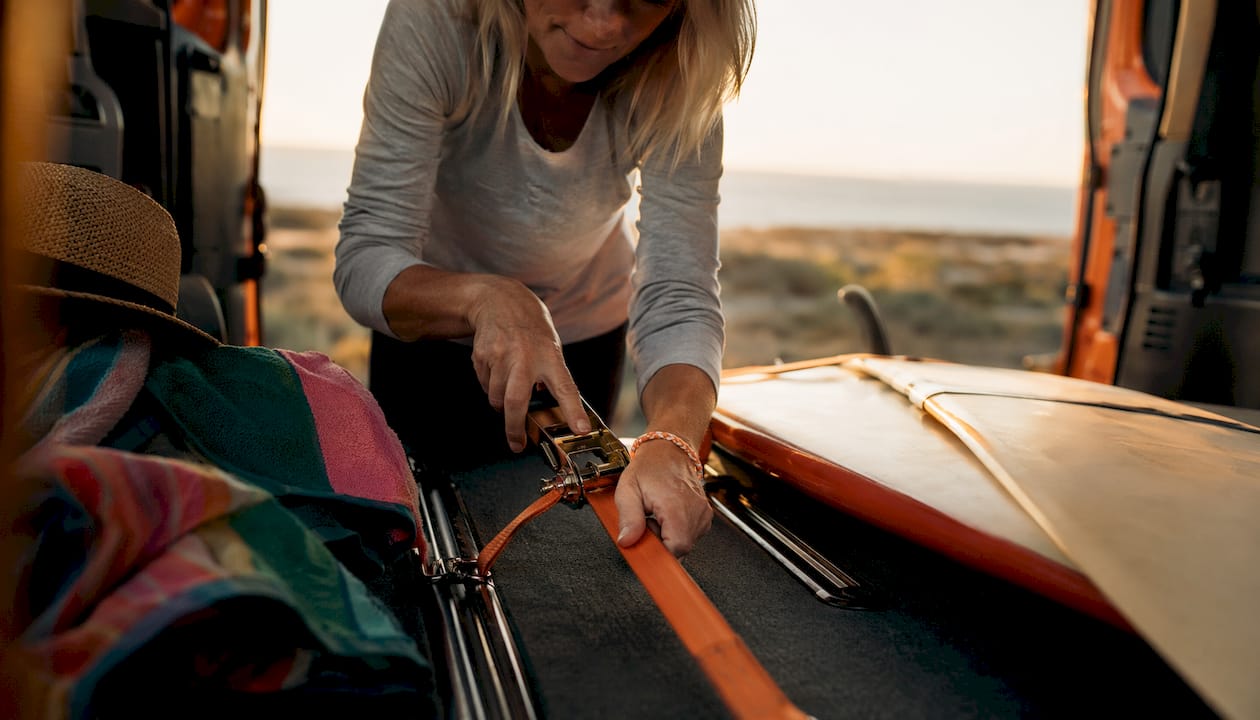
For interior loads, use a strap from the board bag to a fixed metal cargo loop as the primary restraint. Add the front passenger seatbelt threaded around the bag as a secondary restraint if the board extends forward. Wedge folded towels on both sides to stop rolling. Never hook straps onto plastic trim, headrest posts at odd angles, or parcel shelf mounts.
For exterior racks, the securing sequence matters:
- Place the board into the rack’s stabilizing pocket or holder before fastening any strap
- Attach the lower strap first to anchor the tail, then the upper strap across the body
- Check that no strap crosses a fin box or rail edge without padding underneath
- Give the board a firm lateral push after strapping to confirm zero movement
The PUSH components PUSHrack uses integrated stabilizing pockets that hold the board in position before you fasten the straps. This makes solo loading practical without a second person to hold the board steady.
Load balance affects vehicle handling. Place heavier boards closer to the van’s center of gravity, not at the extreme rear. For multiple boards on a roof rack, distribute weight evenly left to right. An unbalanced roof load raises the van’s center of gravity and affects cornering.
Pro Tip: Use racks with integrated board holders for solo trips. Trying to hold a 9-foot longboard in position while simultaneously reaching for a strap is how boards get dropped and fins get snapped.
Securing methods at a glance:
- Fixed metal cargo loops or D-rings: primary interior anchor
- Rated ratchet straps (not bungee cords): for exterior rack tie-downs
- Padded strap sleeves: protect rails where straps cross the board
- Foam wedges or rolled towels: prevent rolling inside the van
- Optional anti-theft security kit: available for the PUSHrack system to deter board theft at stops
Pre-driving safety checks for a van loaded with surfboards
Before you pull out of the parking lot, run through a quick physical check. It takes two minutes and prevents the kind of damage that costs you a security deposit.
Essential pre-drive checks:
- Strap tension: Pull each strap firmly. If it gives more than an inch, tighten it.
- Board position: Confirm no board edge or fin protrudes into the driver’s sightlines via mirrors
- Rack attachment: Grip the rack itself and push laterally. No movement should be felt at the mounting points.
- Van height: Note the total height with rack installed and set a reminder or note on your phone for low-clearance areas on your route
- Rear door clearance: If using a rear-door rack, confirm the door can still open enough for emergency access if needed
- Interior boards: Close the rear doors and gently pull the board bag to confirm it does not slide forward
- Sensor check: Some vans have rear parking sensors or cameras mounted low on the bumper. Confirm no rack hardware blocks or contacts them.
After your first mile of driving, pull over and recheck strap tension. Vibration from road surfaces can loosen straps that felt tight at rest. This is especially true for roof racks at highway speeds, where wind load adds to the stress on every mounting point.
Test braking gently on a quiet road before entering traffic. A loaded van stops differently than an empty one, and a board shifting forward under hard braking is a serious hazard.
Research insights: modern rack designs and interior storage solutions
The surfboard transport category has seen real product development in the past few years, driven by the growth of van life culture and surf travel. Three areas stand out: modular take-apart boards, exterior racks with integrated holders, and surf-ready van builds.
Modular surfboards from NewaveSurf address the storage problem at the source. NewaveSurf produces take-apart boards in two or three sections that assemble by hand without tools. The 7-piece quiver packs into a wheeled bag measuring 124 × 60 × 47 cm, which fits under a van bed or in a standard storage compartment. Common van models like the Renault Trafic, VW Transporter, and Fiat Ducato have compartments 80–100 cm deep and 70–140 cm wide, which accommodate the NewaveSurf bag flat or vertically. The 2-board pack bag measures 124 × 60 × 25 cm, and a single-board backpack measures 110 × 55 × 23 cm.
PUSH components’ PUSHrack focuses on exterior transport with a stabilizing pocket system that allows one person to load a board safely without assistance. The rack mounts to the rear door using Airline, Thule, or Fiamma rails and carries up to three boards. Its contact surfaces are designed to protect board rails, and an optional anti-theft security kit with alarm capability is available for stops at campsites or surf spots.
Ocean Camper’s surf-ready van builds in Portugal demonstrate what a purpose-built surf rental van looks like: roof bars for longboards, interior board storage on the Bohemian model, and outdoor showers on every van to rinse gear before it enters the living space. Yescapa, a European motorhome rental platform, similarly emphasizes outdoor showers and secure interior board storage as standard features for surf trip rentals.
Key findings from modern rack and storage research:
- Ceiling-mounted interior racks free floor space but reduce headroom, making them practical only for shortboards in standard-height vans
- Rear-door exterior racks keep sand, salt, and wet gear outside the vehicle entirely
- Modular boards eliminate the length problem for interior storage without sacrificing board performance
- Anti-theft security kits are now available as add-ons for modular rack systems
- Vans under 2.25 meters tall generally cannot accommodate the upper rail required for rear-door rack systems like the PUSHrack
Key Takeaways
Choosing the right van and securing boards with two independent restraints at fixed metal anchor points is the foundation of safe surfboard transport in any rental van.
| Point | Details |
|---|---|
| Van selection matters first | Choose a van with a flat load floor, fixed cargo rails, and roof rail compatibility before booking. |
| Two restraints on every board | Use a fixed cargo loop as the primary strap and a secondary restraint to prevent forward sliding. |
| Exterior racks keep interiors clean | Rear-door racks like the PUSHrack carry up to three boards and mount to Airline, Thule, or Fiamma rails. |
| Track total height with racks installed | Adding any exterior rack increases van height; plan your route to avoid low-clearance obstacles. |
| Myvanrentals for coastal surf trips | Myvanrentals offers van rentals across surf-friendly US cities with local teams who know coastal routes. |
The part most surfers skip until it costs them
Most surf travel advice focuses on which rack to buy or how to strap a board. The step that actually causes problems is earlier: the moment you pick up the van and assume it will work without checking.
Rental vans are not purpose-built surf vehicles. The cargo rails may be in the wrong position for your board length. The rear door opening may be narrower than the bag you packed. The seat-folding policy may be stricter than the booking page implied. None of these are deal-breakers, but all of them require five minutes of attention at pickup rather than an hour of improvising at the trailhead.
The other thing worth saying plainly: exterior racks are not just a convenience upgrade. For anyone carrying more than one board, or a longboard over 9 feet, they are often the only practical option. Interior loading of a longboard in a standard cargo van requires a van long enough that the board fits straight, a flat floor with no step, and a rear door opening wide enough for the fin box to clear. That combination exists, but it is not guaranteed in every rental fleet.
Modern rack systems like the PUSHrack have made solo loading genuinely easy. The stabilizing pocket holds the board in position before you reach for the strap. That detail matters more than it sounds on a windy beach parking lot with wet hands.
Prep before pickup. Measure at the lot. Confirm permissions in writing. The surfing part is easy once the logistics are handled.
Myvanrentals has vans ready for your next surf trip
Surfers heading to Southern California need a van that fits the boards, not a compromise. Myvanrentals operates city-specific fleets in surf-friendly markets including Los Angeles, Miami, and Orlando, managed by local teams who know coastal routes, parking, and beach access points.

Every rental comes with the ability to confirm cargo features, tie-down compatibility, and interior dimensions before you book. Whether you are running a group trip to the coast or a solo session with a quiver of shortboards, Myvanrentals connects you with the right vehicle for the load. Book your van and confirm surfboard transport options directly with the local team. For surf-heavy destinations like Huntington Beach, the Huntington Beach fleet includes Sprinter and passenger van options suited to group beach trips with gear.
Useful sources for surfboard van transport
- California DMV: Transporting Cargo Safely — Federal and California cargo-securing requirements for all vehicles
- PUSH components PUSHrack Surfboard Rack — Product specs, compatible van models, and installation guidance for rear-door surf racks
- NewaveSurf: Transporting Surfboards in a Van — Practical guide covering interior rack options, modular board solutions, and van storage layouts
- Ocean Camper Surf Campervan Portugal — Example of a purpose-built surf rental van with roof bars, board storage, and outdoor showers
- Yescapa: Van and Motorhome Rental for Surf Trips — European motorhome rental platform with surf-specific van features and trip planning advice
- Hola Car Rentals: Carrying a Surfboard in a California Hire Car — Detailed guide on measuring interior space, protecting boards, and rental agreement compliance
FAQ
How do people transport surfboards in a van?
Surfers transport boards either inside the van on the load floor using padded board bags and fixed tie-down straps, or outside on roof racks, rear-door racks, or side-mounted surf poles. Exterior racks keep sand and salt out of the interior and are the practical choice for longboards or multiple boards.
How do you store a surfboard in a van?
Lay the board flat on a padded surface and secure it to fixed metal cargo loops with rated straps, not bungee cords or plastic trim. For multiple boards, place foam or a folded towel between each one to prevent contact damage during transit.
How do you load a surfboard on a van without help?
Use a rear-door rack with integrated stabilizing pockets, such as the PUSH components PUSHrack, which holds the board in position before you fasten the straps. This design makes solo loading safe and practical without a second person to steady the board.
Can you carry a surfboard in a rental van legally in the US?
Yes, provided the board is secured against shifting or falling per California DMV and federal DOT cargo rules. Exterior loads must not obstruct driver visibility, and rear overhangs beyond 4 feet require a red flag or light. Always confirm your rental agreement permits any rack installation or seat folding before you drive.
How much does it cost to rent a van for a surf trip?
Rental pricing varies by van size, location, and rental duration. Myvanrentals offers van rentals across major US coastal cities; pricing is not publicly listed as a flat rate and depends on the specific vehicle and booking dates. Contact the local team directly for a current quote.