Planners: 12–15 Passenger Vans for U.S. Wedding Guest Transport

Planners: 12–15 Passenger Vans for U.S. Wedding Guest Transport
Provide guest transportation if your wedding spans multiple venues, has limited parking, draws many out-of-town guests, or runs a late-night open bar. For most U.S. weddings, start with passenger vans sized for about a dozen to mid-teens capacity or a mixed fleet of vans, since they balance capacity, luggage room, and venue access better than a single large motorcoach, as detailed in this branded transportation and event shuttles guide. The next step is simple: count your likely riders and request one consolidated quote instead of piecing together separate vendors.
TL;DR:
- Vans are the most versatile option for weddings with multiple stops, limited venue access, or many out-of-town guests, especially for groups under 150 people.
- Booking early, six to nine months in advance, is critical as peak season weekends quickly sell out, and late booking risks limited availability.
- Planning routes around RSVP numbers and clustering hotels reduces the number of vans needed and simplifies logistics, with most guests using shuttles if staying at the hotel block.
- Timing buffers of at least 45 minutes before the ceremony and staggered departure waves help prevent delays from cascading, especially during peak traffic or late arrivals.
- Vehicle choice should prioritize the room for luggage, venue driveway access, and group size, with larger vehicles requiring extra planning for step height, insurance, and driver requirements.
Table of Contents
- Which Vehicle Types Work Best for Wedding Guest Transportation Vans?
- How Does Wedding Guest Transportation Work on the Day?
- What Does Wedding Guest Transportation Cost?
- How Do You Estimate Vehicle Counts and Plan Routes?
- How Do You Choose Between Vans, Minibuses, and Coaches?
- How Do Shuttles Move Guests From Hotel to Reception and Back?
- When Should You Plan Timing Buffers and Departure Waves?
- How Do You Handle Delays or Emergencies During Guest Transportation?
- How Should Transportation Providers Coordinate With Planners and Venues?
- Why My Van Rentals Recommends a Van-First Approach
- Get a Quote for Your Wedding Guest Transportation
- Sources
- FAQ
Which Vehicle Types Work Best for Wedding Guest Transportation Vans?
Vehicle choice comes down to headcount, luggage, and how tight your venue’s driveway actually is. A hotel with a narrow porte cochere rules out a full-size coach before you even talk pricing.
12 to 15 passenger vans are the workhorse for wedding guest transportation vans because they thread through venue gates a coach can’t, carry gift bags and overnight luggage without a second trip, and don’t require the commercial driver credentials larger vehicles often trigger. They work for hotel shuttle loops, bridal party transport, and airport runs alike.
Minibuses and coaches make sense once you’re moving 150 or more guests between one hotel and one venue with no stops in between. They lose their advantage the moment your guest list is spread across three hotels or your reception venue has a tight turnaround.
Limos and black cars shine for the ceremonial entrance and small VIP transfers, like getting the couple from ceremony to reception for photos. They’re a poor fit for mass guest shuttling: low headroom and minimal trunk space make boarding slow and luggage awkward, a point echoed in Limousine of trip type versus vehicle class.
For accessibility, check step height and aisle width before booking. Photo-friendly arrivals still matter, and executive vans offer a cleaner walk-up shot than a boxy coach.
- Vans: flexible, luggage-friendly, best for multi-stop days
- Minibuses/coaches: high capacity, best for single-stop, large-guest-count runs
- Limos/black cars: ceremonial and VIP use, not shuttle duty.
- Accessibility: confirm step height and ramp availability in advance
How Does Wedding Guest Transportation Work on the Day?
Most weddings run one of three models. A continuous loop cycles a van between the hotel and venue every 15 to 20 minutes, useful when guests trickle in over a couple of hours. A single-wave transfer moves everyone at once, which works when your ceremony has a hard start time and guests are staying at one or two hotels. A staggered wave model sends vans in sequence, first the bridal party, then family, then general guests, spacing arrivals so nobody’s standing in a parking lot.
- Start hotel pickups 45 to 60 minutes before ceremony time to absorb boarding delays and traffic.
- Build a 15-minute buffer between each wave so drivers aren’t rushing back for the next load.
- Assign one person, planner or point-of-contact, to hold the final headcount and confirm it with the driver morning-of.
- Share the driver’s direct cell number with the wedding party lead, not just the couple.
Pro Tip: Print a one-page manifest for each driver listing pickup order, names, and phone numbers. Drivers who know who they’re waiting for make faster decisions when someone’s running late.
Operator guidance from Charter a Coach backs this up: wave planning and driver professionalism, not just vehicle size, are what keep a wedding day on schedule.
What Does Wedding Guest Transportation Cost?
Providers typically price weddings one of two ways: an hourly rate with a minimum booking window (often three to five hours), or a flat all-in quote covering mileage, wait time, and gratuity. Large vans and any vehicle rated for 16 or more passengers can also trigger CDL and higher insurance requirements, which raises the base rate.
Rough budgeting by guest count:
- Small weddings (50 or fewer riders): one or two vans, hourly pricing, often a few hundred dollars per vehicle for a half-day block.
- Mid-size weddings (50 to 150 riders): two to four vans running staggered waves, or one van plus a minibus.
- Large weddings (150-plus riders): a mixed fleet of vans and a coach, priced as a bundled package to avoid per-vehicle markup.
Holiday weekends and peak wedding months (May through October) usually carry a premium, so book early. Ask providers to include mileage, wait time, and gratuity in one number. Vendor pages that advertise single-quote, all-in pricing tend to produce fewer surprise line items on the final invoice, according to Glyde Bus’s guest transportation guidance.
Statistic Callout: Vehicles built for 16 or more passengers often cross the threshold requiring a commercial driver and increased insurance coverage, a cost factor that frequently pushes couples back toward multiple smaller vans instead of one large coach.
How Do You Estimate Vehicle Counts and Plan Routes?
Start with your RSVP list, not your guest list. A rough rule: 60 to 80% of out-of-town guests staying in your room block will use a provided shuttle rather than drive themselves, especially if there’s an open bar.
- Pull your room-block numbers by hotel and divide by van capacity (typically 14 riders comfortably per 15-passenger van).
- Cluster hotels into as few pickup points as possible. Three hotels within a mile of each other can usually share one pickup location.
- Decide between rotation (fewer vans, more trips) and simultaneous capacity (more vans, one trip) based on your ceremony’s start-time flexibility.
- Add one extra van if your venue is remote or your timeline has less than a 20-minute buffer anywhere.
Pro Tip: Put transportation details on your wedding website and repeat them on day-of signage at the hotel lobby. Guests forget details from a save-the-date; they don’t forget a sign by the elevator.
For RSVP copy, something like: “Shuttle service will run from the [hotel name] lobby starting at 4:30 PM. Look for the driver holding a sign with our names.” Simple, specific, and answers the question before anyone has to ask it. For deeper route logistics, this multi-van event planning guide walks through rotation math in more detail.
How Do You Choose Between Vans, Minibuses, and Coaches?
Run a simple formula: capacity times luggage needs times venue access equals vehicle class. If any one factor is tight, tight venue driveway, heavy luggage, or a headcount over 150, let that factor drive the decision rather than defaulting to whatever seems most impressive.
The most common mistake is booking too late. Popular vendors sell out peak wedding weekends months ahead, a point Brides’ transportation coverage makes clear when it recommends reserving early. The second mistake: underestimating boarding time. A coach full of guests in heels and formalwear takes longer to load than a spreadsheet suggests.
- Match vehicle class to your tightest constraint, not your average guest count.
- Check step height and trunk space before signing, not on arrival day.
- Book six to nine months out for peak season weekends.
- Confirm photo-friendly arrival options if curb appeal matters to your timeline.
Pro Tip: Walk your venue’s driveway or call the venue coordinator and ask what vehicle size they’ve hosted before. They’ll know before any vendor does.
How Do Shuttles Move Guests From Hotel to Reception and Back?
The full-day shuttle arc usually breaks into four legs: hotel to ceremony, ceremony to reception (if they’re at different venues), reception throughout the evening for guests who leave early, and end-of-night return trips.
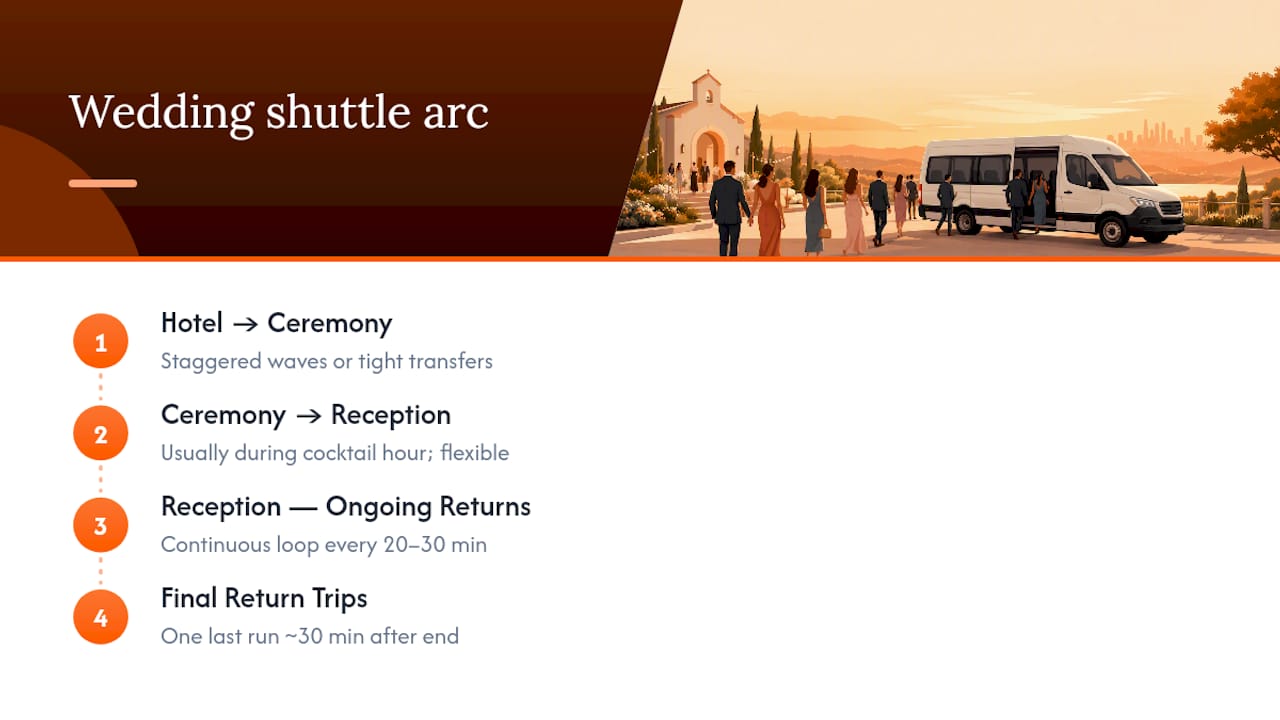
The hotel-to-ceremony leg is the highest-stakes segment because it’s tied to a fixed start time. This is where staggered waves or a tight single transfer matter most. The ceremony-to-reception leg, when venues differ, often runs during cocktail hour, giving vans more flexibility since there’s no hard deadline.
The reception-to-hotel return is where most couples under-plan. Guests leave at different times all evening, some right after dinner, most after the dance floor closes. A continuous loop running every 20 to 30 minutes from 9 PM until the reception ends handles this better than a single scheduled pickup, because it doesn’t strand anyone who leaves early or force stragglers to wait an hour for the “official” last shuttle.
Build in one final “last call” run about 30 minutes after the venue’s official end time, since venues almost always run over. Coordinate this last leg directly with the venue’s closing staff so drivers aren’t sitting outside an empty building or missing guests who got delayed settling the bar tab.
When Should You Plan Timing Buffers and Departure Waves?
Every timing plan needs slack built in, because weddings run late almost as a rule. Hair and makeup finish behind schedule, photos take longer than planned, and traffic near popular venues on Saturday afternoons is unpredictable.
Plan departure waves around fixed anchor points rather than guessing at intervals. If your ceremony starts at 4 PM, your first wave should leave the hotel no later than 3:15 PM, giving 45 minutes to cover a 15-minute drive with room for delays. A second wave 15 minutes behind the first catches stragglers without leaving anyone waiting more than 20 minutes in a lobby.
On-site waiting matters just as much as departure timing. If your venue has a cocktail hour between ceremony and reception, that’s a built-in buffer. If not, plan for guests to have somewhere to be, and something to do, for at least 20 minutes between the ceremony ending and the reception opening, rather than standing in a parking lot waiting on vans.
Confirm final guest counts with your transportation provider 48 to 72 hours before the wedding, not the morning of. Late changes to headcount can mean a driver shows up with a van too small, or too large, for the actual group.
How Do You Handle Delays or Emergencies During Guest Transportation?
Plan for at least one delay, because on a day with this many moving parts, something usually runs behind. The goal isn’t preventing every possible hiccup. It’s making sure a fifteen-minute delay doesn’t cascade into a missed ceremony.
Build a phone tree before the day starts: one point of contact (often the planner or a designated family member) who has every driver’s cell number and is the single person drivers call if something changes. Without this, a stuck van means five different guests calling five different people trying to figure out what’s happening.
If a vehicle breaks down or a driver is delayed, ask your provider in advance what their backup plan is. Providers with multiple vehicles in a market can usually swap in a replacement faster than one operating a single van. Reliable operators build slack into their fleet for exactly this reason.
Weather delays deserve their own plan, especially for outdoor ceremonies. If rain pushes your ceremony indoors or delays it by 30 minutes, your transportation waves need to shift with it, which means your driver contact needs real-time authority to adjust pickup times without waiting for you to notice and call.
Keep a simple printed contact sheet with driver numbers, the venue coordinator’s number, and your planner’s number in the glove box of the getaway car. Cell service fails at the worst moments, and a paper backup costs nothing.
How Should Transportation Providers Coordinate With Planners and Venues?
The transportation vendor, the wedding planner, and the venue coordinator need to be talking to each other before the wedding week, not discovering conflicts on the day.
Share your final timeline with your transportation provider as soon as it’s locked, ideally two to three weeks out, and again with any changes 48 hours before. Include ceremony start time, cocktail hour length, and expected end time so the driver’s schedule isn’t built around guesswork.
Loop the venue coordinator in on where vans will stage and how long they’ll idle in loading zones. Many venues have specific rules about where oversized vehicles can park, and finding this out the morning of causes avoidable delays.

If you’re working with a planner, make transportation their responsibility to confirm, not yours. Planners who coordinate multiple weddings a month already know which local providers show up on time and communicate well, and they can flag scheduling conflicts (like two arrivals hitting the venue driveway at once) before they become a problem.
Ask your provider directly whether they’ve worked with your venue before. A driver who already knows the loading zone and traffic pattern saves real time on a day where every minute is scripted.
Why My Van Rentals Recommends a Van-First Approach
Certain van rental providers run Ford Transit, Mercedes Sprinter, and Chevrolet Express vans nationwide, with some offering high-roof and extra luggage configurations suitable for multi-stop wedding days. Vans avoid the CDL and insurance thresholds that push coach pricing up, and they fit venue drives a full-size bus can’t. For a wedding day with hotel loops, ceremony transfers, and a late-night return run, that flexibility usually matters more than raw seat count.
— Gabriel
Get a Quote for Your Wedding Guest Transportation
Getting an accurate quote takes less information than most couples expect: your wedding date, an estimated guest count, pickup and drop-off addresses, and a rough timeline for the day. That’s enough for a provider to recommend vehicle count and pricing without back-and-forth.

Some van rental providers offer 12 and 15 passenger Sprinter and Ford Transit vans with flexible pickup and delivery to hotels or venues, and coordinate multi-van bookings to simplify working with multiple vendors for various transportation needs. If you’re weighing a van against multiple individual rentals for your wedding party, this comparison of vans versus separate car rentals breaks down the cost and logistics difference. Check availability in your city and request a consolidated quote through My Van Rentals’ city pages, or browse the full fleet lineup to see which configuration fits your guest count.
Sources
For deeper planning guidance, Brides’ transportation guide covers vehicle options and timing tips. The United Motorcoach Association publishes safety and operator standards worth knowing before booking any large vehicle.
- Wedding transportation: planning tips, costs, and ideas — Brides
- Charter a Coach — Wedding charter bus guidance
- Limousine
FAQ
What Is the Average Cost of Wedding Guest Transportation?
Costs vary by vehicle type and hours booked, but most couples pay per vehicle using either an hourly rate with a multi-hour minimum or a flat all-in quote covering mileage and wait time. Small weddings with one or two vans typically spend far less than large weddings needing a mixed fleet across a full evening.
Do We Need to Provide Transportation for Wedding Guests?
It’s strongly recommended when your wedding spans multiple venues, has limited parking, involves many out-of-town guests, or runs a late-night open bar, since it removes drunk-driving risk and keeps your timeline on schedule. It’s less critical for a single-venue, local-guest wedding with ample on-site parking.
Is a Party Bus or a Limo Cheaper for Wedding Guest Transportation?
Limos generally cost more per passenger than vans or party buses because they carry fewer riders and require higher-end vehicle maintenance, while vans and minibuses spread the cost across more seats. For pure guest shuttling, vans usually deliver the better cost-per-rider than a limo.
How Do You Ask Wedding Guests If They Need Transportation?
Include a simple line in your RSVP or wedding website: ask guests staying at the room-block hotel to confirm whether they’ll use the provided shuttle, and list pickup times and location clearly. Repeating the same details on day-of signage at the hotel lobby catches guests who missed the earlier notice.
What’s the Difference Between a Van and a Coach for Wedding Guests?
Vans (12 to 15 passengers) offer more flexibility for tight venue access, multiple pickup points, and luggage, while coaches make sense only when moving large groups between a single hotel and single venue with no stops in between. Vans also often avoid the CDL and insurance requirements that raise coach pricing.