Student Group Travel by Van: Plan It, Rent It, Keep It Safe

Student Group Travel by Van: Plan It, Rent It, Keep It Safe
Student group travel works best when the whole group rides together, with one itinerary, one set of drivers and one person who knows where everyone is. A rented passenger van does that for club trips, team travel, class projects and campus events. This guide covers how to pick the van, what to check before you sign, how to set up drivers and supervision, and what to put in the budget. If you are renting, My Van Rentals offers 12 and 15 passenger vans, Ford Transit and Mercedes Sprinter models, and school programs with tax-exempt and PO billing.
TL;DR
- Count people plus luggage first. A 12 or 15 passenger van full of bags is a smaller van than it looks on paper.
- Federal law restricts the sale or lease of new 12- and 15-passenger vans for school-related transport of high school and younger students. College groups are not covered by that rule. If you are a K-12 school, confirm your district’s policy before you book.
- Ask for the operator’s USDOT number, safety record, insurance and seat belts in every seat, then give a safety briefing before you leave.
- Use trained, rested, non-student drivers, plan rest stops, and leave a written travel list with two people at home.
- Budget for extra miles, fuel, tolls, parking and insurance, not just the daily rate.
Table of Contents
- Who this guide is for
- Step 1: Decide how many vans you need
- Step 2: Know the rule that applies to your students
- Step 3: Check the operator before you sign
- Step 4: Choose drivers carefully
- Step 5: Load and seat the group safely
- Step 6: Set up supervision and communication
- Step 7: Budget the real cost
- A quick pre-departure checklist
- Where we fit
- Our view: one van, one plan
- FAQ
- Sources
Who this guide is for
This guide is for the person who has to move a group of students and make it work: a club officer, a coach, a teacher, a trip leader or a campus event organizer. You may be taking a college group to a conference, a youth group to a theme park, or a class to a field site. Some of the rules below depend on the age of the students and on who sponsors the trip. We say so where they do.
If you are planning a trip for your own family or friends, the vehicle and budget sections still apply. The supervision and paperwork parts are written for organized groups.
Step 1: Decide how many vans you need
Start with a headcount that includes every driver, chaperone and student. Then add the gear. Sports equipment, instruments, display boards, duffel bags and coolers take real space.
The University of Florida’s sport club travel guide tells organizers to work out how many vehicles they need for travelers plus equipment and baggage. That is the right order. People first, then bags, then the van.
A simple way to do it:
- Count travelers, including at least two drivers for a long trip.
- List every bag and piece of equipment.
- Decide what sits in the cargo area and what rides at the feet of passengers. Neither should block aisles or exits.
- If it does not fit with seats left empty, move up a size or add a second vehicle.
Choosing the van type
The vans in our fleet fit different group sizes:
| Van | Best for |
|---|---|
| Minivan (8-passenger) | Small teams, committees, a faculty and student delegation |
| Ford Transit (low roof) | Groups with moderate luggage |
| Med roof Ford Transit | Groups that need more headroom and cargo space |
| Mercedes Sprinter | Larger groups and longer trips |
| Mercedes Sprinter Executive | Visiting speakers, donors, formal events |
If your group carries a lot of gear, read our guide to high roof passenger van benefits. For city-specific 15-passenger Transit models, see for example the high roof Transit in Savannah or the high roof Transit in Washington DC.
Step 2: Know the rule that applies to your students
This is the part organizers most often miss. It depends on the students’ age.
The Federal Motor Carrier Safety Administration (FMCSA) states that federal law prohibits the sale or lease of new 12- and 15-passenger vans for school-related transportation of high school and younger students. The reason it gives is a higher rollover risk in these vans when they carry many occupants. The same page notes that vans with 10 or more occupants had a single-vehicle rollover rate nearly three times that of lightly loaded vans.
What this means in practice:
- College and university groups: The federal sales and lease prohibition is aimed at high school and younger students. The NHTSA warning reproduced by the University of California Office of the President says the law does not extend to college students.
- K-12 school trips: Your district sets the policy. States also set their own use standards. The Maine Department of Education explains that NHTSA generally does not regulate a school’s use of a 15-passenger van and leaves that to states. Ask your transportation office which vehicle types are approved before you reserve anything.
- Smaller groups: If your district approves smaller vehicles, a Ford Transit low roof or an 8-passenger minivan can cover a smaller class or team without the larger-van rules in play.
For school-specific questions on cost and process, see our guide to school field trip vans.
Step 3: Check the operator before you sign
When a group travels in a for-hire vehicle, the operator’s record matters as much as the van. The National Transportation Safety Board (NTSB) publishes a checklist for school districts chartering vehicles. Any student organizer can use it. It asks you to:
- Get the operator’s company name and USDOT number. A USDOT number is the federal registration number for a company that carries passengers or freight.
- Look the company up in the FMCSA Passenger Carrier Search by Company tool and check its safety performance. The NTSB looks for a Satisfactory rating.
- Verify licensing and insurance for passenger-carrying operations.
- Confirm lap and shoulder belts in every seat.
FMCSA adds that a recent safety rating is a more timely indicator than one several years old, and that interstate drivers, generally those crossing state lines, are subject to federal qualification standards.
Our positioning is simple: we specialize in 12 and 15 passenger group vans, with a fully insured modern fleet and no surprise charges at pickup. Rental liability coverage is available through Renter’s Contingent Liability Insurance (RCLI), which you can add when you book.
Insurance numbers to know
FMCSA’s education-related transportation page explains that for-hire interstate passenger carriers need $1.5 million in financial responsibility for vehicles with 15 or fewer seats, including the driver, and $5 million for 16 or more. It also explains that school-district-sponsored student transport can be exempt from some rules, and that 9 to 15 passenger operations that collect only indirect compensation, such as a total package charge, are exempt from most FMCSA safety regulations.

That is a lot of fine print. The takeaway for an organizer: ask in writing what insurance covers your group, who is covered as a driver, and whether your school, club or university requires its own coverage on top.
Step 4: Choose drivers carefully
The driver is the biggest safety decision on the trip. Two sources give practical guidance:
- The University of Florida guide says to plan at least two drivers per 500 miles, confirm every driver holds a valid license and a safe-driving reputation, and have the vehicle checked by a mechanic before departure.
- Sadler Sports’ 12- and 15-passenger van summary recommends a trained, experienced, non-student driver who drives these vans regularly. It suggests limiting drive time to 8 hours a day and running a motor vehicle record check showing no more than two minor violations in three years and no major offenses, such as DUI or reckless driving, in five. It also notes a commercial driver’s license (CDL) is not required but is preferred.
A 15-passenger van handles differently from a car. It is taller, longer and heavier, and the load changes how it brakes and turns. A driver who has never handled one should practice in an empty lot before the group boards.
Rental agencies also set age rules. Most want drivers at a minimum age, and a student driver may not qualify. Confirm who is allowed to drive before you reserve, and list every driver on the agreement.
Step 5: Load and seat the group safely
Belts come first. The NTSB checklist asks that all students and chaperones wear them, and that the driver gives a pre-trip briefing covering belt use, dialing 911, and the location and use of emergency exits and fire extinguishers. The NTSB reports deaths and serious injuries where belts went unused or briefings were skipped.

The numbers back this up. In the NHTSA warning, 80% of those killed in 2000 in 15-passenger van rollovers were unbelted, and 92% of belted occupants survived fatal single-vehicle rollovers over the prior decade.
Loading rules from the 2018 NHTSA advisory, as summarized by Sadler Sports:
- Never exceed 15 passengers.
- When the van is not full, seat people in front of the rear axle, front to back.
- Keep cargo off the roof and forward of the rear axle.
- Inspect tires before every trip.
A high roof van gives you more interior cargo space, so bags stay inside and off the roof. Our passenger van packing list shows what to bring and how to load it.
Pack for the unexpected too. A roadside emergency kit list helps you decide what should be on board before a long drive.
Step 6: Set up supervision and communication
Student trips go wrong less often when the paperwork is done before the van leaves. The University of Florida guide requires:
- A travel list with names, times, destination, itinerary and phone numbers, given to at least two accessible people.
- A pre-trip meeting at least one month ahead.
- A communication or buddy system for the group.
- Planned routes, hotels and rest stops, with alternate routes for construction, accidents and weather.
Add a few items of your own: emergency contacts for each student, any medical or allergy notes your school or club requires, signed permission forms, and a clear rule for who makes decisions if the schedule changes.
Run the pre-trip meeting like a short briefing. Cover seating, belts, phone use, stops, check-in times and what to do if the van breaks down. Do it again at the start of the drive, so the driver’s briefing is the last thing everyone hears.
Step 7: Budget the real cost
The daily rate is only part of the bill. For a student trip, build the budget from these lines:
| Cost | What to ask |
|---|---|
| Daily or weekly rental | Is the price live and complete at booking? |
| Mileage | Is there an included allowance, and what is the extra-mile fee? |
| Insurance | What does the rental include, and do you need added liability coverage? |
| Fuel | Estimate miles and fuel economy for the full route. |
| Tolls and parking | Check the route and the campus or venue parking rules. |
| Driver costs | Meals and lodging for a second driver on long trips. |
Our extra-mile fees are listed on the fleet page: $0.50 per extra mile for the Ford Transit low roof and med roof Ford Transit, and $0.75 per extra mile for the Mercedes Sprinter and the 8-passenger minivan. The Mercedes Sprinter Executive is $5.00 per extra mile.
Here is a worked example with those fees. A group drives 200 miles over its allowance in a Ford Transit. At $0.50 per mile, the extra miles come to $100. The same 200 miles in a Mercedes Sprinter at $0.75 per mile come to $150. Plan your route before booking, so you choose the van with the right mileage for the trip.
Splitting the cost helps. A 15-passenger van split between a full group usually costs each student far less than separate cars or tickets, and everyone arrives at the same time.
Parking is another cost that surprises groups. A full-size van does not fit every garage or street space. Our guide to street parking a passenger van covers size, rules and fines.
A quick pre-departure checklist
- Headcount, bags and equipment match the van size.
- Your school, club or university has approved the vehicle type.
- Operator and USDOT number confirmed, safety record checked.
- Insurance and liability coverage confirmed in writing.
- Two or more qualified, rested, non-student drivers named.
- Tires and vehicle inspected before departure.
- Travel list left with two people at home.
- Safety briefing given: belts, 911, exits, extinguisher.
- Route, rest stops and backup routes planned.
- Total budget includes miles, fuel, tolls and parking.
Where we fit
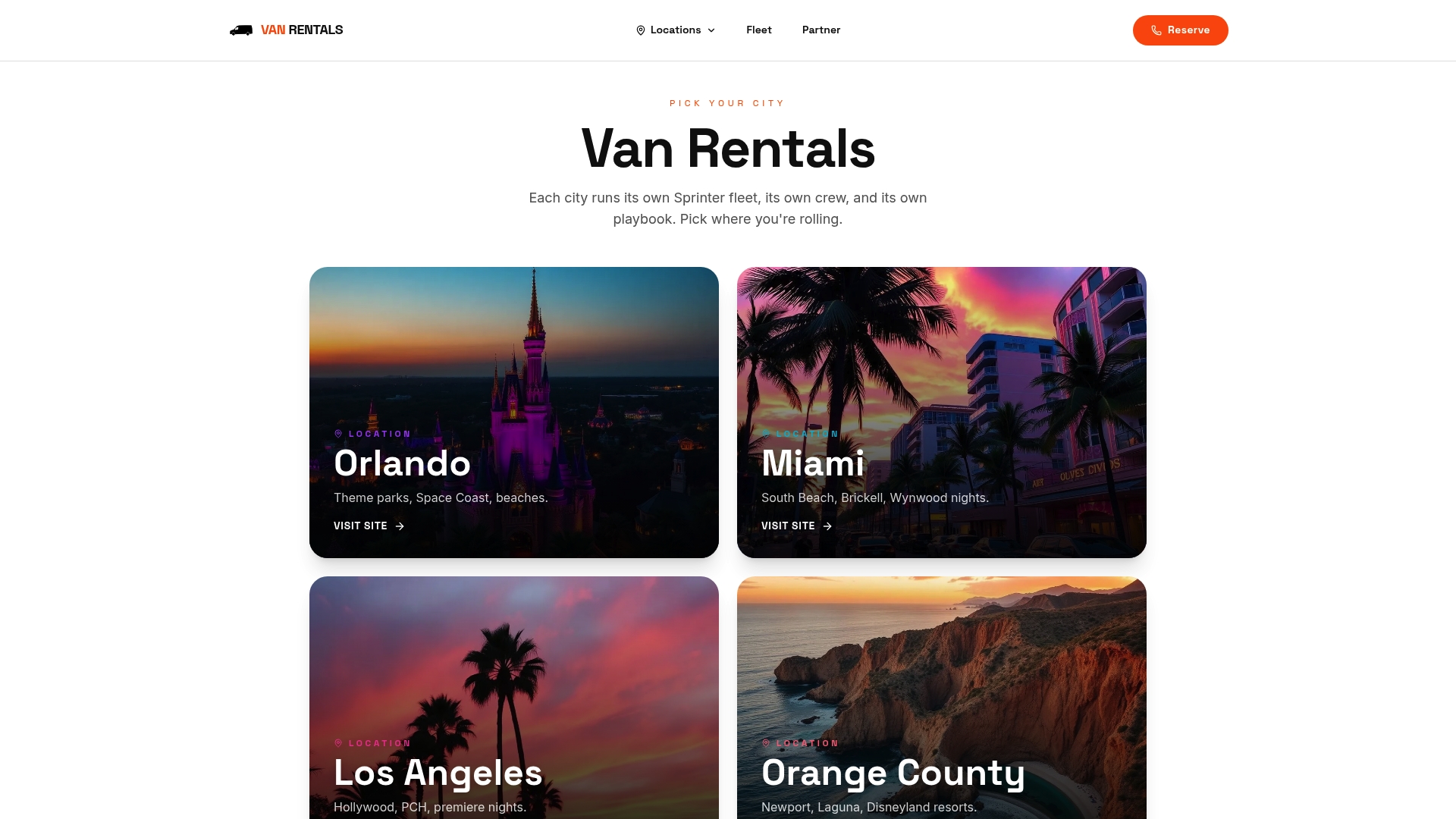
We built our service around group travel. You can reserve a 12 or 15 passenger van, or a Sprinter, Transit or minivan, in major U.S. cities. We offer airport pickup, delivery to hotels or venues, and school programs that include tax-exempt and PO billing. Church and event programs run the same way.
Start on our home page to choose your city and dates, or browse the full fleet to match the van to your group.
Our view: one van, one plan
Student groups travel best when they stay together. One vehicle means one schedule, one meeting point and one head count. That is why we focus on 12 and 15 passenger vans.
We think the planning matters as much as the van. Pick the right size. Know which rules apply to your students. Use rested, qualified drivers. Wear belts. Give the briefing.
Our job is to make the booking part simple. We show live pricing, we aim for no surprise charges at pickup, and we can deliver the van to your hotel or venue. Schools and churches can use tax-exempt and PO billing. Our fleet is insured and modern, and we have local teams in major cities.
If you plan well and book early, your group arrives together and on time.
Gabriel
FAQ
Can a student group rent a 15-passenger van?
Yes, for many groups. Federal law restricts the sale or lease of new 12- and 15-passenger vans for school-related transport of high school and younger students, and it does not extend that restriction to college students. Check your school, district or university policy first, and confirm who may drive.
What do I need to check before booking a school group van rental?
Get the operator’s USDOT number, check its safety record in the FMCSA search tool, and verify insurance and belts in every seat. The NTSB’s checklist lists these steps. Then confirm in writing who can drive and what the rental price includes.
How many drivers does a student trip need?
For long trips, plan at least two drivers per 500 miles, according to the University of Florida guide. Use trained, rested, non-student drivers. Limit driving to about 8 hours a day.
Does a student group van driver need a CDL?
A CDL is generally not required for a 15-passenger van, but it is preferred by some risk managers. Rules also vary by state, school and whether the trip crosses state lines. Ask your school or insurer which standard applies.
Sources
- Sport Club Travel Preparation and Procedures Guide, University of Florida
- Passenger Carrier Search by Vehicle, FMCSA
- January 2004 letter regarding 15-passenger vans, University of California Office of the President
- Passenger Vans, Maine Department of Education
- School District Checklist: Charter the Safest Vehicles, NTSB
- Tips for Chartering a Bus, FMCSA
- Education-Related Transportation, FMCSA
- 12- and 15-Passenger Vans, Sadler Sports