Save Fuel on Long Trips: Passenger Van MPG for Renters, 11–22 MPG
Save Fuel on Long Trips: Passenger Van MPG for Renters, 11–22 MPG
Expect varying MPG depending on the van size and type, with minivans and compact passenger wagons generally offering the best fuel efficiency and full-size 12 or 15-passenger vans offering lower MPG unless equipped with a diesel Sprinter or operated with light loads. If fuel economy is your priority, a compact passenger wagon or a diesel Sprinter beats a gas V8 full-size van on nearly every trip.
TL;DR:
- Minivans and hybrid passenger wagons can achieve over 30 MPGe, but their limited capacity makes them ideal only for small groups of up to eight people.
- Full-size passenger vans typically deliver 11 to 18 real-world MPG, with diesel Sprinters outperforming gas models at highway speeds when loaded.
- Loaded full-size vans often lose 15% to 30% of their EPA-rated MPG, especially with heavy payloads, high roofs, or roof racks increasing aerodynamic drag.
- Real-world MPG for popular models like the Mercedes Benz Metris and Ford Transit Connect stays close to their EPA estimates, while larger vans see more significant drops.
- Small, deliberate adjustments such as checking tire pressure, avoiding roof racks, and maintaining steady speeds can noticeably improve fuel economy during long trips.
Table of Contents
- Comparing Passenger Van MPG by Class
- EPA Ratings vs. Real-World Loaded MPG
- Real MPG Numbers for Popular Passenger Van Models
- What Actually Moves the Needle on Passenger Van Fuel Economy
- How to Estimate Fuel Costs for Your Trip
- Simple Ways to Improve Your Van’s MPG
- What Renters Get Wrong About Passenger Van MPG
- Book the Right Van for Your MPG Priorities
- Where the Numbers Come From
- Sources
- FAQ
Comparing Passenger Van MPG by Class
Not every passenger van burns fuel the same way, and the differences are bigger than most renters expect. A minivan sips gas compared to a 15-passenger van, but it also can’t seat more than eight. Picking the right class means weighing MPG against how many seats and how much cargo room you actually need.
Minivans and hybrid passenger wagons sit at the top of the fuel economy chart. Hybrid minivans can post figures north of 30 MPGe, which makes them the obvious pick for smaller groups who care more about the pump than passenger count. The trade-off is capacity. Once you need more than 7 or 8 seats, minivans are out of the running entirely.
Compact passenger vans like the Ford Transit Connect and Mercedes Metris hold the middle ground. These run around 19 to 23 combined MPG in both EPA testing and everyday driving, giving you 7 to 8 seats without the fuel penalty that comes with a full-size van. They’re a strong fit for airport runs, small tour groups, or church groups that don’t need the full 12 or 15-seat capacity.
Full-size 12 and 15-passenger vans cover the widest range, typically landing between 11 and 18 combined MPG once loaded with people and luggage. Diesel Sprinter variants routinely beat gas-powered full-size vans, often by several MPG at highway speeds.
Here’s how the trade offs break down by class:
- Minivans and hybrid wagons: highest MPG, lowest seating capacity, best for groups of 8 or fewer.
- Compact passenger vans (Transit Connect, Metris): solid middle ground on both fuel economy and seating.
- Full-size gas vans (Transit, Express, ProMaster passenger): most seating flexibility, weakest MPG, especially loaded and at highway speed.
- Full-size diesel vans (Sprinter): near full-size capacity with meaningfully better highway MPG than gas competitors.
Your best move is matching the class to your group size first, then optimizing within that class for the engine and configuration that protects your MPG the most.
EPA Ratings vs. Real-World Loaded MPG
EPA combined MPG numbers are a useful starting point, but they rarely match what you’ll see with a full van and a loaded roof rack. The EPA test cycle doesn’t account for eight adults, luggage, and a cooler in the back, and that gap matters more the bigger the van gets.
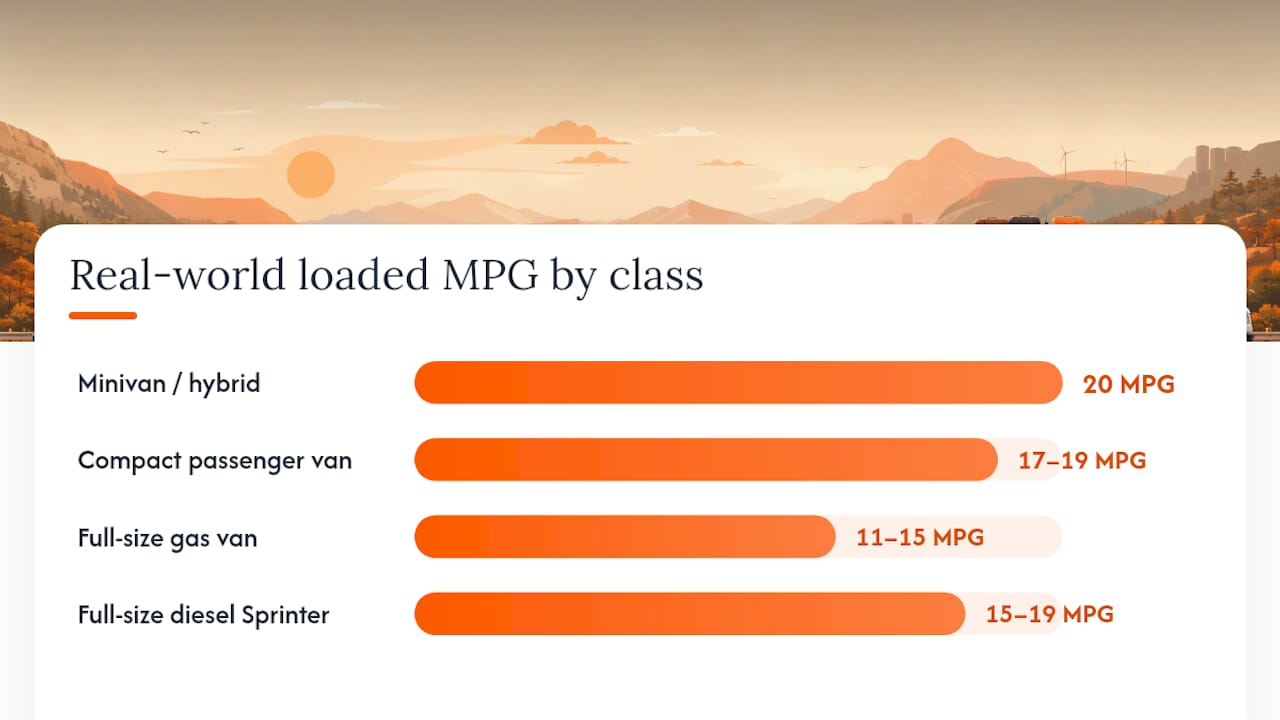
Minivans and hybrid wagons see the smallest EPA-to-real-world gap because they’re lighter and rarely pushed to full capacity. Compact passenger vans like the Metris and Transit Connect track fairly close to their EPA numbers too, usually within a couple MPG under normal loads.
Full-size 12 and 15-passenger vans see the biggest drop. Owner-aggregated data show these vans commonly lose 15% to 30% of their EPA-rated MPG once you load them with passengers and gear. A van rated at 16 combined might realistically deliver 12 to 14 MPG on a family road trip with everyone and everything on board.
| Van class | EPA combined MPG (typical) | Real-world loaded MPG (typical) |
|---|---|---|
| Minivan / hybrid wagon | 22 to 30+ | 20 |
| Compact passenger van | 19 to 23 | 17 to 19 |
| Full-size gas van (12/15-pass) | 14 to 17 | 11 to 15 |
| Full-size diesel van (Sprinter) | 17 to 20+ | 15 to 19 |
The size of that gap depends on three things: engine type, roof height, and whether the van has been converted with extra equipment. A high-roof Sprinter with a rooftop AC unit and shelving will burn noticeably more fuel than a low-roof passenger version doing the same route. Diesel engines tend to hold their highway MPG better under load than gas engines, which is part of why fleet operators lean toward diesel Sprinters for long-distance group trips.
Real MPG Numbers for Popular Passenger Van Models
Specific numbers help more than ranges when you’re comparing two vans side by side. Here’s what the data shows for the models renters ask about most.
| Model | EPA combined MPG | Real-world combined MPG | Engine/fuel | Note |
|---|---|---|---|---|
| Ford Transit Connect (passenger wagon) | ~23 | 20 to 23 | Gasoline | Historically EPA-rated near 19 combined; light loads keep it close to rated MPG |
| Mercedes-Benz Metris Passenger | 19 | 17 to 19 | Gasoline | EPA-rated at 19 combined, 18 city / 22 highway |
| Ford Transit Passenger Van | 16 to 17 | 14 to 17 | Gasoline | Edmunds lists combined near 16 to 17; owner estimates run lower when full |
| Mercedes-Benz Sprinter Passenger (diesel) | 17 to 20+ | 17 to 22 | Diesel | Fleet and van-life data show diesel Sprinters leading real-world full-size MPG |
| Chevrolet Express Passenger Van | Not EPA-tested (gross weight exempt) | 11 to 14 | Gasoline (V8) | Gas V8 full-size vans commonly land in the low teens combined |
| Ram ProMaster Passenger Van | Not widely EPA-listed for passenger trim | 14 to 17 | Gasoline | Real-world figures track close to comparable full-size gas vans |
A few notes on why the real-world column moves the way it does. The Transit Connect and Metris stay close to their EPA numbers because they’re rarely pushed to full capacity and don’t carry heavy roof modifications. The full-size Ford Transit passenger van shows a wider spread because trim, roof height, and rear-wheel versus all-wheel drive all shift the number, and Edmunds’ listed figures assume a lighter load than a 15-passenger van running at capacity.
The Sprinter diesel holds its number better than any other full-size van in this table, which is the main reason fleet operators reach for it on long highway runs. The Chevrolet Express, by contrast, isn’t formally EPA-tested in its heavier passenger configuration because it falls into a weight class that’s exempt from the standard rating, so the 11 to 14 MPG figure reflects owner and fleet reporting rather than a government test.
What Actually Moves the Needle on Passenger Van Fuel Economy
MPG numbers on a spec sheet assume ideal conditions. Real trips rarely deliver ideal conditions, and a handful of factors explain most of the gap between the number on the window sticker and the number on your dashboard.
Payload is the biggest one. Fleet-focused guides estimate roughly a 1% MPG loss for every 100 pounds of added weight, which adds up fast once you count 12 adults, luggage, and coolers. A van that’s EPA-rated at 17 MPG empty can easily drop two or three MPG once it’s carrying a full 15-passenger load.

Roof height and rooftop accessories come next. A rooftop cargo carrier or roof rack can cut highway MPG by 5% to 15% due to added drag, and that penalty grows the faster you drive. Choosing a low or medium roof configuration when it’s available is one of the few controllable decisions that meaningfully protects your MPG on a long highway trip.
Engine and drivetrain matter too. Diesel engines generally hold MPG better than gas under load, and all-wheel drive versions of any van carry a fuel penalty compared to their rear-wheel drive counterparts. Driving style plays a role as well: steady highway cruising beats stop-and-go city driving, heavy AC use costs real MPG in summer heat, and headwinds or mountain grades will eat into your number no matter how efficient the van is on paper.
Here’s what tends to hurt MPG the most, in rough order of impact:
- Heavy passenger and cargo loads, especially on long highway trips.
- Rooftop carriers or racks, which create drag at highway speeds.
- High-roof configurations, which increase wind resistance compared to low or medium roofs.
- All-wheel drive, which adds mechanical drag versus rear-wheel drive.
- Heavy AC use and stop-and-go city driving, both of which drag down highway-rated numbers.
Pro Tip: Check tire pressure before every long trip. Underinflated tires are one of the cheapest fixes available and can meaningfully improve MPG on a fully loaded van, especially on multi-day rentals where nobody thinks to check it after day one.
How to Estimate Fuel Costs for Your Trip
Once you know your van’s realistic MPG, estimating fuel cost for a trip takes two simple steps.
- Divide your trip distance by your van’s real-world MPG to get gallons needed. A 300-mile trip in a van averaging 18 MPG needs about 16.7 gallons.
- Multiply gallons needed by the current price per gallon at your fuel stops to get total cost. At $3.50 a gallon, that 300-mile Sprinter diesel trip runs about $58.
- Repeat the math for mixed driving conditions, since city stretches lower your MPG. A 200-mile trip in a loaded Transit averaging 14 MPG needs about 14.3 gallons, or roughly $50 at $3.50 a gallon.
- Check current pump prices before you commit to a route, since a few cents per gallon adds up fast across a multi-day rental with a full tank of diesel or gas.
These two worked examples show why van choice matters as much as route planning. The Sprinter diesel trip covers 100 more miles than the Transit trip and still costs roughly the same, purely because of the MPG gap between the two vans.
Simple Ways to Improve Your Van’s MPG
Small changes add up over a multi-day trip, and most of them cost nothing.
Before you leave, check tire pressure, clear out anything you don’t need for the trip, and pick the smallest van class that still fits your group comfortably. On the road, hold steady highway speeds, use cruise control where you can, and accelerate gently instead of flooring it away from every stoplight. Heavy AC use costs MPG, so use it deliberately rather than constantly on max.
If you’re renting, ask about diesel or hybrid options up front, and confirm whether a low-roof configuration is available for your group size. Skip the rooftop rack unless you genuinely need the extra cargo space, since that alone can cost you real MPG at highway speeds.
- Before you go: check tire pressure, cut unnecessary weight, pick the right-size van for your group.
- While driving: hold steady speeds, use cruise control, accelerate gently, manage AC use.
- When booking: ask about diesel or low-roof options, and skip roof racks you don’t need.
Pro Tip: Plan your fuel stops around price, not just convenience. Gas prices can swing 30 to 50 cents a gallon between exits on a long highway route, and stopping to fill up at the right exit can save real money over a multi-day trip.
What Renters Get Wrong About Passenger Van MPG
Most people renting a 12 or 15-passenger van for the first time assume the EPA number on a spec sheet is what they’ll actually see at the pump. It almost never is, and the gap catches people off guard on long highway trips more than short local ones. MPG differences that feel small on a 20-mile airport run become real money on a 400-mile drive to a wedding or tournament.
The renters who plan around fuel economy tend to ask better questions upfront: how many seats do they truly need, is a diesel Sprinter available, and does the trip involve enough highway miles to justify the switch from a gas van. Groups doing mostly city driving rarely see enough of a difference to change their van choice. Groups covering 300 or more highway miles almost always do.
What surprises people most is how much a rooftop carrier can cost them. A group that adds a cargo box for extra luggage space often loses more MPG from the drag than they gain in convenience, especially on a van already running a high roof. If your trip is highway heavy, skip the rack and pack lighter instead.
Fuel efficiency is one factor among several. Reliability, seating comfort, and available pickup locations matter just as much for most groups, but MPG is the factor people underestimate the most until they’re paying for the second tank of gas.
— Gabriel
Book the Right Van for Your MPG Priorities
My Van Rentals gives you a real choice instead of a one-size-fits-all fleet. If highway fuel economy matters for your trip, you can book a diesel Mercedes Sprinter for full-size capacity without the gas V8 penalty, or step down to a Ford Transit low-roof configuration to cut the aerodynamic drag that comes with a high roof. Smaller groups get the same flexibility with a Mercedes Metris or a standard minivan that trades seating capacity for meaningfully better MPG.

Every van in the fleet comes with real fuel economy expectations, not just a spec sheet number, so you can match your trip distance and group size to a van that won’t surprise you at the pump. Search availability and pick your city on the My Van Rentals homepage to compare options and book the van that fits your MPG priorities.
Where the Numbers Come From
The MPG figures and ranges in this article come from a short list of sources worth bookmarking if you’re comparing vans on your own:
- Fueleconomy, the EPA’s official vehicle fuel economy database.
- Edmunds, for model-specific MPG and spec data.
- The VanSmith, for real-world van fuel economy analysis.
For a broader look at fuel economy trade offs across fleet vehicles, this fleet manager’s guide to hybrid fleets covers the operational side of the decision.
Sources
- Fueleconomy
- Van With Best Gas Mileage: Most fuel-efficient vans — The VanSmith
- 2025 Ford Transit Passenger Van MPG & gas mileage data — Edmunds
FAQ
What passenger van has the best MPG?
Among passenger vans, minivans and hybrid wagons post the highest MPG, often 30 MPGe or more. Among full-size 12 and 15-passenger vans, diesel Sprinter variants typically lead with real-world combined MPG in the 17 to 22 range.
What is the MPG for a 12-passenger van?
A 12-passenger van typically gets 11 to 18 combined MPG in real-world use, with gas V8 models like the Chevrolet Express landing in the low teens and diesel Sprinters reaching the higher end of that range. Owner data shows full-size vans commonly lose 15% to 30% of EPA-rated MPG once loaded.
What is the MPG of a 15-passenger van?
A 15-passenger van follows a similar range to a 12-passenger van, roughly 11 to 17 combined MPG in real-world conditions, since the extra seats add weight without changing the underlying engine or aerodynamics much. Loading it to capacity pushes the number toward the lower end of that band.
What is the gas mileage of a Ford Transit passenger van?
The Ford Transit passenger van shows combined figures near 16 to 17 MPG in current model listings, with owner and fleet estimates running a few MPG lower once the van is loaded with passengers and gear. High-roof and all-wheel drive versions tend to land at the lower end of that range.