5 Steps to Measure Your Van as Equipped for Renters
5 Steps to Measure Your Van as Equipped for Renters
Most parking garages post clearances between 6’8" and 8’2", with the federal ADA standard requiring at least 8’2" (98 inches) on routes serving van-accessible spaces. High-roof vans often exceed that. Before you drive into any garage, measure your van fully loaded and equipped, then add a safety buffer to that number.
TL;DR:
- Always measure your van’s fully loaded height, including rooftop accessories, and add a safety buffer of 3 to 6 inches before entering a garage.
- Many garages built before modern codes have clearances as low as 6’8", but newer structures usually meet or exceed the ADA minimum of 8’2" for van routes.
- Ledgered heights on signs may not reflect actual clearances, as internal obstructions, rooftop gear, and level differences can reduce usable headroom.
- Van models vary significantly, with high-roof versions often exceeding 8’6", making precise measurement crucial for safe parking.
- Contact garages ahead, verify interior conditions, and re-measure after adding or removing rooftop gear to avoid costly damage.
Table of Contents
- What Are Typical Parking Garage Height Clearances?
- How Do You Measure Your Van’s Actual Height?
- How Tall Are Common Vans Like the Sprinter and Transit?
- How Do You Verify a Garage’s Clearance Before You Arrive?
- What Should You Do If Your Van Won’t Fit?
- Practical Checks for Renters and Fleet Operators
- Why “Close Enough” Is the Most Dangerous Number in This Whole Topic
- Sources
- FAQ
What Are Typical Parking Garage Height Clearances?
Garage clearance depends heavily on when and why the structure was built. Older downtown parking decks, many built decades before accessibility codes tightened, sometimes post clearances as low as 6’8". Newer garages, especially those built to serve retail centers or mixed-use developments, tend to run higher.
The common code baseline for ordinary parking spaces sits at 7’0" (84 inches), according to practical clearance guides that track garage design across the country. That number covers standard-height vehicles, not vans with raised rooflines.
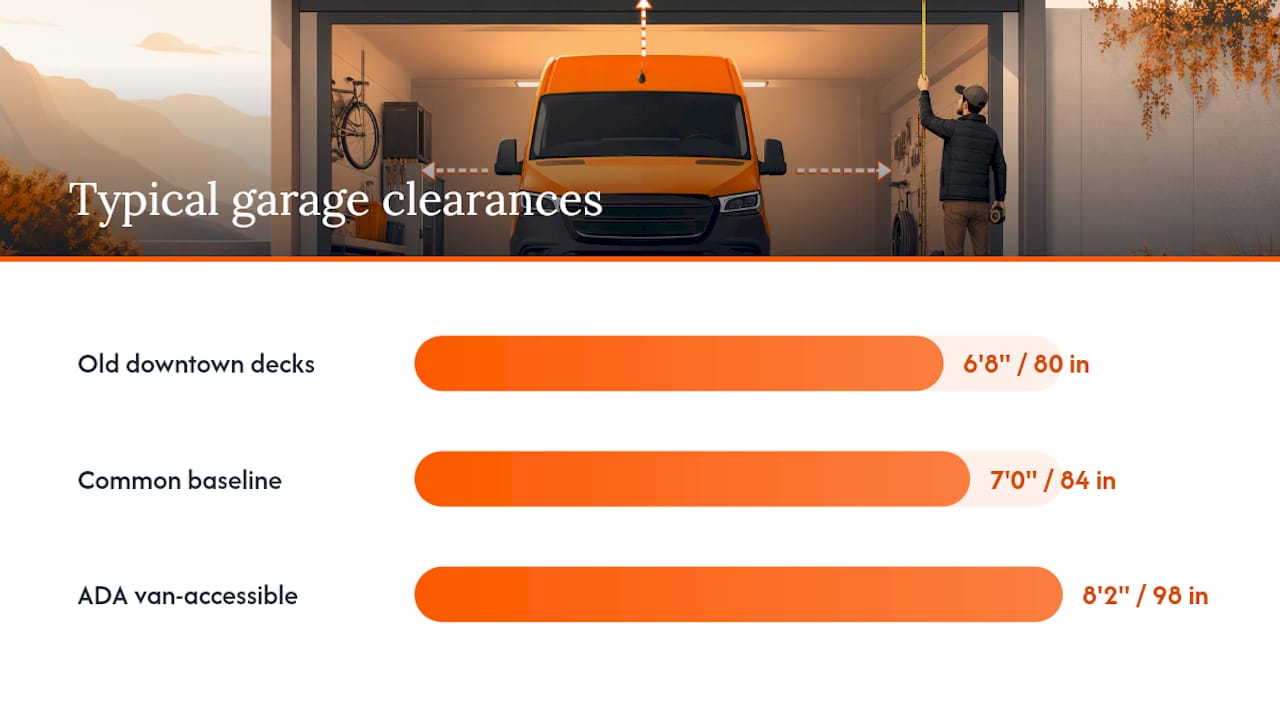
Van-accessible routes are a different story. The ADA requires 98 inches, or 8’2", of vertical clearance along any path serving accessible van parking. That extra headroom accounts for raised roofs and wheelchair lifts, which is exactly why van drivers should look for facilities that mention van-accessible routes specifically.
A few things worth knowing before you commit to a garage:
- Posted clearance signs are the legal, authoritative number. Treat them as fact, not as a rough guess.
- Clearance can change level to level inside the same garage, especially near lower ceiling beams or mechanical rooms.
- Airport garages and newer mixed-use structures often run taller than older downtown decks built before modern codes.
- A facility meeting the ADA 8’2" minimum on its accessible route doesn’t guarantee 8’2" clearance everywhere else in the structure.
The number that matters most for tall vans is 98 inches. Anything close to that figure means you need an exact as-equipped measurement, not a guess based on your van’s spec sheet.
How Do You Measure Your Van’s Actual Height?
Spec sheets tell you the factory number. They don’t tell you what’s sitting on your roof right now. That gap is where most garage collisions happen.
Here’s a reliable way to get your real number:
- Park on level ground with your van at normal operating tire pressure and typical passenger or cargo load.
- Measure from the ground to the highest fixed point on the vehicle, not the roofline alone.
- Include every rooftop accessory: antennas, A/C units, roof racks, light bars, or cargo boxes.
- Round up to the nearest whole inch, never down.
- Subtract that number from the garage’s posted clearance to see your actual margin.
Rooftop accessories are the most commonly overlooked variable. Industry guidance on Ford Transit roof configurations points out that factory height specs frequently exclude add-ons like A/C condensers or shuttle-service light bars, which can add several inches nobody accounted for at purchase.
Once you have your as-equipped number, build in a cushion. A buffer of 3 to 6 inches between your measured height and the posted clearance gives you room for uneven pavement, sagging suspension under load, or a garage entrance that’s a hair lower than the main deck.
Pro Tip: Re-measure any time you add or remove rooftop gear, and again at pickup if you’re renting. A van that cleared a garage last month with an empty roof rack might not clear it today with a cargo box strapped on.
How Tall Are Common Vans Like the Sprinter and Transit?
Roof height varies enormously by model and trim, and the difference between a low roof and a high roof is often the difference between fitting comfortably and not fitting at all.
- Mercedes-Benz Sprinter: Low-roof models generally stay under 7’6", while high-roof configurations commonly measure in the high 8-foot range, with some builds pushing close to 9 feet overall height.
- Ford Transit: Low-roof Transits are the most garage-friendly of the bunch, typically clearing under 7 feet. Medium and high-roof versions climb well past 8 feet, and dealer spec pages show meaningful variation by model year and trim.
- Ram ProMaster: Low-roof ProMasters run similar to low-roof Transits, generally in the 7-foot neighborhood. High-roof versions exceed most standard garage clearances by a wide margin.
- Chevrolet Express: As a traditional full-size van rather than a European-style high-cube design, the Express tends to run lower overall, often clearing 7 to 7’5" depending on the roof rack or upfit.
None of these ranges are guarantees. Published dimensions shift by model year, trim package, and any upfitting done after the van left the factory. If you’re renting or buying, confirm the specific vehicle’s height rather than relying on a general category number. My Van Rentals breaks down exact figures for Sprinter mirror height and interior headroom so renters can check before they ever pull up to a garage entrance.
How Do You Verify a Garage’s Clearance Before You Arrive?
A posted number at the entrance is a starting point, not the whole picture. Internal hazards routinely reduce usable headroom below what the sign says.
- Check the garage operator’s website or a parking app for the posted clearance before you leave.
- Call the facility directly and ask about interior obstructions like sprinkler pipes, ductwork, or lighting fixtures that hang lower than the entrance.
- Ask whether clearance changes level to level, since many multi-level garages have a taller ground floor and tighter upper decks.
- Use street view imagery to look at the entrance sign and approach angle, particularly if there’s a ramp or a low awning near the gate.
- If you’re still unsure once you arrive, have a passenger act as a spotter while you approach slowly.
Practical clearance guides consistently repeat this sequence for a reason: it catches problems before they become expensive ones. A five-minute phone call beats a scraped roof every time.
What Should You Do If Your Van Won’t Fit?
Forcing a tall van into a garage that’s too short risks serious damage, from a torn-off A/C unit to a crushed roof rack, and most parking facilities won’t cover that damage under their liability policies.
If your measured height doesn’t leave a safe margin, here’s what to do instead:
- Look for surface lots nearby, which have no overhead clearance issue at all.
- Ask the garage operator about an oversize-vehicle or commercial parking area. Many facilities keep one even when the main deck runs low.
- Use curbside loading or valet service if the venue offers it, especially for airport pickups or event drop-offs.
- Remove or stow rooftop gear temporarily if that’s enough to get you under the clearance with your buffer intact.
- Shift to a different, taller garage and walk the extra block rather than gambling on a tight fit.
Parking operators often maintain a dedicated oversize area even when general clearance is posted low. A quick phone call before you arrive can save you the maneuver entirely.
Practical Checks for Renters and Fleet Operators
Fleet managers who avoid garage damage all run the same short checklist: measure the van at pickup, confirm what’s actually mounted on the roof, verify the posted clearance on the planned route, and ask the facility about alternative parking before committing to a garage.

That last step matters more for rentals than owned vehicles, since the exact roof height can vary between two vans of the same model name. Before you book, check the Sprinter dimensions and headroom breakdown so you know what you’re getting into, and confirm availability on the main booking page once you’ve settled on the right roof height for your route.
Fleet operators managing multiple vans over time should also build routine upkeep into the process. Programs like Sprinter van maintenance services help catch suspension sag or tire wear that can quietly add inches to a van’s effective height over months of use.
Why “Close Enough” Is the Most Dangerous Number in This Whole Topic
Most advice on van height treats the spec sheet as gospel. It isn’t. The real danger zone isn’t the van that’s obviously too tall for a garage. It’s the one that’s within an inch or two of the posted clearance, because that’s exactly where drivers stop measuring and start guessing.
The conventional wisdom says “check the sign at the entrance.” That’s necessary but nowhere near sufficient. The sign tells you what the facility promises at the gate. It says nothing about the sprinkler pipe hanging six inches lower two rows in, or the roof rack you installed last spring and forgot to factor back in.
If there’s one habit worth building, it’s this: measure as-equipped, every time, not once at purchase. Rental vans especially can vary from unit to unit even under the same model name. Renters who skip that step are trusting a stranger’s roof rack decisions from months ago. Do the five-minute measurement, build in your buffer, and treat the posted number as a ceiling you’re trying to stay well under, not a target you’re trying to hit exactly.
— Gabriel
Sources
- Willifit
- Mercedes‑Benz Sprinter dimensions (ISeeCars)
- Can a cargo van fit in a parking garage? (Peregraph)
FAQ
What Is the Height Clearance of Most Parking Garages?
Most garages post clearances between 6’8" and 8’2", with 7’0" as a common baseline for standard spaces. Van-accessible routes must meet the federal ADA minimum of 8’2" (98 inches), though internal obstructions can reduce that usable headroom.
Will a 15-Passenger Van Fit in a Parking Garage?
It depends entirely on the roof height. A low-roof van, such as a Chevrolet Express, often clears 7 to 7’5" and fits many standard garages, while a high-roof Sprinter or Transit can exceed 8’6" and won’t clear most decks.
Will an F-150 Fit in a Parking Garage?
A standard Ford pickup typically stands around 6’4" to 6’8" depending on cab and trim, which fits under most garage clearances without modification. Aftermarket lift kits, roof racks, or oversized tires can push that height closer to the 7’0" code minimum, so it’s worth measuring after any modification.
What Is the Standard Garage Door Height for a Sprinter Van?
There’s no universal “standard” garage door height for Sprinters since clearance depends on the specific garage, not the van. Sprinter high-roof models commonly measure in the high 8-foot range, so drivers should confirm their exact as-equipped height against each garage’s posted number rather than assuming a fixed figure.