Miami Traffic Times: Why 10:30 AM to 2:30 PM Is Often the Fastest Window
Miami Traffic Times: Why 10:30 AM to 2:30 PM Is Often the Fastest Window
Miami’s morning rush runs roughly 7:00 to 9:30 AM, and the evening rush from about 4:00 to 7:30 PM is worse. The calmest stretch for cross-city driving falls between 10:30 AM and 2:30 PM. TomTom’s traffic data confirms evening delays outpace the morning, and Miami-Dade’s Metrorail schedule gives you a backup plan for downtown trips. If you can shift your departure into that midday window, do it.
TL;DR:
- Traveling between 10:30 AM and 2:30 PM significantly reduces driving time, as highways are least congested during this midday window.
- I-95, Palmetto Expressway, and Miami Beach causeways are consistently the worst traffic bottlenecks, especially during evening rush and weekend nights.
- Evening congestion levels reach around 86.3%, adding about four minutes to every 10 km drive compared to mornings, costing drivers an estimated 6.1 days annually.
- Using Metrorail, Metromover, or rideshare can often bypass peak-hour gridlock, particularly for downtown and Brickell trips.
- Accounting for unpredictable factors like weather, crashes, and construction is essential; check live traffic maps before leaving, especially for airport and event-related trips.
Table of Contents
- What Are the Typical Miami Rush Hour Times on Weekdays?
- Which Miami Highways and Corridors Get Worst?
- How Much Time Does Miami Traffic Actually Cost You?
- How Can You Avoid Miami Traffic?
- When Should You Use Transit Instead of Driving?
- What Else Changes Miami’s Traffic Patterns?
- A Planner’s Take on Buffer Time for Group Trips
- Skip the Multi-Car Headache With One Miami Van
- Where to Check Live Miami Traffic Before You Leave
- Sources
- FAQ
What Are the Typical Miami Rush Hour Times on Weekdays?
Weekday traffic follows a predictable rhythm, and knowing the shape of it helps you pick a smarter departure time than just guessing.
- Morning peak (about 7:00–9:30 AM): Traffic builds steadily as commuters head downtown and toward Brickell, then tapers off closer to 9:30.
- Midday lull (about 10:30 AM–2:30 PM): Highways and surface streets move freely. Short and medium drives are fastest here, and it’s the window most local guides recommend for cross-city trips.
- Evening peak (about 4:00–7:00 or 7:30 PM): This stretch runs longer and heavier than the morning, especially on I-95 and the Palmetto, as workers head home and traffic merges with school pickups and dinner traffic.
- Weekends and Fridays: Evening congestion often starts earlier on Fridays, and nightlife traffic around Miami Beach and Downtown can push delays past 7:30 PM, especially on weekend nights.
Which Miami Highways and Corridors Get Worst?
Certain corridors bear the brunt of Miami’s congestion almost every day, and knowing them lets you plan a detour before you’re stuck in one.
- I-95: The main north-south artery through Miami-Dade backs up heavily during both rush periods, particularly near the Golden Glades interchange and downtown exits.
- Palmetto Expressway (826): A frequent bottleneck for east-west traffic, especially where it meets the Dolphin Expressway and near Miami International Airport.
- Dolphin Expressway (836): Airport-bound traffic converges here, and delays spike sharply during afternoon flight rushes and evening rush hour combined.
- Florida’s Turnpike: Congestion builds where it feeds into 826 and 95, particularly for commuters coming from the western suburbs.
- Causeways to Miami Beach (MacArthur, Julia Tuttle, Venetian): These narrow, bridge-heavy routes back up fast during evening rush and again during weekend beach traffic.
- Downtown and Brickell approaches: Merge points near the Miami River bridges and the I-395/I-95 interchange are chronic pinch points, worsened further by event traffic at venues like Kaseya Center or Bayfront Park.
Airport routes deserve special mention. Trips between Miami International Airport and South Beach can balloon from a normal 20-minute drive into 45 minutes or more once evening rush and flight-arrival traffic overlap.
How Much Time Does Miami Traffic Actually Cost You?
The numbers back up what Miami drivers already suspect: evenings are worse than mornings, not just anecdotally but measurably.
TomTom’s 2025 traffic index found that a 10 km drive across Miami averaged 19 minutes and 56 seconds during morning rush, compared to 23 minutes and 43 seconds during evening rush.
| Metric | Morning Rush | Evening Rush |
|---|---|---|
| Time for 10 km | 19:56 | 23:43 |
| Congestion level | ~65.4% | ~86.3% |
Miami drivers reportedly lose around 6.1 days a year sitting in traffic. That’s not a fluke of bad luck. It’s the compounding cost of driving during the wrong two or three hours, day after day.
GeoStat’s commute data, drawn from Census American Community Survey figures, shows why the morning peak forms where it does: a large cluster of commuters leaves between 7:00 and 8:30 AM, with departures tapering off through 9:00. For a quick 10 to 20 minute errand, the difference between rush and off-peak might only cost you five extra minutes. For a cross-city haul from Kendall to the Beach, the gap between smart timing and bad timing can eat up half an hour or more.
How Can You Avoid Miami Traffic?
You can’t eliminate Miami traffic, but you can dodge most of it with a little planning.
- Time your departure around the lull. Aim for the 10:30 AM to 2:30 PM window for cross-city trips whenever your schedule allows it.
- Choose your route based on trip length. Short local drives often move faster on surface streets than fighting your way onto a jammed highway ramp. Cross-city trips still need the highway, but avoid entering I-95 or the Palmetto right at their worst chokepoints.
- Check real-time conditions before you leave. NBC Miami’s traffic map tracks live incidents and closures, and a standard map app layered with crash reports catches problems a fixed schedule can’t predict.
- Consider express lanes for long highway stretches. Tolled express lanes on I-95 and 826 often move faster during peak hours, though they can fill up during major incidents. If you’re renting a car locally, it’s worth knowing whether you need a SunPass before you hit the toll roads.
- Build in extra buffer for airport runs. Flight schedules don’t bend for traffic, so pad your travel time generously during evening rush.
Pro Tip: If you’re coordinating a pickup for a group, don’t assume everyone hits green lights at the same rate. Build your buffer around the slowest possible route, not the average one.
When Should You Use Transit Instead of Driving?
Sometimes the smartest move isn’t a better route. It’s skipping the road entirely.
- Metrorail and Metromover work well for downtown and Brickell trips, especially during peak hours when parking and gridlock both work against you. Check the Metrorail schedule before you go.
- Rideshare makes sense for one-way trips into parking-limited areas like South Beach, but fares and wait times climb fast during evening rush.
- A single rented van cuts through the guesswork entirely for groups. One driver, one route, one buffer to manage instead of three or four cars getting separated across different lanes of the same jam.
What Else Changes Miami’s Traffic Patterns?
Rush hour is the baseline, but Miami has a handful of wild cards that stretch those windows further.
- Winter high season brings a wave of visitors from November through April, thickening traffic near the Beach, Downtown, and MIA well beyond normal local commuter volume.
- Weekend nightlife and events at venues like Bayfront Park and Kaseya Center can extend evening congestion past 7:30 PM, especially on Friday and Saturday nights.
- Rain and crashes are the fastest way to turn a normal commute into a crawl. A single lane closure on I-95 can add 20 minutes or more with no warning.
- Construction zones shift over time, so it pays to check NBC Miami’s live traffic map for current alerts before a trip that matters.
A Planner’s Take on Buffer Time for Group Trips
Groups need bigger buffers than solo drivers, since one late car delays everyone. [brand_signal] A single meeting point and a set luggage-loading window keep pickups from unraveling. [internal_data]
— Gabriel
Skip the Multi-Car Headache With One Miami Van
A rented van can be a convenient alternative to splitting your group across multiple vehicles during evening rush hour, allowing one driver to manage timing and routes more easily.
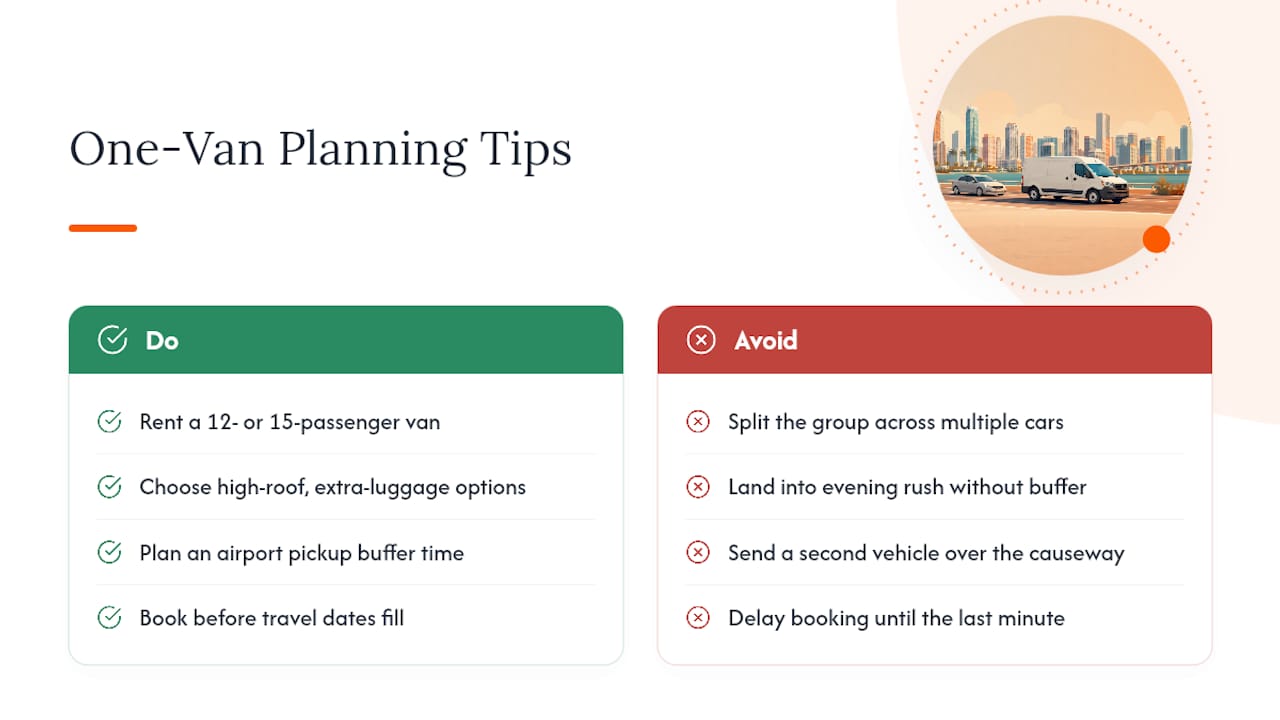
For groups heading to a wedding, a sports tournament, a church event, or just a family trip through South Florida, a 12 or 15-passenger van rental in Miami keeps everyone together instead of scattered across the causeway at different times. The fleet includes Ford Transit and Mercedes-Benz Sprinter vans with high-roof and extra-luggage options, so bags and passengers both fit without a second trip. If you’re flying into MIA, planning your airport pickup buffer ahead of time avoids the scramble that comes with landing right into evening rush. And if your group’s headed for the sand, the Miami Beach van rental page covers the causeway crossing without anyone getting lost in a second vehicle.
Ready to lock in a vehicle for your next Miami trip? Check availability on the van rentals by city page and book before your travel dates fill up.
Where to Check Live Miami Traffic Before You Leave
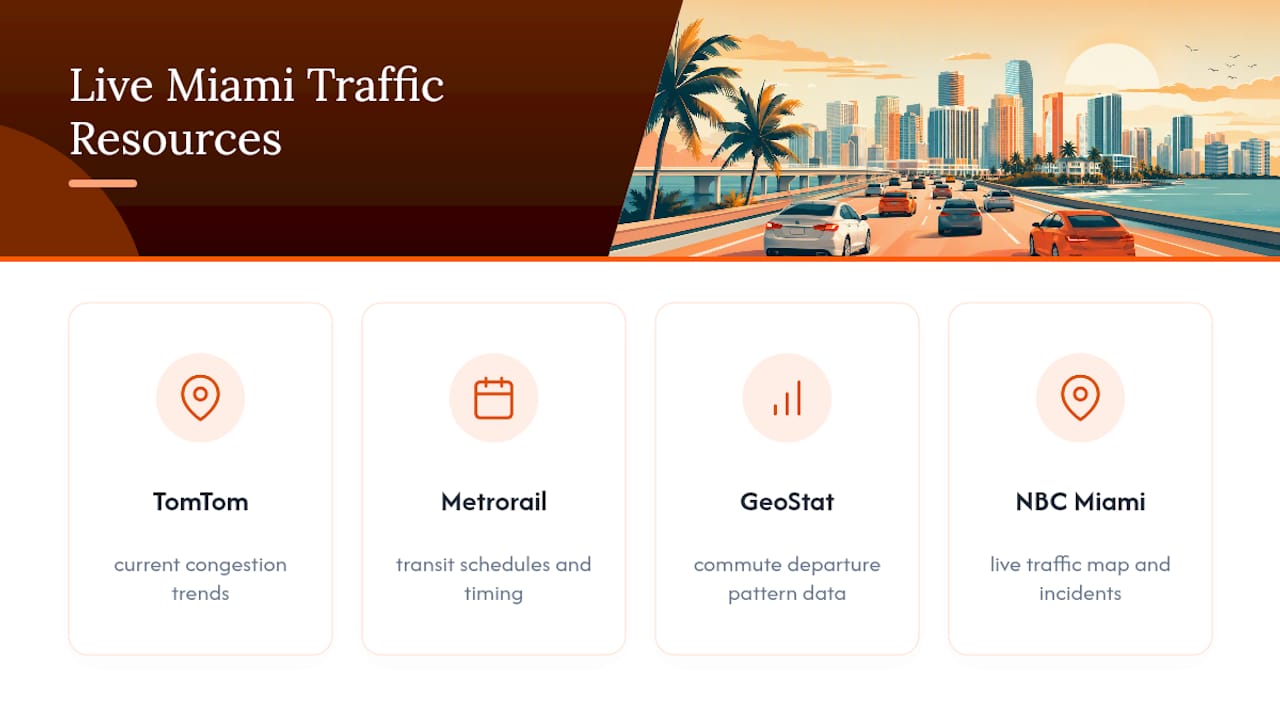
Before any trip that matters, check the TomTom Traffic Index for current congestion trends, the Metrorail schedule for transit timing, GeoStat’s commute data for departure patterns, and NBC Miami’s traffic map for live incidents. If you’re flying out and need travel documents sorted quickly, Florida passport services are worth checking too.
Sources
- Miami, FL traffic report | TomTom Traffic Index
- Geostat
- Metrorail Schedules
- Miami traffic map – NBC 6 South Florida
FAQ
What Time Does Traffic Get Bad in Miami?
Traffic typically thickens by 7:00 AM and stays heavy until about 9:30 AM, then builds again around 4:00 PM and stays congested until roughly 7:00 to 7:30 PM.
What’s the Worst City in the U.S. for Traffic?
Rankings vary by year and methodology, but Miami consistently lands among the more congested large U.S. cities, with drivers losing an estimated 6.1 days a year to traffic delays.
When’s the Worst Time to Drive in Miami?
Evening rush between 4:00 and 7:30 PM on weekdays is generally the worst, with TomTom data showing congestion levels around 86.3% compared to roughly 65.4% in the morning.
How Do You Avoid Miami Traffic?
Drive between 10:30 AM and 2:30 PM when possible, check live conditions on NBC Miami’s traffic map before leaving, and consider Metrorail for downtown or Brickell trips instead of fighting highway congestion directly.
Is Traffic Worse on Weekends in Miami?
Weekend traffic shifts rather than disappears. Daytime hours tend to be calmer than weekday rush, but Friday and Saturday nights near Miami Beach and Downtown often stay congested well past 7:30 PM.