15 Seats, 425 cu ft: Ford Transit Passenger Specs for Buyers & Renters
15 Seats, 425 cu ft: Ford Transit Passenger Specs for Buyers & Renters
The Ford Transit passenger van seats up to 15 people, comes in low, medium, and high roof heights, and offers two gasoline V6 engines paired with a 10-speed automatic. Buyers choose between a 25-gallon standard fuel tank or a 31-gallon extended tank, and cargo volume behind the rear seats stretches to roughly 425 cubic feet on the largest configuration. The XL trim covers basic utility needs; the XLT adds comfort and technology upgrades for regular passenger service.
TL;DR:
- Cargo volume reaches up to 425 cubic feet behind the front seats in high-roof extended models, which offers the most space but requires taller garages.
- Towing capacity generally peaks around 4,500 pounds, with payload limits up to approximately 3,401 pounds, depending on configuration and seats.
- Fuel tank options include a standard 25-gallon tank and an extended 31-gallon tank, affecting range especially on long routes.
- Roof height and wheelbase significantly influence cargo capacity, overall height, and maneuverability, so match specifications to parking and loading needs.
- The 3.5L EcoBoost V6 engine provides a substantial power boost over the standard V6, improving trailer tow capacity and low-end performance.
Table of Contents
- Ford Transit Passenger Specs at a Glance
- Ford Transit Passenger Dimensions and Cargo Capacities
- How Are Ford Transit Passenger Seating Layouts Configured?
- Powertrain and Performance: What the Engines Deliver
- Towing, Payload, and Fuel Tank Options
- Safety and Driver-Assist Technology
- XL vs XLT: Trim Differences and Standard Equipment
- Ford Transit Passenger Pricing and Warranty Coverage
- How to Choose the Right Transit Configuration
- When Renting a Transit Beats Buying One
- What the Spec Sheet Doesn’t Tell You
- Renting a Ford Transit Without the Ownership Commitment
- Sources
- FAQ
Ford Transit Passenger Specs at a Glance
Before you dig into wheelbase numbers and payload math, here’s the shortlist of figures most buyers ask about first.
| Spec | Range |
|---|---|
| Seating capacity | 2, 12, or 15 passengers |
| Roof heights | Low, medium, and high roof options with a range of exterior heights |
| Engines | 3.5L PFDi V6, 3.5L EcoBoost V6 |
| Transmission | 10-speed automatic |
| Fuel tank | Standard and extended range fuel tank options |
| Cargo volume (behind row 1) | Cargo volume varies with configuration, with high-roof extended models offering the most space |
| Max towing | Maximum towing capacities depend on configuration |
| Max payload | Up to ~3,401 lbs |
A few things shift depending on how the van is built, including roof height and wheelbase length, both of which affect cargo volume and overall height numbers.
- Roof height and wheelbase length both move the cargo volume and overall height numbers.
- Payload capacity drops as you add passenger seats, so a 15-passenger build carries less freight room than a 2-seat cargo-style version.
- Towing capacity depends on the engine and axle setup chosen at order time.
Pro Tip: Always confirm the exact configuration with a dealer before finalizing a purchase or lease. Ford revises trim packages and standard equipment most model years, so a number you saw for last year’s Transit may not carry over.
Ford Transit Passenger Dimensions and Cargo Capacities
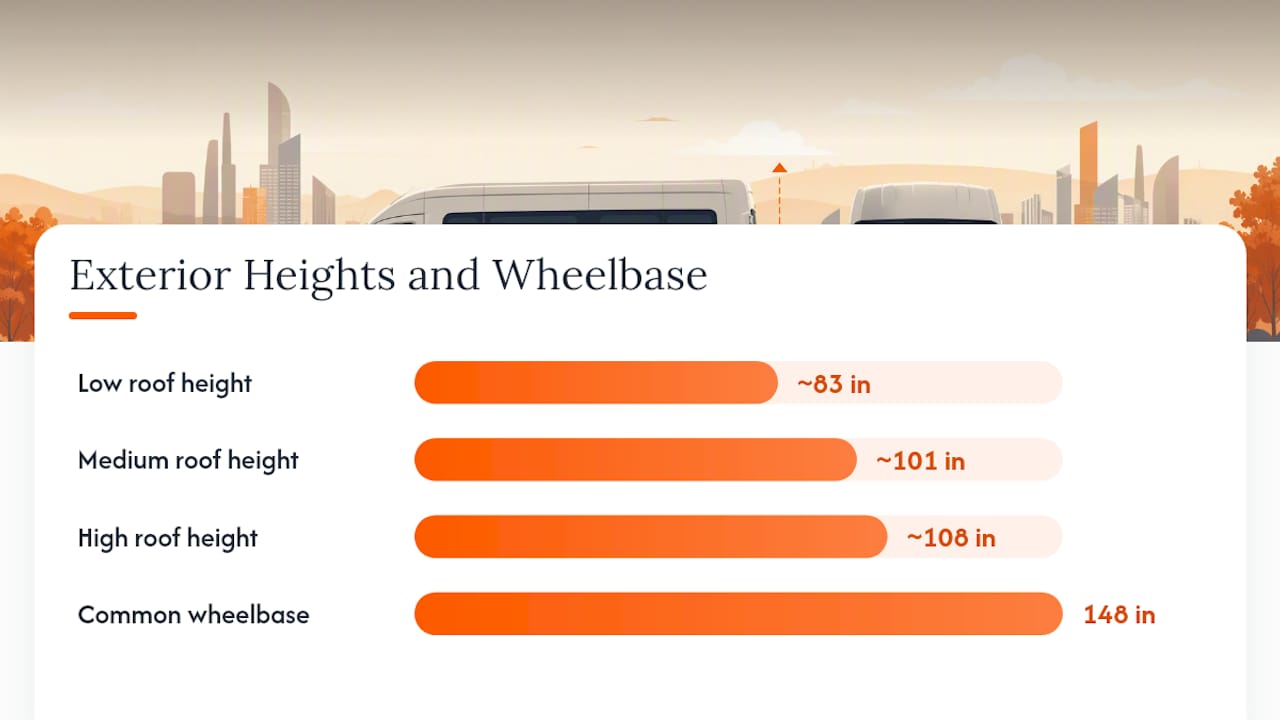
Exterior size determines what fits in your garage, what clears a parking structure, and how much luggage rides behind the last row of seats. The passenger van’s wheelbase most commonly measures 148 inches, though longer wheelbase options exist for extended-length builds.
Roof height is where the real variation shows up. Ford builds the Transit in three heights, and the jump between them changes both exterior clearance and usable headroom inside:
| Roof height | Approx. exterior height | Typical use case |
|---|---|---|
| Low roof | ~83 inches | Height-restricted parking, garages |
| Medium roof | ~101 inches | Balance of headroom and clearance |
| High roof | ~108 inches | Maximum standing headroom, cargo volume |
Cargo volume behind the first row climbs along with roof height and wheelbase. A low-roof regular-wheelbase model holds noticeably less than a high-roof extended-length version, which tops out near 425 cubic feet behind the front seats. That gap matters more than the headline “cargo volume” figure most spec sheets lead with, since door opening width and load height determine whether your actual gear (folding tables, sports equipment, luggage racks) fits through the opening.
A few practical notes:
- Low-roof models suit garages and multi-level parking with strict clearance limits.
- High-roof models trade some clearance for meaningfully more luggage and equipment room.
- Turning radius and load height figures vary by wheelbase, so cross-check them against your typical parking and loading spots before ordering.
How Are Ford Transit Passenger Seating Layouts Configured?
The Ford Transit passenger van can be built to seat 2, 12, or 15 people, and the layout changes how comfortable those seats feel over a long drive. A 12-passenger configuration typically spreads occupants across four rows with a bit more shoulder and hip room per seat, while the 15-passenger build packs five rows to maximize headcount for the same footprint.
Interior passenger space matters as much as the seat count. Headroom, legroom, shoulder room, and hip room all shift slightly by row, with rear rows generally tighter than the front bench. For groups riding an hour or more, that difference is noticeable.
- The 12-passenger layout gives each row marginally more breathing room, which matters on longer routes.
- The 15-passenger layout maximizes headcount for shuttle runs, church groups, and sports teams where trip length is shorter.
- XLT trim adds reclining rear seats and higher-grade materials that improve comfort on multi-hour drives, according to Edmunds’ trim analysis.
- Rear bench seats can be removed for cargo flexibility, though aisle width and seat-track spacing affect how quickly that swap happens.
Pro Tip: If your group skews toward taller adults or you’re running airport shuttle routes with luggage in the aisle, test-sit the rear rows before committing. Legroom differences that look small on a spec sheet feel bigger after 90 minutes on the highway.
Powertrain and Performance: What the Engines Deliver
Ford builds the Transit passenger van around two gasoline V6 options, and the choice affects everything from merge-lane acceleration to how confidently it pulls a trailer. The standard 3.5L PFDi V6 produces 275 horsepower and 260 lb-ft of torque. The available 3.5L EcoBoost V6 steps that up to 310 horsepower and 400 lb-ft of torque, a meaningful jump in low-end pulling power.
Both engines pair with a 10-speed SelectShift automatic transmission, and all-wheel drive is available depending on configuration.
- The PFDi V6 suits light-duty passenger routes without heavy trailer work.
- The EcoBoost V6 makes more sense for groups hauling trailers, gear, or operating in hilly terrain.
- AWD adds traction in wet or snowy climates but affects payload slightly.
- Check the EPA’s official fuel economy ratings for your exact trim and engine before budgeting fuel costs, since real-world MPG varies with load and roof height.
Towing, Payload, and Fuel Tank Options
Towing and payload numbers swing widely based on engine, wheelbase, and how many passenger seats are installed. Manufacturer figures list max payload around 3,401 pounds and max towing near 4,500 pounds, but those are best-case numbers tied to specific configurations, not universal defaults.
By the numbers: Standard fuel tank capacity is 25 gallons, with an available extended-range tank option mounted midship. That extra 6 gallons adds real range for airport shuttle and long-route operators who don’t want to hunt for fuel stops mid-route.
- Fully loaded weight (passengers, luggage, fuel, and any trailer tongue weight) needs to stay under GVWR, not just under the payload sticker.
- Adding passenger seats reduces available payload, so a 15-passenger build has less cargo allowance than a 2-seat version.
- Plan trailer routes around the lower towing figure for your specific trim, not the marketing-page maximum.
Safety and Driver-Assist Technology
Ford equips the Transit passenger van with a driver-assist suite that scales up with trim level. Ford Co-Pilot360® bundles automatic emergency braking, lane-keeping support, and post-collision braking as part of the baseline safety package, and Co-Pilot360 Assist 2.0 adds adaptive cruise control for highway driving.
BLIS® blind-spot monitoring with cross-traffic alert, a 360-degree camera system, and reverse sensing round out the visibility features, with some systems extending coverage to account for a trailer in tow.
- Co-Pilot360® safety features come standard across the passenger van lineup.
- BLIS® with trailer coverage and the 360-degree camera are more commonly bundled or standard on XLT.
- SYNC® 4 runs on a 12-inch center display on XLT, a notable step up from the smaller screen configuration on XL.
- Confirm which driver-assist features are standard versus optional for your specific trim year, since Ford adjusts packages periodically.
XL vs XLT: Trim Differences and Standard Equipment
The trim split boils down to utility versus comfort. XL covers the essentials: functional seating, basic tech, and straightforward upfit compatibility for fleets and utility buyers. XLT layers in the features that matter for regular passenger service.
- XL keeps things simple with essential equipment and easier third-party upfitting.
- XLT adds the 12-inch SYNC 4 display, BLIS® with cross-traffic alert, and available Co-Pilot360 Assist 2.0.
- Common upgrades worth considering: all-wheel drive, the 31-gallon extended fuel tank, power seats, and an enhanced towing package.
- Groups running frequent shuttle routes tend to lean XLT for the comfort payoff; utility fleets often stick with XL.
Ford Transit Passenger Pricing and Warranty Coverage
Starting MSRP for a recent Transit Passenger Van XL lands around $59,180, with XLT starting closer to $62,165, though exact pricing shifts by model year, engine choice, and regional market adjustments.
- Ford’s standard warranty covers 3 years or 36,000 miles bumper-to-bumper, plus 5 years or 60,000 miles on the powertrain.
- Roadside assistance typically runs alongside the bumper-to-bumper window.
- Check with local dealers for current incentives, since fleet and commercial pricing programs often shift the out-the-door number.
How to Choose the Right Transit Configuration
Matching spec sheet numbers to your actual trip pattern comes down to a short checklist:
- Count your typical passenger load, then add 2 to 3 seats of buffer for growth or last-minute additions.
- Estimate luggage volume per passenger, since airport and tour groups need more room than a local shuttle run.
- Measure your garage or regular parking clearance against roof height before ordering high-roof.
- Decide if you’ll tow a trailer regularly, and size the engine and towing package accordingly.
- Rank how much onboard tech and comfort matters, then pick XL or XLT accordingly.
A frequent passenger-service operator running airport runs often does best with an XLT medium-roof build. A group hauling heavy luggage or equipment benefits more from a high-roof extended-length configuration, even with the taller clearance requirement.
Pro Tip: Ask your dealer directly about seat removal certification and whether the specific upfit you want voids any part of the factory warranty. Some seating modifications require documented compliance work.
When Renting a Transit Beats Buying One
Ownership makes sense for daily, predictable use. It stops making sense fast for one-off events, seasonal spikes, or testing a configuration before committing tens of thousands of dollars to it.
Renting lets you try a high-roof extended Transit for a wedding weekend, a sports tournament, or a corporate retreat without carrying depreciation, insurance, or maintenance costs year-round. My Van Rentals runs a nationwide fleet that includes Ford Transit low-roof configurations with flexible pickup and delivery.
Before booking, confirm a few things:
- Roof height and seating capacity match your group size and luggage needs.
- Seat condition and safety equipment are current, not just “available.”
- Pickup and delivery policies fit your event timeline, especially for 15-passenger builds at busy locations.
What the Spec Sheet Doesn’t Tell You
Spec sheets are precise about horsepower and cargo volume, but they say nothing about the trade-offs you’ll actually feel. Cargo space and seating capacity pull in opposite directions. Comfort features and utility upfitting pull in opposite directions too. And AWD versus rear-wheel drive is less about raw capability and more about which climate you drive in most.
The numbers on a spec page are a starting point, not a decision. Verify EPA fuel ratings and the dealer’s current option list before you sign anything, since both change more often than most buyers expect.
— Gabriel
Renting a Ford Transit Without the Ownership Commitment
If the math on a $59,000 to $62,000 purchase, insurance, and maintenance doesn’t pencil out for occasional group trips, renting closes that gap without locking you into a five-year loan.
Rental fleets offer 12- and 15-passenger Ford Transit vans, including high-roof options, with pickup and delivery available in multiple U.S. cities. Compare the total cost of a rental against the total cost of ownership (purchase price, insurance, depreciation, maintenance) for your actual usage pattern, not just the sticker price. For infrequent trips, a rental almost always wins on cost per use. Browse available locations by city to check fleet availability near you, or start with a rental in Renton, Washington if you’re planning a Pacific Northwest trip. If your group is heading to the coast, groups booking Panama City Beach accommodations often pair a passenger van rental with their stay to keep everyone traveling together.
FAQ
What Year Ford Transit Should You Avoid?
Early Transit model years drew more complaints about driveshaft and powertrain control module issues than later years, so buyers shopping used should have any older Transit inspected by a mechanic familiar with the platform before purchase.
How Many Miles Per Gallon Does a 12-Passenger Ford Transit Get?
Fuel economy varies by engine, roof height, and load, so check the EPA’s official window sticker rating for your exact configuration rather than relying on a general estimate.
What Are Common Ford Transit Problems?
Reported issues on some model years include driveshaft wear, transmission hesitation, and electrical faults tied to the power control module, though later model years have addressed many of these through recalls and design updates.
What Is the Difference Between a 12-Passenger and 15-Passenger Ford Transit?
The 15-passenger build adds a fifth row of seating for a higher headcount, while the 12-passenger layout spreads occupants across four rows with slightly more space per seat. Both configurations use the same body and engine options; only seating count and row spacing change.
Is It Cheaper to Rent or Buy a Ford Transit Passenger Van?
For occasional group trips, renting a 15-passenger Transit from a fleet like My Van Rentals typically costs less than ownership once you factor in depreciation, insurance, and maintenance on a vehicle used only a few times a year.