U.S. Convention Transportation: Cut Day of Confusion 20–30 Minutes
U.S. Convention Transportation: Cut Day of Confusion 20–30 Minutes
Most conventions run smoothly on a mix of passenger vans suited for hotel-to-venue loops, with coaches reserved for large clustered airport arrivals. Build the program around a digital manifest, a single-point account contact, FMCSA/DOT-verified drivers, defined staging zones, and GPS tracking with attendee texts. My Van Rentals supplies nationwide 12- and 15-passenger vans that fit this exact model for convention programs of nearly any size.
TL;DR:
- Planning shuttle schedules based on cycle time, not total attendee numbers, ensures vehicle efficiency during peak departure windows.
- Booking transportation 60 to 90 days in advance is essential for large events, especially in high-demand cities during peak seasons.
- Providers must furnish FMCSA compliance documents, including safety reports and insurance, before contracting to avoid legal and safety issues.
- Manifests should include detailed attendee needs, such as ADA requirements, to prevent delays and ensure proper vehicle allocation.
- Using shared vans with newer fleets and consolidating routes reduces carbon footprint and enhances sustainability efforts.
Table of Contents
- Choosing the Right Vehicle Mix for Convention Transportation
- How Far in Advance Should You Book Convention Transportation?
- What Compliance Documents Should You Require From a Transportation Provider?
- Running the Shuttle Program: Manifests, Staging, and Cycle Time
- What Drives Convention Transportation Costs?
- Last-Mile Transportation Options and Strategies
- Making Convention Transportation Accessible to Every Attendee
- Environmental Impact and Sustainable Convention Transportation
- Contingency Planning for Convention Transportation Delays
- Working With Local Transit and Ride-Share Services
- Estimating and Budgeting for Convention Transportation
- Provider Perspective: What a Fast Convention Quote Actually Requires
- How My Van Rentals Supports Convention Transportation Programs
- Sources
- FAQ
Choosing the Right Vehicle Mix for Convention Transportation
Vehicle selection for convention transportation comes down to matching capacity against access constraints, not just headcount. A downtown convention hotel with a tight porte cochere and a single loading lane behaves nothing like a suburban resort with a wide circular drive, and your vehicle choice needs to reflect that.
12- and 15-passenger vans work best for hotel-to-venue loops, satellite properties, and any route where a full-size coach can’t maneuver. They load fast, turn quickly, and let you run frequent departures instead of waiting to fill a 50-seat bus.
Sprinter vans and executive vehicles earn their place on VIP transfers, speaker pickups, and small groups traveling with heavy luggage or AV equipment. A Sprinter luxury van gives sponsors or keynote speakers a private, comfortable ride without the overhead of a full charter.
Minibuses and full coaches make sense when you’re consolidating airport arrivals from a single terminal or moving several hundred attendees from one hotel cluster on a fixed schedule.
The trade-off runs both ways: vans give you flexibility and access but require more cycle repetitions, while coaches reduce trip count but need wider staging areas and longer boarding windows. Providers familiar with a venue’s loading docks and traffic patterns can shave 20 to 30 minutes off day-of confusion, which matters when you’re running back-to-back sessions on a tight schedule.
My Van Rentals maintains Ford Transit, Mercedes-Benz Sprinter, and Chevrolet Express vans across major U.S. cities, so planners can typically source both the flexible shuttle fleet and the executive vehicles from one relationship. Review the range of corporate van rental types before locking in your quote request.
How Far in Advance Should You Book Convention Transportation?
Start the transportation planning process several weeks before a medium to large conference, and allow extra lead time for large public gatherings or events during peak convention season. A single airport transfer or small VIP shuttle can often be arranged on a shorter timeline, but anything involving multiple hotels and a shared attendee pool needs runway.
Work the timeline in this order:
- Scope the event: attendee count, hotel blocks, venue distance, arrival/departure windows.
- Request quotes from multiple vetted providers rather than accepting the first bid.
- Negotiate contract terms, including rates, cancellation policy, and insurance requirements.
- Share a preliminary manifest with your provider once room blocks start filling.
- Hold a planning call roughly 14 days before the event to confirm staging, routes, and headcounts.
- Submit the final manifest 48 to 72 hours before the first pickup.
Skipping steps here is the most common source of trouble. Late bookings, thin manifest maintenance, and no single point of contact are the three mistakes that drive up cost and create day-of scrambling, according to industry logistics guidance. Starting outreach earlier consistently reduces typical risks and costs.
Transportation planning should run parallel to hotel room-block scheduling, not after it. Once your venue is confirmed, your hotel block and your shuttle capacity need to move together, especially in cities where convention centers cluster demand into the same two or three weeks each year.
Pro Tip: Start transportation outreach the same week you sign your venue contract, not after your hotel block opens. In major convention cities, van and coach availability during peak weeks gets reserved months ahead, and waiting until room blocks fill often means settling for whatever capacity is left.
What Compliance Documents Should You Require From a Transportation Provider?
Any provider moving convention attendees must meet FMCSA and DOT standards, and it’s on you to verify that before signing, not after something goes wrong. Vehicles carrying 16 or more passengers fall under stricter federal oversight, which means the paperwork trail matters even more.
Request these documents before booking:
- Active USDOT number and FMCSA Safety Measurement System (SMS) report
- Certificate of insurance showing minimum liability coverage appropriate for passenger transport
- CDL driver rosters confirming passenger endorsement for each assigned driver
- Written drug and alcohol testing policy compliant with FMCSA rules
- Recent vehicle inspection logs and hours-of-service documentation
You can verify most of this independently. The FMCSA’s public safety compliance requirements cover USDOT registration, CDL credentials, drug testing, hours-of-service limits, inspections, and insurance minimums, and the FMCSA’s SAFER portal lets you look up a carrier’s safety rating directly rather than relying solely on their claims.
Your contract should name your organization as an additional insured party, spell out cancellation terms, define backup vehicle provisions for mechanical failure, and list an escalation contact who can be reached in real time on event day.
A useful gut check on quotes: if a bid arrives well below competitors with no supporting documentation offered upfront, treat that as a signal to dig deeper, not a reason to celebrate the savings. Vague answers about driver credentials or insurance coverage are the clearest red flag in any convention transportation proposal.
Running the Shuttle Program: Manifests, Staging, and Cycle Time
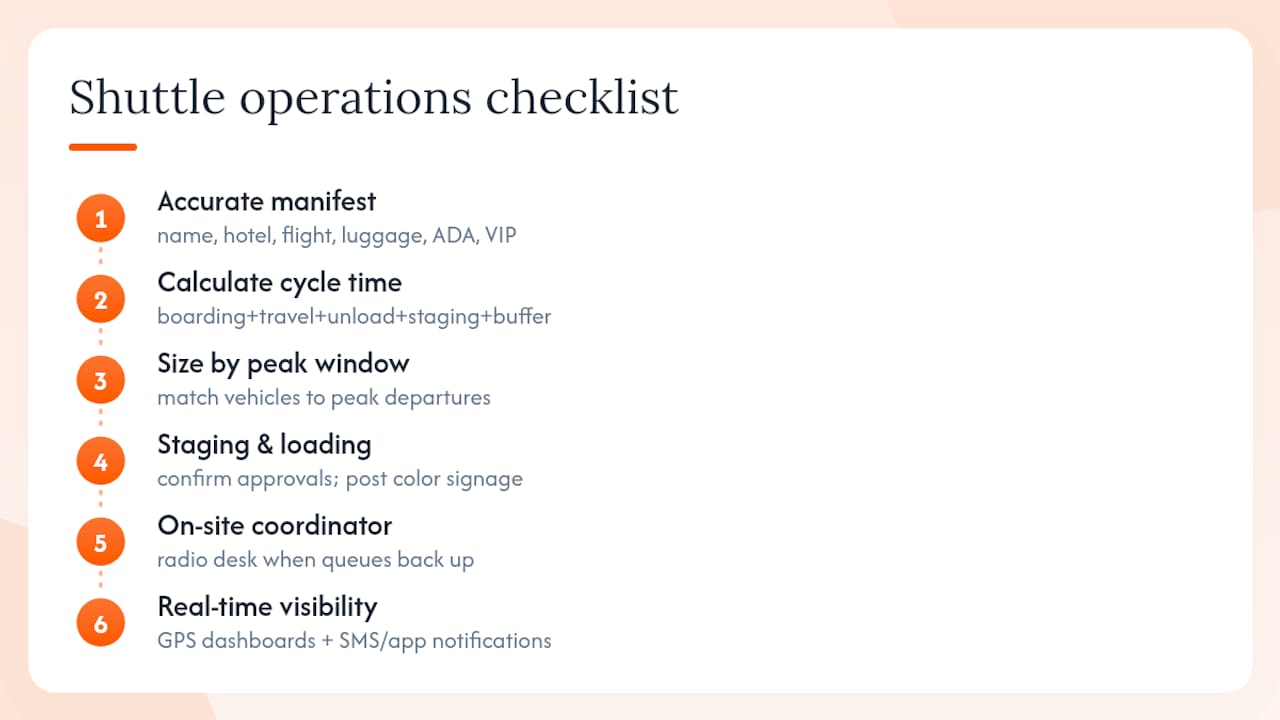
A convention shuttle program lives or dies on its manifest. Build one with fields for attendee name, hotel and room block reference, flight numbers, luggage count, ADA accommodation needs, and VIP flags. A manifest that’s accurate 48 hours out prevents the worst day-of surprises: a wheelchair user assigned to a van without a lift, or a VIP group split across two vehicles departing ten minutes apart.
Cycle time, not seat count, determines how many vehicles you actually need. Calculate cycle time by adding boarding time, travel time, unloading time, staging time, and a recovery buffer, then match vehicle count to your peak departure window rather than your total registration number. A 15-minute route with 5 minutes of boarding and unloading on each end supports far more trips per hour than a 40-minute cross-town run, and your fleet size should reflect that math.
Staging and loading zones need the same discipline. Confirm loading-dock approvals with the hotel and venue in advance, post color-coded signage for multi-route programs, and assign an on-site coordinator who can radio the transportation desk when a queue backs up.
Real-time visibility is no longer optional for attendees or planners. GPS dashboards let your team watch every vehicle’s position and adjust dispatch on the fly, while SMS or app notifications keep attendees informed about pickup timing without flooding your help desk with “where’s my shuttle” calls. Build a clear escalation path, too. Someone specific needs to own the decision when a route falls behind schedule.
What Drives Convention Transportation Costs?
Vehicle-hours and mileage form the base of most quotes, but deadhead time (the empty miles a vehicle drives to reach your first pickup) often adds more to the bill than planners expect. Driver overtime, airport access fees, parking, and seasonal demand pricing stack on top of that.
Hotels can meaningfully reduce your transportation costs if you negotiate the right terms into the contract. Some properties already run their own shuttle programs or maintain preferred-vendor relationships that come with priority scheduling and better rates. Others will arrange VIP transfers as part of a room-block agreement if you ask during negotiation instead of after signing.
When drafting your hotel or venue agreement, address these points directly:
- Whether shuttle service is included in the room block or billed separately
- Hourly and mileage rates, plus how overtime is calculated and billed
- Cancellation fee structure and the notice window required to avoid it
- Insurance naming requirements and indemnification language
- Exact scope of service (which routes, which hours, which vehicle types)
Ask your hotel sales contact directly whether they have an existing shuttle program, a preferred transportation vendor, or loading-zone access you can use, since hotels that manage their own fleets sometimes offer better pricing than an outside provider working cold.
Last-Mile Transportation Options and Strategies
The final stretch between a shuttle drop-off and the convention center’s front door often causes more frustration than the airport transfer itself. Attendees dropped a full block from the entrance because of a construction detour or a blocked loading zone will remember that inconvenience more than a slightly delayed flight.
Coordinate directly with venue operations on exact drop-off points before finalizing routes, and build in a walking-distance buffer for attendees with mobility limitations or heavy exhibitor materials. For sprawling convention campuses, consider a secondary shuttle loop that connects satellite parking or overflow hotels to the main entrance on a tighter interval than your primary airport or hotel routes.
Ride-share and taxi options fill gaps your scheduled shuttle program can’t cover economically, particularly for attendees arriving outside standard shuttle windows or heading to off-site dinners. Rather than ignoring this reality, publish clear guidance in your attendee communications: scheduled shuttle times, designated pickup points for ride-share vehicles, and walking directions for anyone staying within a few blocks.
Signage matters more here than almost anywhere else in the program. A confused attendee standing at the wrong exit doesn’t know whether to wait, walk, or call a car, and that hesitation compounds during peak arrival windows when every minute of delay ripples through your cycle-time math. Position staff or volunteers at key last-mile decision points during your highest-volume hours.
Making Convention Transportation Accessible to Every Attendee
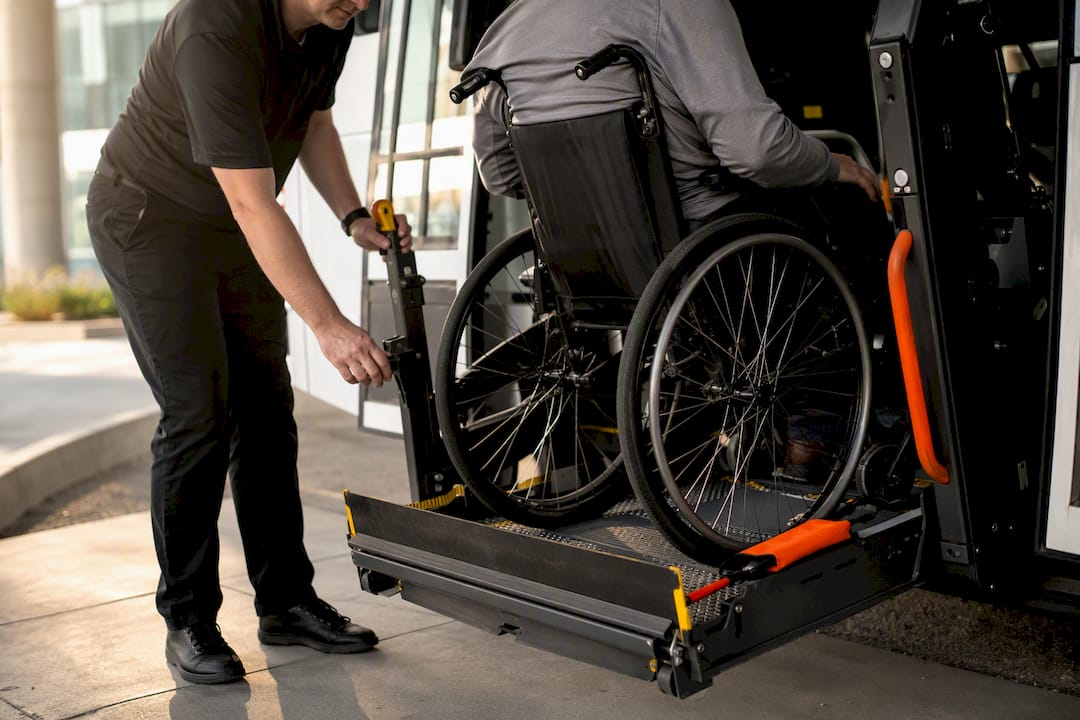
ADA-compliant transportation isn’t a side consideration. It needs to be built into your vehicle mix and manifest from the first planning call. Confirm with every provider how many wheelchair-accessible vans or lift-equipped vehicles are available and whether they can guarantee placement on your specific routes, not just somewhere in their broader fleet.
Your manifest should flag accessibility needs explicitly, including wheelchair users, attendees who need extra boarding time, service animal accommodations, and anyone requiring a specific seating configuration. Flagging these needs only in a general notes field means they get missed when a dispatcher is working quickly during a peak departure window.
Build extra time into your cycle-time calculations for routes serving attendees with mobility needs. Lift deployment and secure wheelchair positioning both take longer than standard boarding, and pretending otherwise on your schedule just pushes the delay downstream to the next departure.
Communicate accessibility options clearly in your pre-event materials rather than making attendees ask. List which pickup points have accessible vehicles, how frequently they run, and who to contact if a specific accommodation isn’t covered by the standard shuttle schedule. Attendees managing a disability are already navigating an unfamiliar city and venue. Clear, upfront information about transportation removes one more layer of uncertainty from their trip.
Environmental Impact and Sustainable Convention Transportation
Convention transportation has a real carbon footprint, and more event organizers are being asked by sponsors or attendees to account for it. Shared shuttles already outperform individual ride-share trips on a per-passenger emissions basis simply by moving more people per vehicle, so a well-run van program is a sustainability win even without added intervention.
A few practical adjustments push that further. Consolidating routes to reduce deadhead mileage, running fuller loads on off-peak windows instead of half-empty vans on a fixed schedule, and choosing providers who maintain newer, well-serviced fleets all cut fuel consumption without adding cost to your program.
Some providers now offer hybrid or lower-emission vehicles as part of their standard fleet, which is worth asking about during your RFQ process if sustainability messaging matters to your sponsors or attendees. Even without a specialized fleet, publishing your shuttle program’s consolidation strategy (fewer, fuller vehicles instead of many partially loaded ones) gives you a concrete, honest sustainability talking point for event marketing.
Encouraging attendees to use the shared shuttle system instead of individual ride-share trips is itself a sustainability lever. It’s also usually the cheaper and less stressful choice for the attendee, since group transportation removes the risk of surge pricing during peak departure windows right after a keynote session ends.
Contingency Planning for Convention Transportation Delays
Every convention transportation plan needs a backup plan, because flight delays, traffic incidents, and mechanical failures happen regardless of how well you scheduled the program. The providers who handle these moments well are the ones who built contingency procedures into the contract before the event started, not the ones improvising on the day.
Require your provider to specify backup vehicle availability in writing. A single mechanical failure shouldn’t strand a group with no replacement vehicle en route, and your contract should state a maximum response window for a backup to arrive.
Build slack into your schedule rather than running every route back to back with no buffer. A shuttle program with zero recovery time between trips turns one late flight into a cascading delay across the entire afternoon’s departures. Your cycle-time math should already account for this, but padding matters most during your highest-volume arrival and departure windows.
Designate a clear communication chain for emergencies: who the on-site coordinator calls, who has authority to reroute vehicles, and how attendees get notified if a route changes. GPS tracking dashboards make it far easier to spot a developing delay early and reroute before a small problem becomes a large one. Keep your provider’s escalation contact number accessible to your entire on-site team, not just the lead planner, so a decision doesn’t stall waiting for one person to answer a phone.
Working With Local Transit and Ride-Share Services
Your scheduled van program doesn’t need to cover every possible trip an attendee might take, and trying to do so usually wastes budget. Local public transit and ride-share services can absorb overflow demand, particularly for attendees heading to off-site dinners, exploring the city after sessions end, or arriving on flights that miss your scheduled shuttle windows entirely.
Reach out to the local transit authority early in your planning process to confirm route options near your venue and hotel cluster, and whether any convention-specific passes or bulk fare arrangements exist. Some cities offer discounted transit passes for large conventions, which can reduce pressure on your van program while giving attendees an easy way to get around independently.
Ride-share coordination works best when you designate specific pickup and drop-off zones separate from your scheduled shuttle loading area. Mixing ride-share pickups into the same lane as your van program creates congestion and confusion for drivers trying to identify the right vehicle among a crowd of similar-looking cars.
Include this information in your attendee communications alongside your official shuttle schedule: nearest transit stations, estimated ride-share costs to key locations, and any designated pickup zones your venue has established. Attendees appreciate having options, and giving them clear information reduces the number of people improvising their own transportation in ways that create bottlenecks at your hotel’s front entrance.
Estimating and Budgeting for Convention Transportation
Building an accurate transportation budget starts with realistic passenger and luggage estimates, not your total registration count. Pull historical data from past events if you have it, and factor in how many attendees are flying in versus driving, since fly-in attendees drive most of your airport transfer demand while local attendees mostly need hotel-to-venue loops.
Request itemized quotes from providers rather than a single lump sum, so you can see vehicle-hour rates, mileage charges, driver overtime rates, and any airport or parking access fees separately. This breakdown makes it much easier to identify where you can trim costs, whether that’s consolidating routes, adjusting departure frequency, or shifting some trips to off-peak windows with lower demand.
Build a contingency line into your budget, typically enough to cover one or two unexpected additional trips or a schedule extension if sessions run long. Transportation is one of the few line items in an event budget where under-provisioning creates a visible, immediate problem for attendees, so err toward slightly more capacity rather than less.
Compare quotes across multiple vetted providers before committing, and weigh total cost against the operational trust signals discussed earlier: compliance documentation, insurance coverage, and manifest management capability. A slightly higher quote from a provider with strong FMCSA compliance and a proven manifest process often costs less in the long run than a cheap bid that creates day-of problems.
Provider Perspective: What a Fast Convention Quote Actually Requires
If there’s one thing convention planners underestimate, it’s how much a clean manifest and an early call save later. Start outreach the moment your venue is signed. Ask every provider for their USDOT number, insurance certificate, and CDL driver roster before you compare pricing. And size your fleet using cycle time, not headcount.
My Van Rentals typically supports convention programs with a nationwide fleet of 12- and 15-passenger vans, flexible delivery or pickup at hotels and venues, and access to a partner network in cities where demand spikes during peak convention weeks. Understanding how fleet management works across a partner network helps explain why availability holds up even during high-demand seasons.
To get a fast, accurate quote, send your event dates, hotel list, estimated passenger and luggage counts, and any ADA accommodation needs. That’s usually enough to return a solid number within a day.
— Gabriel
How My Van Rentals Supports Convention Transportation Programs
My Van Rentals runs a nationwide fleet of Ford Transit, Mercedes-Benz Sprinter, and Chevrolet Express vans built for exactly the kind of hotel-to-venue loops and airport transfers a convention program depends on, with delivery and pickup coordinated at hotels and venues instead of forcing your team to chase down a rental counter.
Getting a fast quote is straightforward. Send your event dates, a list of hotels in your room block, estimated passenger and luggage counts, and any ADA accommodation needs, and you’ll get vehicle recommendations sized to your actual cycle time rather than a generic package. Planners running multi-van programs across several hotels can review the multi-van event rental planning guide for a full walkthrough of how the booking and scheduling process works.
Ready to move forward? Browse available cities and van fleets to check availability for your convention dates, or start with the conference and team transport booking guide to see exactly what information gets you the quickest quote turnaround.
Sources
- Group event transport explained: reliable solutions for US events
- Logistics Guide for Event Shuttles - Charter a Coach
FAQ
How Many Vans Do I Need for a Convention?
Base this on cycle time, not attendee count. Calculate boarding, travel, unloading, staging, and recovery time for your busiest route, then size your fleet to cover your peak departure window rather than your full registration list.
What’s the Difference Between a 12-Passenger and 15-Passenger Van for Events?
Both offer similar maneuverability for hotel-to-venue loops, but a 15-passenger van carries three more riders per trip, which reduces the number of cycles needed during peak arrival or departure windows.
How Early Should I Book Convention Shuttle Services?
Start 60 to 90 days ahead for medium to large conferences, and 90 or more days ahead for large public events or anything during peak convention season, when availability in major metros tightens fast.
What Documents Should I Require From a Transportation Provider?
Ask for their USDOT number, FMCSA safety report, certificate of insurance, CDL driver rosters with passenger endorsement, and a written drug and alcohol testing policy before signing any contract.
Can My Van Rentals Handle Multi-Hotel Convention Programs?
Yes. My Van Rentals offers 12- and 15-passenger vans across major U.S. cities with flexible delivery and pickup at hotels and venues, which supports multi-hotel shuttle loops and airport consolidation routes alike.