16 Occupant Rule: CDL Rules for 15 Passenger Vans in the U.S.
16 Occupant Rule: CDL Rules for 15 Passenger Vans in the U.S.
Most people renting or driving a 15-passenger van for personal, church, family, or business travel do not need a CDL. The federal threshold kicks in at vehicles designed to carry 16 or more people, including the driver. That said, three things flip the answer: getting paid to transport passengers, school-related student transport, and state laws that set stricter rules than federal law. Check your state DMV and rental terms before you drive.
TL;DR:
- A 15-passenger van’s design capacity of 16 occupants includes the driver, meaning most private use remains exempt from CDL requirements unless there is payment or organized student transport.
- Moving passengers for direct or bundled compensation, or regularly transporting students, triggers federal CDL, endorsement, and medical certificate requirements regardless of van size.
- State laws can impose stricter rules than federal standards, so contacting your DMV directly and clarifying your specific use case is essential before driving.
- Rental agreements often restrict commercial use, minors, or organized transport, and exceeding these limits could leave you uninsured or violate contract terms.
- Proper safety measures, such as experienced drivers, seat belt enforcement, and correct cargo loading, are crucial to reducing rollover risks regardless of legal driving requirements.
Table of Contents
- Do You Need a CDL for a 15 Passenger Van Under Federal Law?
- What Situations Trigger a CDL or Endorsement?
- Which State Rules Might Override Federal Exemptions?
- What Rental Restrictions and Insurance Gaps Should You Check?
- What Safety Practices Reduce 15-Passenger Van Risk?
- How Do You Verify Your Trip Is Legal Before You Drive?
- My Van Rentals Perspective: Helping Renters Stay Legal and Safe
- Reserve a 15-Passenger Van With Local Pickup Support
- Sources
- FAQ
Do You Need a CDL for a 15 Passenger Van Under Federal Law?
Federal law draws the line at 16, not 15. Under 49 CFR § 383.5, a vehicle “designed to transport 16 or more passengers, including the driver” falls into the passenger CDL group. A standard 15-passenger van seats 15 riders plus a driver, which lands it at 16 total occupants by design capacity, even though it’s marketed and sold as a “15-passenger” van. That naming quirk trips up a lot of renters.
Here’s where the confusion usually starts:
- Manufacturers build these vans to maximize seating without crossing the federal CDL line, so the design capacity itself becomes the legal test, not the number printed in the brochure.
- Removing seats to lower the headcount does not change how regulators classify the vehicle, according to legal explainers covering CDL requirements for 15-passenger vans. The van was still designed to carry 16, seats or no seats.
- Federal rules distinguish personal, non-commercial driving from commercial passenger operations. A family road trip and a paid airport shuttle service are treated completely differently, even in the identical vehicle.
Statistic to know: A 15-passenger van’s legal seating math is 15 riders plus 1 driver, equaling the exact 16-occupant design threshold that 49 CFR § 383.5 uses to define passenger CDL groups. That’s why most private, non-paid use stays under the federal CDL requirement, while anything involving payment or student transport needs a second look.
What Situations Trigger a CDL or Endorsement?
Three scenarios turn a simple “no CDL needed” answer into something more complicated.
- Direct compensation. Charging riders directly for a ride, running a paid shuttle, or operating a charter service puts you into commercial territory fast. FMCSA guidance on small passenger-carrying vehicles explains that vehicles designed or used to carry 9 to 15 passengers for compensation in interstate commerce trigger registration, vehicle marking, accident recordkeeping, and driver qualification rules under parts 385 and 390 through 396.
- Indirect compensation. You don’t need cash changing hands at the door. FMCSA treats bundled transportation, like a tour package or event fee that includes the ride, as compensation too. That means a 9 to 15 passenger van used this way can still fall under federal oversight even without a per-seat charge.
- School and nonprofit transport. Hauling students regularly, even for a church youth group or nonprofit program, often calls for a passenger endorsement (P) and sometimes a school endorsement (S), plus a valid DOT medical certificate under 49 CFR § 390.5. These rules exist specifically because young passengers and recurring routes raise the stakes.
Which State Rules Might Override Federal Exemptions?
States can set stricter passenger-transport rules than the federal government, and several do. Federal law sets the floor. Your state can raise it.
New York is a clear example. The NY DMV’s CDL passenger brochure requires a CDL with a passenger endorsement for certain passenger-capacity vehicles, and it lays out separate school endorsement requirements for anyone regularly transporting students. California and New Jersey are commonly cited as having tighter passenger-vehicle rules too, though the specifics vary by use case and vehicle type, so don’t assume your home state’s rule applies once you cross a border.
Virginia’s DMV page on commercial driver’s licenses shows how states classify CDLs using both weight and passenger-count triggers, which don’t always mirror the federal 16-person threshold exactly.
Before you get behind the wheel:
- Call your state DMV directly and ask specifically about 15-passenger van rules, not general CDL rules.
- Ask whether your planned use (church trip, school event, business shuttle) counts as an exception.
- Confirm whether a passenger or school endorsement applies even if you’re not driving across state lines.
Pro Tip: Don’t rely on a Google search result from another state. Call your own state DMV’s commercial licensing line and describe your exact trip, vehicle, and passenger type. A five-minute phone call beats guessing.
What Rental Restrictions and Insurance Gaps Should You Check?
Even when the law says you’re fine, your rental agreement might say otherwise. Rental companies frequently write contractual limits into their terms specifically to avoid the FMCSA oversight and higher insurance costs that come with certain uses.
Watch for these common restrictions:
- Minimum driver age requirements, often 25 for larger passenger vans.
- Explicit bans on transporting students or minors as part of an organized school activity.
- Prohibitions on for-hire or shuttle use, even informal ones like charging friends gas money per seat.
- Personal auto insurance policies that exclude coverage for commercial or compensated trips, leaving you exposed if something goes wrong.
Before you sign anything, ask the rental counter directly: “Does my planned use count as commercial under this agreement?” Get the answer in writing, ideally in your confirmation email, so there’s no dispute later.
What Safety Practices Reduce 15-Passenger Van Risk?
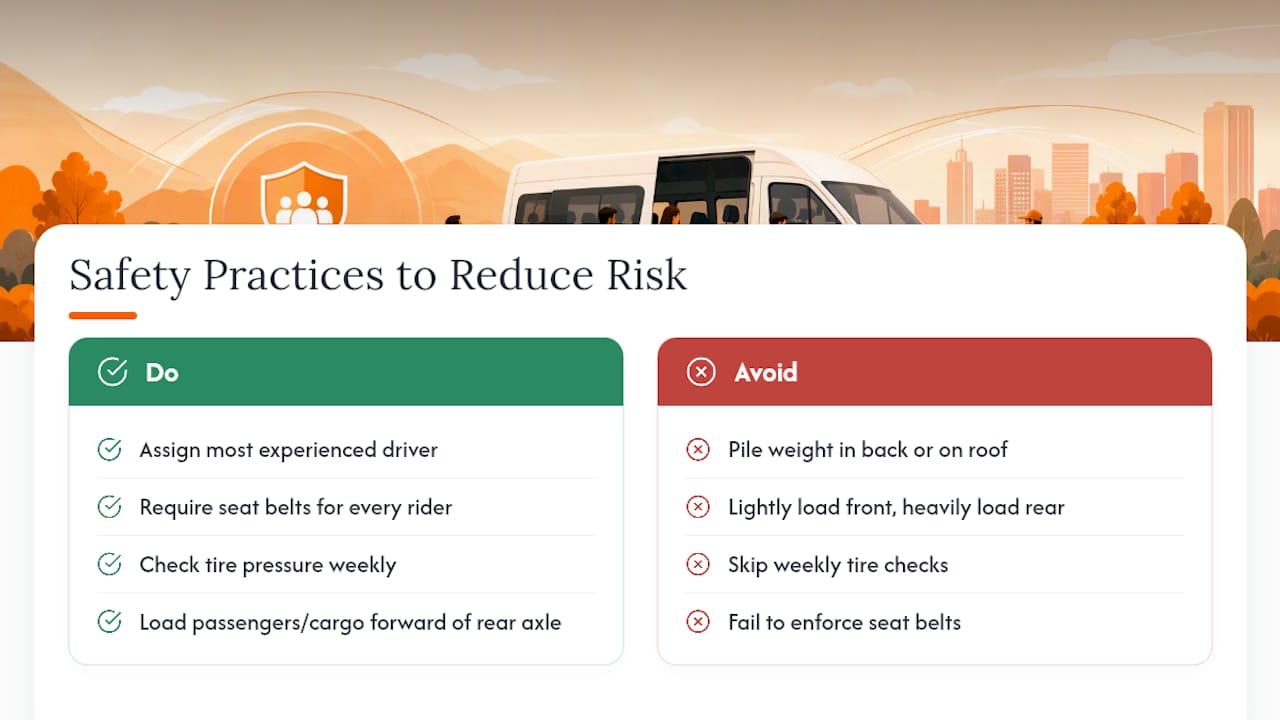
License class isn’t the biggest safety factor here. Handling and loading are. NHTSA’s guidance on 15-passenger vans points out that these vehicles carry distinct rollover risk, especially when lightly loaded in the front and heavily loaded in the back.
NHTSA recommends putting your most experienced driver behind the wheel, enforcing seat belts for every rider, checking tire pressure weekly, and loading passengers and cargo forward of the rear axle rather than piling weight in the back or on the roof.
Statistic to know: NHTSA’s own safety data ties van rollover risk directly to loading position and driver experience, not to whether the driver holds a CDL. That’s worth remembering even when you’re legally clear to drive without one.
Pro Tip: Even if you don’t need a CDL for your trip, treat it like you do. Run a full pretrip check: tires, mirrors, seat belts for every seat, and a basic emergency kit before you pull out of the lot. Packing smart matters too. Our guide on loading a 15-passenger van’s cargo space covers how to keep weight balanced without sacrificing luggage room.
How Do You Verify Your Trip Is Legal Before You Drive?
Run through this before you book or drive:
- Call your state DMV’s commercial licensing division and describe your exact use case.
- Review FMCSA’s small passenger-carrying vehicle guidance if any compensation, direct or bundled, is involved.
- Read your rental agreement’s permitted-use section and ask the rental agent directly about restrictions.
- If a CDL or endorsement turns out to be required, plan for entry-level driver training (ELDT), a knowledge test, a behind-the-wheel skills test, and a DOT medical exam. Expect the process to take several weeks depending on your state’s testing appointment availability.
My Van Rentals Perspective: Helping Renters Stay Legal and Safe
My Van Rentals provides passenger van rentals including Ford Transit, Mercedes-Benz Sprinter, and Chevrolet Express vans. When renters ask us about eligibility for school trips, church events, or business travel, we point them toward their state DMV and FMCSA resources rather than guessing. Compliance questions deserve real answers, not assumptions.
— Gabriel
Reserve a 15-Passenger Van With Local Pickup Support
My Van Rentals offers information to help renters understand trip requirements before booking to avoid surprises at pickup.
Our nationwide fleet includes Transit, Sprinter, and Express 15-passenger vans with pickup in cities like Los Angeles, San Diego, and Orlando. If your trip involves school transport, a paid shuttle, or anything potentially regulated by FMCSA, consider a limo or party bus for event planners to avoid front door jams, and inform the rental company at booking to clarify documentation or driver requirements before travel. Browse van rentals by city to check availability near you and get your questions answered before you reserve.
This article is general information, not a substitute for advice from a qualified lawyer. Consult a qualified legal professional about your own circumstances before acting on anything here.
Sources
- Small passenger-carrying vehicles | FMCSA
- 49 CFR § 383.5 — Definitions – eCFR
- 15-passenger vans | NHTSA
- Transporting Passengers Safely | NY DMV brochure (CDL)
FAQ
Do You Need a CDL to Drive a 15-Passenger Van?
Generally no, for private, non-paid use, since federal law sets the CDL threshold at vehicles designed to carry 16 or more people. A CDL, endorsement, or state-specific rule may apply if you’re paid to transport passengers, transporting students, or driving in a state with stricter rules.
What Is the Largest Passenger Van You Can Drive Without a CDL?
Under federal law, you can drive a vehicle designed to carry up to 15 passengers, including the driver, without a CDL. Once a vehicle’s design capacity hits 16 total occupants, it falls under the passenger CDL group per 49 CFR § 383.5.
Is a 15-Passenger Van Considered Commercial?
It depends entirely on use, not the vehicle itself. A 15-passenger van used for a family trip is personal, while the same van used for a paid shuttle or bundled tour service can trigger FMCSA commercial oversight for 9 to 15 passenger vehicles used for compensation.
How Hard Is Driving a 15-Passenger Van?
It handles differently than a car or minivan, with a higher center of gravity and rollover risk when loaded incorrectly. NHTSA recommends experienced drivers, consistent seat belt use, weekly tire checks, and loading passengers and cargo forward of the rear axle.
Can I Drive a 15-Passenger Van Without a CDL for a Church or School Trip?
A one-time church trip with no compensation typically doesn’t require a CDL. Regular student transport can require a passenger endorsement and sometimes a school endorsement, so check with My Van Rentals or your state DMV before you commit to recurring school routes.