U.S. Operators' Checklist for 15 Passenger Van Safety Backed by NHTSA
U.S. Operators’ Checklist for 15 Passenger Van Safety Backed by NHTSA
Fifteen-passenger vans carry higher rollover risk than cars, especially when fully loaded, but that risk is manageable. Enforce key controls on every trip such as seat belts for all occupants, regular tire pressure checks against manufacturer specifications, and front-to-back seating with no items stored on the roof. Skipping any one of these increases the risk substantially.
TL;DR:
- Ensuring all occupants wear seat belts and regularly checking tire pressure reduces rollover risk and prevents preventable crashes.
- Strictly controlling loading, occupancy, and seating arrangements minimizes the van’s high center of gravity and stabilizes vehicle handling.
- Regular maintenance, including tire inspections and brake checks, significantly lowers mechanical incidents linked to tire failure or suspension issues.
- Assigning experienced drivers, providing proper training, and adapting to weather conditions are crucial for safe operation, especially in adverse weather.
- Utilizing fleet rentals with built-in safety features and adherence to official guidelines offers a practical way to maintain safety without the responsibility of full maintenance.
Table of Contents
- What Real 15 Passenger Van Safety Looks Like
- Rollover Risk and What the Numbers Actually Mean
- Maintenance Priorities That Actually Change Crash Risk
- Driver Experience and Handling Differences That Matter
- The Pre-Trip Inspection and Loading Routine
- Emergency Response: What to Do When Something Goes Wrong
- My Van Rentals’ Approach to Safe Group Transportation
- Child Passenger Safety in 15-Passenger Vans
- How Weather Changes the Safety Equation
- Technology Safety Features in Modern Vans
- Where to Verify This Guidance Yourself
- The One Change That Matters Most
- Rent a Well-Maintained 15-Passenger Van With My Van Rentals
- Sources
- FAQ
What Real 15 Passenger Van Safety Looks Like
Operators who avoid incidents don’t rely on luck. They run a short, repeatable checklist before every departure and refuse to make exceptions for “just this once.” The National Highway Traffic Safety Administration built its 15-passenger van guidance around exactly this idea: rollover risk climbs with occupancy, so the fix is procedural, not just mechanical.
Here’s the enforceable version of that guidance:
- Seat belts. Every seat, every trip. Do a visual buckle check before the doors close, because belts in 15-passenger vans often get buried between cushions and riders will skip them rather than dig them out.
- Occupancy and seating order. Fill seats front-to-back and balance passengers left to right. Never let the rear rows sit empty while people cluster near the door.
- Tire pressure. Check weekly, and check front and rear separately since these vans often run different pressures per axle.
- Cargo placement. Nothing on the roof, ever. Heavy items go low and forward of the rear axle, not stacked behind the last row.
- Driver standards. Require experience with high-profile vehicles, cap consecutive driving hours, and ban phone use behind the wheel.
- Records. Keep a maintenance log and a trip manifest for every departure.
- Bullet point: Check occupancy against the van’s rated capacity, not “how many fit.”
- Confirm cargo weight doesn’t exceed the GVWR posted on the door sill.
- Log driver name, mileage, and pre-trip inspection results before leaving the lot.
Pro Tip: Assign one person, not the driver, to do the buckle check. A driver focused on mirrors and traffic will miss a passenger who never clicked in.
Rollover Risk and What the Numbers Actually Mean
The rollover rate for 15-passenger vans carrying 10 or more occupants is significantly higher in single-vehicle crashes than for vans carrying fewer than five occupants, according to NHTSA crash data. This increase greatly affects crash outcomes, increasing rollover risk.
The restraint gap: Between 2010 and 2019, nearly 60 percent of 15-passenger van occupants killed in crashes were not wearing a seat belt, and unrestrained riders are about four times more likely to die in a single-vehicle crash than belted ones.
Loading changes the physics directly. A full van sits higher off the ground relative to its wheelbase, and weight added behind the rear axle raises the center of gravity even further. That’s why occupancy limits should be strictly followed. When fully loaded, driving more cautiously and reducing speed on curves and ramps is strongly advised because the margin for correction is smaller than it feels from the driver’s seat.
Maintenance Priorities That Actually Change Crash Risk
Tires cause more preventable 15-passenger van incidents than any other mechanical factor. Under-inflation and age matter more than tread depth alone, and the NTSB safety alert on these vehicles specifically calls out dry rot on vans that sit unused between trips.
- Check and log tire pressure weekly against the door-sill spec, not the tire sidewall number.
- Read the tire identification number (TIN) on the spare. If it’s over six years old, replace it before the tire ever touches pavement.
- Inspect brakes and suspension components on a fixed schedule, not “when something sounds off.”
- Check every seat belt for missing buckles, frayed webbing, or a latch that doesn’t click firmly.
- Log every inspection with date, mileage, and the name of who checked it.
Pro Tip: A fleet inspection checklist with signed sign-offs does double duty. It catches problems early and gives you a paper trail if a claim ever gets questioned.
Driver Experience and Handling Differences That Matter
A 15-passenger van doesn’t drive like a minivan or a pickup, and treating it like one is how drivers end up overcorrecting into a rollover. The vehicle’s high center of gravity and long wheelbase change how it responds to sudden steering input, especially when loaded near capacity.
- Choose drivers with documented experience in high-roof or high-profile vehicles before handing over the keys.
- Run a short training module covering mirror setup, blind-spot checks, and how to recover from a drifting rear axle without jerking the wheel.
- Practice tire-blowout response in an empty lot: ease off the gas, hold the wheel steady, avoid braking hard until speed drops.
- Cap continuous driving time and require rest breaks on longer trips.
- Avoid night driving and bad-weather routes when a daytime or dry-weather alternative exists.
Most states require only a standard driver’s license for personal or organizational use of 15-passenger vans; however, transporting passengers for compensation often requires a commercial driver’s license (CDL). Confirm your state’s requirements with the Department of Motor Vehicles before assigning drivers for paid passenger transport.
The Pre-Trip Inspection and Loading Routine
Run this sequence before every departure, no exceptions for short trips:
- Walk the exterior. Check for leaks, damaged tires, and working lights and turn signals.
- Check tire pressure on all positions, including the spare.
- Test mirrors and adjust for the driver’s seating position.
- Confirm every seat belt is visible, unbuckled, and functional.
- Load cargo low and forward of the rear axle. Nothing goes on the roof.
- Seat passengers front-to-back, balancing left and right.
- Brief passengers on seat belt use and emergency exits before pulling out.
Log the date, vehicle ID, tire status, belt status, and driver initials on a manifest before leaving. If any item fails, postpone the trip rather than hoping it holds up for one more run. A quick reference on group trip coordination can help you build passenger briefings into your standard routine.
Emergency Response: What to Do When Something Goes Wrong
If the van starts to feel unstable, whether from a tire failure or a sudden swerve, ease off the accelerator gradually and steer smoothly toward the direction of travel. Hard braking or sharp correction is what turns a recoverable skid into a rollover.
After a crash, prioritize getting passengers out safely and accounting for everyone before doing anything else. Call emergency services immediately, even if injuries look minor.
- Move uninjured passengers to a safe area away from traffic.
- Do not move the vehicle or clear debris until investigators say it’s clear.
- Take photos and note witness names if you’re able to safely.
- Schedule a full mechanical inspection before the van returns to service.
Pro Tip: Keep a laminated emergency card in the glove box listing exit locations, a call script for emergency services, and your fleet manager’s number. Panic makes people forget steps they know cold.
My Van Rentals’ Approach to Safe Group Transportation
We provide passenger van rentals suitable for families, businesses, sports teams, churches, schools, wedding parties, and tour groups who need to travel together. The fleet includes Ford Transit, Mercedes-Benz Sprinter, and Chevrolet Express models, several with high-roof configurations and extra cargo room for groups packing for a longer haul.
Vans are offered with flexible pickup or delivery options across various locations, accommodating groups needing vehicle delivery to hotels or venues. We specialize in group transportation rentals for corporate events, churches, sports teams, weddings, and airport transfers, working with partners to maintain availability across markets. A 15-passenger Sprinter model is a good example of the kind of well-equipped vehicle available for groups that want more than a stripped-down cargo van with seats bolted in.
Child Passenger Safety in 15-Passenger Vans
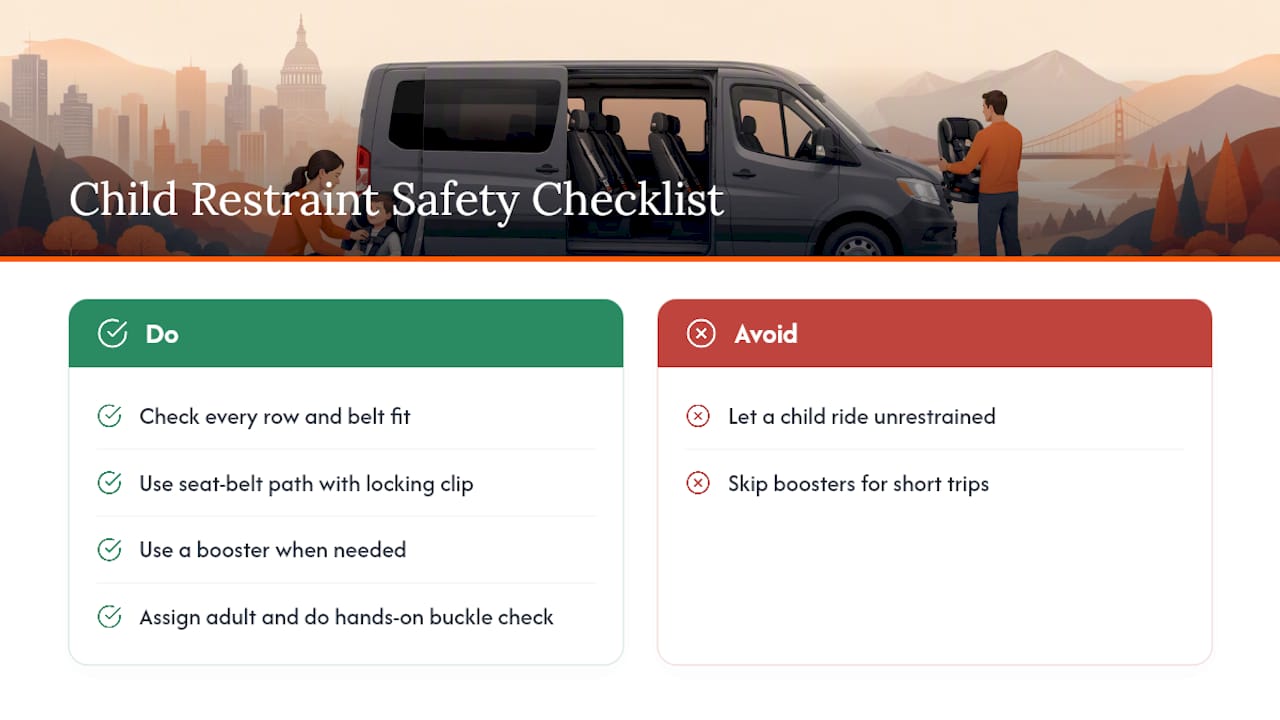
Fifteen-passenger vans complicate child restraint use in ways a family sedan doesn’t. Most rows are bench seats without the LATCH anchor points found in modern passenger cars, which means installing a car seat correctly often requires a seat belt path and a locking clip rather than a snap-in anchor.
Check every row before the trip, not just the first two. Middle and rear bench seats in older vans sometimes have seat belts buried deep in the cushion crease, and a child seat can’t be secured safely if the belt won’t extend far enough to click.
For children too big for a car seat but too small for an adult belt alone, a booster seat is still necessary, and skipping it because “it’s just a short ride” is exactly the kind of shortcut that turns a fender-bender into a serious injury. Never let a child ride unrestrained in a rear bench row because it’s harder to reach. Assign an adult to sit next to any child under 12 who needs help managing a belt or booster, and do a hands-on check of every child’s restraint before pulling out, the same way you’d check every adult’s buckle.
If your group regularly transports kids, and you’re renting rather than using your own fleet, ask about built-in child seat compatibility when booking. Not every van model handles boosters the same way, and confirming this before pickup day saves a scramble at the curb.
How Weather Changes the Safety Equation
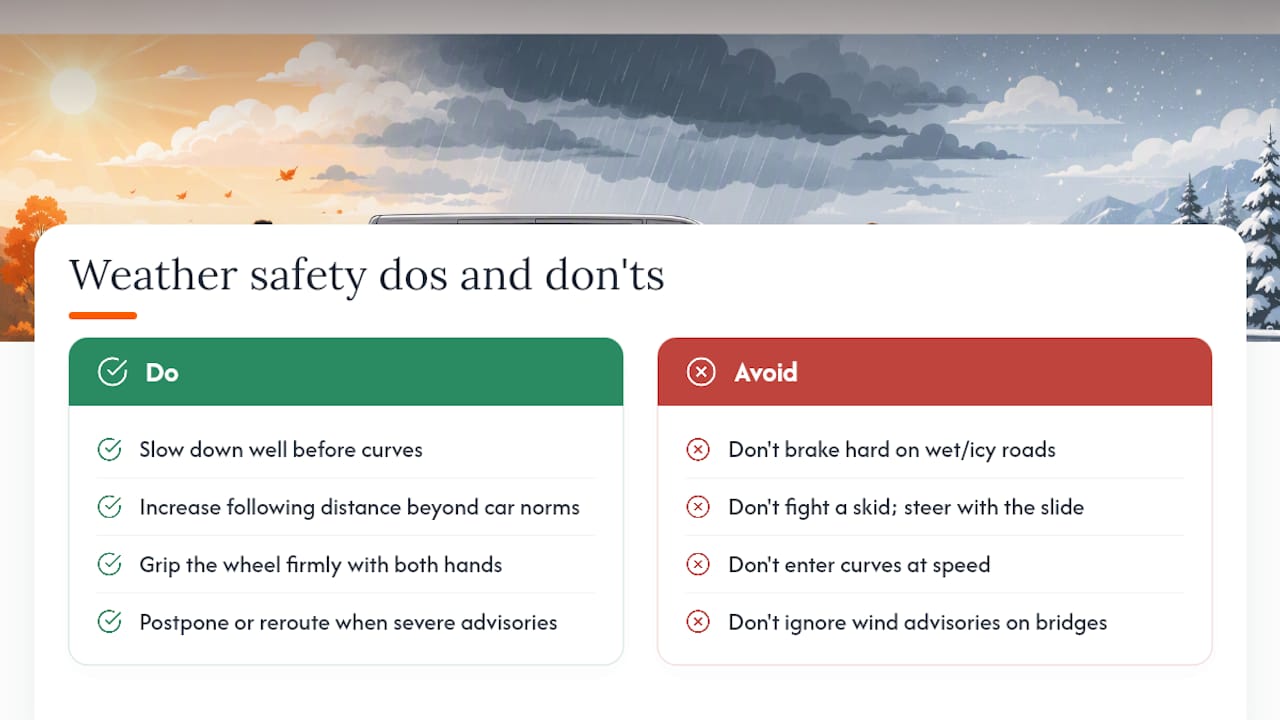
Wet, icy, or windy conditions hit 15-passenger vans harder than they hit a standard sedan, because the same high center of gravity that raises rollover risk also makes the van more sensitive to crosswinds and reduced traction. A gust that barely nudges a car can push a loaded van toward the shoulder.
Rain and snow extend stopping distances substantially on a vehicle already carrying more weight and momentum than most drivers are used to managing. Slow down well before a curve, not while entering it, and increase following distance beyond what feels necessary in a car.
High winds deserve specific attention. Vans with high rooflines catch crosswinds on bridges, overpasses, and open highway stretches, and a sudden gust can pull the vehicle sideways enough to require correction. Grip the wheel firmly with both hands in exposed areas and reduce speed on bridges during advisories.
If a forecast includes ice, heavy snow, or a wind advisory, consider whether the trip can shift to a later window or a different route. Postponing a trip is inconvenient. Managing a loaded van sliding on ice is worse. Drivers should also know how to recover from a skid on a wet or icy surface: ease off the gas, avoid hard braking, and steer gently in the direction the rear of the van is sliding rather than fighting it.
Technology Safety Features in Modern Vans
Electronic stability control (ESC) has become standard on newer 15-passenger van models and measurably reduces rollover risk by automatically applying brakes to individual wheels when the system detects a skid. It’s a meaningful improvement over older vans, but NHTSA data is clear that ESC mitigates risk rather than eliminating it. A van with ESC still rolls over if it’s overloaded, underinflated, or driven too fast into a curve.
Modern models also come with multiple airbags, including front and side curtain coverage in higher trims, along with backup cameras and blind-spot monitoring that help drivers manage a vehicle with limited rear visibility. Some newer Sprinter and Transit configurations add adaptive cruise control and lane-departure warnings, both useful on long highway stretches where driver fatigue creeps in.
None of this replaces the basics. A van with every available safety feature still needs correct tire pressure, front-to-back seating, and belts on every rider. Technology narrows the margin for error. It doesn’t remove the need for the checklist.
Where to Verify This Guidance Yourself
Every operator making safety decisions should read the primary sources directly, not just summaries of them.
- NHTSA’s 15-passenger van guidance on occupancy, tires, and driver training
- NTSB Safety Alert SA-001 on operator precautions
- NHTSA CrashStats rollover and restraint data
- Middlebury’s safety precautions summary on restraint and tire statistics
The One Change That Matters Most
If you only fix one thing, fix seat belt compliance. Nearly every serious statistic tied to these vans traces back to unrestrained occupants in a rollover, and that’s a solvable problem with a five-second check before the doors close. A tire program comes second, because dry rot and under-inflation don’t announce themselves until they fail at speed.
An operator who runs a strict pre-trip checklist for a few months usually catches at least one issue that would have become an incident: a belt buckle jammed in a seat crease, a spare tire older than the van’s last three drivers combined. That’s not a hypothetical. It’s what a checklist is for.
Adopt one, use it every trip, and don’t let a familiar route talk you out of it.
— Gabriel
Rent a Well-Maintained 15-Passenger Van With My Van Rentals
Running your own maintenance program is one path to safer group travel. Renting from a fleet that already handles it is another, often faster one. Operators can access well-equipped passenger vans without the overhead of owning and maintaining a vehicle year-round through rental options.

When you book, ask about the van’s model features and request a driver briefing on handling and seating recommendations before pickup. My Van Rentals offers flexible pickup or delivery for churches, schools, sports teams, and corporate groups across multiple U.S. cities, so you’re not stuck coordinating logistics on top of safety checks. Browse available locations and reserve your 15-passenger van today to lock in a vehicle that fits your group and your timeline.
Sources
- 15-Passenger Vans | NHTSA
- 15-Passenger Vans safety alert (NTSB)
- Traffic Safety Facts — 15-passenger vans (NHTSA CrashStats)
- 15-passenger van safety precautions (Middlebury summary)
FAQ
How safe are 15-passenger vans?
They carry more rollover risk than passenger cars, particularly when carrying 10 or more occupants, but strict seat belt use, tire maintenance, and correct loading substantially reduce that risk.
What is the largest cause of accidents in 15-passenger vans?
Rollovers linked to overloading, under-inflated or aged tires, and driver unfamiliarity with the vehicle’s high center of gravity are the leading contributing factors, and unrestrained occupants account for a majority of rollover fatalities.
Can I drive a 15-passenger van with a regular license in Texas?
For personal or organizational use, a standard driver’s license typically suffices, but transporting passengers for compensation usually requires a commercial driver’s license; check with the Texas Department of Public Safety for your specific situation.
How hard is it to drive a 15-person van?
It handles noticeably differently from a car or minivan, with a higher center of gravity and longer stopping distances, so drivers should practice in an empty lot before taking on passengers, especially when the van is loaded near capacity.