From Cubic Feet to Suitcases: 15-Passenger Van Cargo for Renters

From Cubic Feet to Suitcases: 15-Passenger Van Cargo for Renters
A standard-length 15-passenger van leaves almost no dedicated trunk space once every row is installed. The last bench sits close to the rear doors, so luggage room drops to nearly zero unless you choose an extended-length or high-roof configuration, or pull a row of seats. If your group needs both seats and suitcases, that’s the decision point that matters before you book or buy.
TL;DR:
- A standard 15-passenger van offers minimal cargo space with almost no room behind the last row when all seats are in place, especially in the regular-length models.
- Cargo volume varies significantly by van configuration, with extended-length or high-roof models providing up to nearly 487 cubic feet of space behind the first row in cargo variants.
- Wheelbase and roof height are more accurate indicators of real-world storage capacity than the headline cubic-foot figures, especially for short-wheelbase or standard-height versions.
- Removing a row of seats or choosing an extended-length, high-roof version is necessary to maximize luggage capacity in passenger vans, particularly for groups carrying substantial baggage.
- Always verify cargo depth behind the last row in inches when booking, as seat removal fees and roof rack options can further enhance usable space and prevent overpacking hazards.
Table of Contents
- How Much Cargo Space Does a 15-Passenger Van Really Have?
- Ford Transit, Sprinter, and Chevrolet Express: What Each Layout Means for Luggage
- What Actually Shrinks Your Usable Cargo Space
- How Many Suitcases Actually Fit?
- Choosing Between 12 and 15 Passenger Layouts
- What We See Renters Actually Choose
- Booking a Van That Actually Fits Your Luggage
- Sources
- FAQ
How Much Cargo Space Does a 15-Passenger Van Really Have?
Cargo figures depend entirely on which body style you’re looking at, and manufacturers usually publish them for the cargo-van variant, not the passenger version. That gap trips up a lot of first-time renters comparing spec sheets.
The 2026 Ford Transit, for example, hits about 487.3 cubic feet behind the first row in its cargo-van, high-roof, extended-length configuration. Swap that for the passenger version with all seats installed, and the figure drops to roughly 461.9 cubic feet behind the first row, still measured from behind the front seats, not behind the last row where your actual luggage sits.
Mercedes-Benz publishes cargo-area dimensions rather than raw seat-adjusted cubic footage. On the Sprinter, cargo length behind the first row runs about 132.9 inches, cargo width at the beltline about 70.4 inches, and cargo height on high-roof models around 67.7 inches. Those numbers matter more once you’re trying to figure out whether a stroller or a cello case will actually fit.
| Model | Configuration | Cargo Volume / Dimensions | Notes |
|---|---|---|---|
| Ford Transit | High-roof, extended, cargo van | ~487.3 cu ft behind first row | Cargo variant baseline |
| Ford Transit | High-roof, extended, passenger van | ~461.9 cu ft behind first row | Measured behind first row, not last |
| Mercedes-Benz Sprinter | High-roof | Length ~132.9 in, width ~70.4 in, height ~67.7 in | Interior cargo-area dimensions |
| Chevrolet Express | 12 or 15 passenger | Varies by body style | Seating configuration changes usable cargo |
Industry roundups consistently flag wheelbase as the number that predicts real-world cargo room better than the headline cubic-foot figure. A short-wheelbase 15-passenger van and an extended one can share a nameplate and still behave like different vehicles once you’re loading bags.
Ford Transit, Sprinter, and Chevrolet Express: What Each Layout Means for Luggage
Each platform handles the seats-versus-cargo tradeoff differently, and knowing the difference saves you from a bad surprise at pickup.
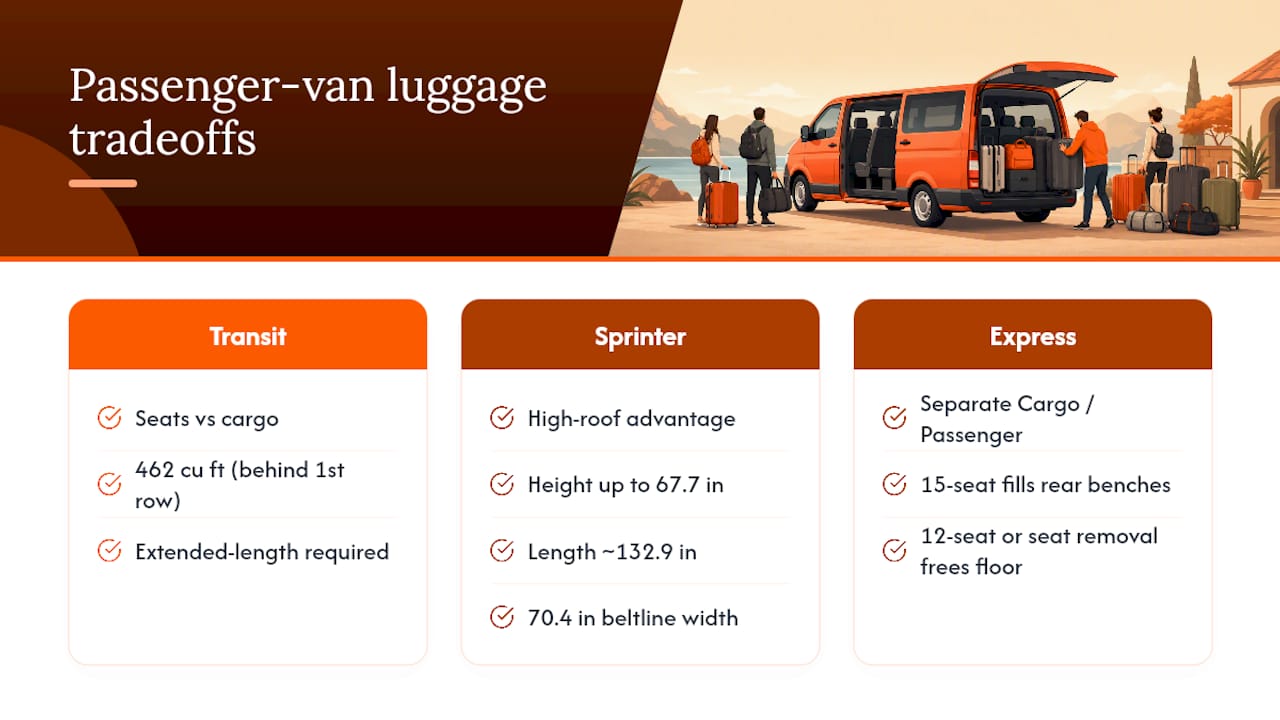
Ford Transit. The high-roof, extended-length passenger van gives you close to 461.9 cubic feet behind the first row, but that number describes the whole cabin, not the sliver left behind row three once 15 seats are bolted in. If you need real luggage room, request the extended-length body specifically. The standard-length Transit passenger van simply doesn’t have the depth behind the last bench to hold much more than backpacks.
Mercedes-Benz Sprinter. Sprinter’s published cargo-area figures, a length of about 132.9 inches behind the first row, width near 70.4 inches at the beltline, and height up to 67.7 inches on high-roof trims, come from Car and Driver’s spec tables. The extra ceiling height is the real advantage here: tall items like garment bags, hockey bags, or camera cases stand upright instead of getting wedged sideways.
Chevrolet Express. Chevrolet builds separate Express Cargo and Express Passenger variants, and the seating layout directly determines how much room is left. A 15-passenger Express fills the body with benches nearly to the rear doors. Drop to a 12-passenger configuration, or ask about seat removal, and you recover a meaningful block of usable floor space without changing vehicles.
What Actually Shrinks Your Usable Cargo Space
Raw cubic-foot numbers rarely match what you can actually pack. A few physical realities eat into that figure before your first suitcase goes in.
- Wheelbase and roof height are the biggest swing factors. A short-wheelbase, standard-roof van loses volume fast compared to an extended, high-roof version.
- Wheelhouse intrusions along the floor, plus seat frames and mounting hardware, cut into usable floor area even when the spec sheet looks generous.
- Roof racks and cargo organizers help reclaim some of that lost room, and pulling a bench seat when you don’t need every position restores real floor space fast.
How Many Suitcases Actually Fit?
Numbers on a spec sheet don’t tell you much until you translate them into suitcases and duffel bags. Here’s roughly what to expect.
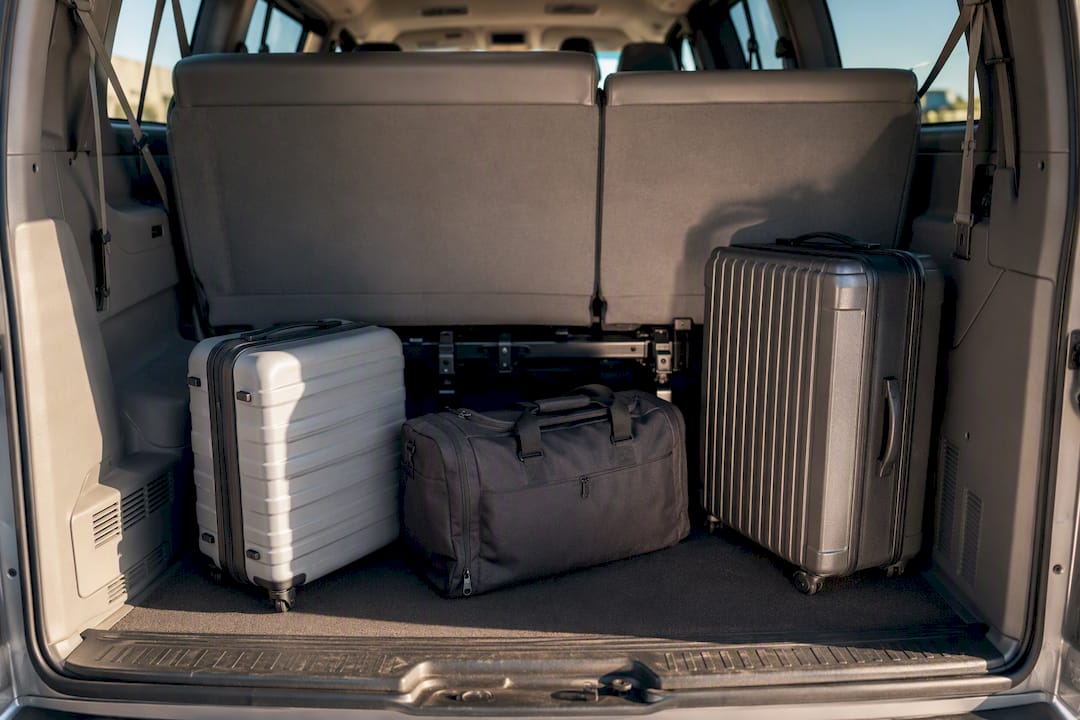
- A 12-passenger layout typically leaves 3 to 4 feet of depth behind the last row, enough for about 4 to 6 large suitcases depending on the model and wheelbase.
- A standard-length 15-passenger layout leaves close to zero usable depth behind the rear bench since the seats sit almost against the rear doors.
- If you’re locked into 15 seats, plan on a rooftop cargo box, an extended-length or high-roof passenger van, or removing one row to open up floor space.
One safety note worth repeating: never stack luggage against rear doors, windows, or emergency exits. Loose bags shifting in transit are a real hazard, and blocked exits are a liability every group leader should take seriously.
Choosing Between 12 and 15 Passenger Layouts
The decision usually comes down to one tradeoff: seats or suitcases. If your group can fit in 12 seats and you need real luggage room, a 12-passenger van is almost always the better call. If you’re carrying 13 to 15 people, you need to solve for cargo separately, whether that’s a rooftop box, a trailer, or an extended-length body style.
- Groups of 12 or fewer with luggage: book the 12-passenger layout and use the recovered space behind the last row.
- Groups of 13 to 15: request an extended-length or high-roof passenger van, or ask about pulling a row of seats.
- Always confirm exact cargo dimensions and seat-removal fees before you book, not after you arrive to pick up the keys.
Pro Tip: Call the rental provider and ask for the cargo depth behind the last row in inches, not just the headline cubic-foot number. That single measurement tells you more about what will actually fit than any spec sheet comparison.
What We See Renters Actually Choose
Most groups with heavy luggage typically choose a 12-passenger van or an extended-length, high-roof Ford Transit rather than a standard 15-passenger layout. Availability varies by city, and many locations offer delivery straight to your hotel or venue, which saves a step when you’re already juggling bags and a schedule.
— Gabriel
Booking a Van That Actually Fits Your Luggage
This rental service offers a variety of 12- and 15-passenger vans, including high-roof and extended-length Ford Transit options, as well as Sprinter and Chevrolet Express models, allowing you to match seating and cargo needs to your trip instead of settling for whatever’s parked closest.

When you book, tell your rental team exactly what you’re carrying. Ask about cargo dimensions behind the last row, seat-removal fees if you’re trimming a bench for space, and roof-rack availability if you’re stuck at 15 seats with a full load of bags. Our Ford Transit high-roof configuration in Scottsdale is a good example of a listing built around exactly that request. Ready to lock in a van that fits your group and your gear? Browse available pickup locations by city and get your reservation started today.
Sources
- 2026 Ford Transit® Van | Pricing, Photos, Specs & More | Ford Pro
- Mercedes‑Benz Sprinter specs (Car and Driver)
- Chevrolet Express Vans: Cargo, 12 Passenger and 15 Passenger
- The Best 15-Passenger Vans for 2023: Wheelbase and Cargo Space
FAQ
Can I drive a 15-passenger van with a regular license?
For personal use, a standard driver’s license is generally enough, but commercial passenger-carrying use can require a CDL or passenger endorsement depending on state rules, so check your state’s requirements before you drive.
How much trunk space does a Chevy Express 15-passenger van have?
Cargo space behind the last row is minimal once all 15 seats are installed, since Chevrolet’s Express Passenger layout fills the body nearly to the rear doors; dropping to a 12-passenger configuration recovers usable floor space.
Are 12 and 15 passenger vans the same size?
The exterior dimensions and wheelbase are often identical or very close on the same platform. The difference is seating layout: the 15-passenger version fills more of the interior with benches, leaving far less cargo room than the 12-passenger version of the same van.
How many feet long is a 15-passenger van?
Length varies by model and body style, but extended versions of platforms like the Ford Transit and Mercedes-Benz Sprinter run noticeably longer than standard-wheelbase versions, which directly affects how much cargo space is left behind the last row.
How many suitcases fit in a 15-passenger van?
In a standard-length layout, expect close to zero dedicated luggage space behind the last row; an extended-length or high-roof configuration, or removing a row of seats, is usually needed to fit more than a few carry-on bags.